
Cooper Pledges to Keep Pressing China on Jimmy Lai’s Detention After Beijing Visit
Cooper Pledges to Keep Pressing China on Jimmy Lai’s Detention After Beijing Visit
British Foreign Secretary Yvette Cooper has vowed to continue raising the case of imprisoned pro-democracy publisher Jimmy Lai with Beijing, following a two-day diplomatic visit to China that drew opposition criticism for failing to secure stronger commitments on human rights.
Lai, a British citizen and founder of Hong Kong’s now-shuttered Apple Daily, has been held in detention since 2020 and faces charges under Hong Kong’s national security law. His trial is ongoing.
Cooper Defends Diplomatic Approach
Speaking to the Press Association at the conclusion of her visit, Cooper said she had raised Lai’s case directly with Chinese Foreign Minister Wang Yi and would continue to do so. “Our case remains we want to see his release as soon as possible — he’s a very elderly man,” she said.
She also confirmed she would maintain contact with Lai’s family. The Foreign Secretary stopped short of detailing the firmness with which she pressed Beijing, drawing criticism from opposition lawmakers who have demanded a harder line.
Uighur Rights and Religious Freedom Also Raised
Cooper confirmed she had raised reported human rights abuses against the Uighur Muslim minority in Xinjiang province, as well as freedom of religion — issues on which the UK government has faced sustained pressure to confront China more directly.
Her responses were notably brief. Asked whether she had voiced objections to the Uighur situation, she said only: “Yes, and I’ve raised freedom of religion as well.”
Rules-Based Order: A “Shared Interest”
During bilateral talks in Beijing’s Great Hall of the People on Tuesday, Cooper met Chinese Vice-President Han Zheng and argued that upholding the “international rules-based order” served both countries’ interests. When asked Wednesday whether China was actually respecting that order, her answer was measured.
“China is a member of the P5, the permanent five members of the UN Security Council, and we have to engage on these global security issues with China,” she said. “We’ve talked about the importance of the rules-based international order — so too has China.”
The formulation — noting that China has talked about the rules-based order rather than affirming its adherence — reflected the careful diplomatic calibration running through Cooper’s visit.
AI Governance and Technology Diplomacy
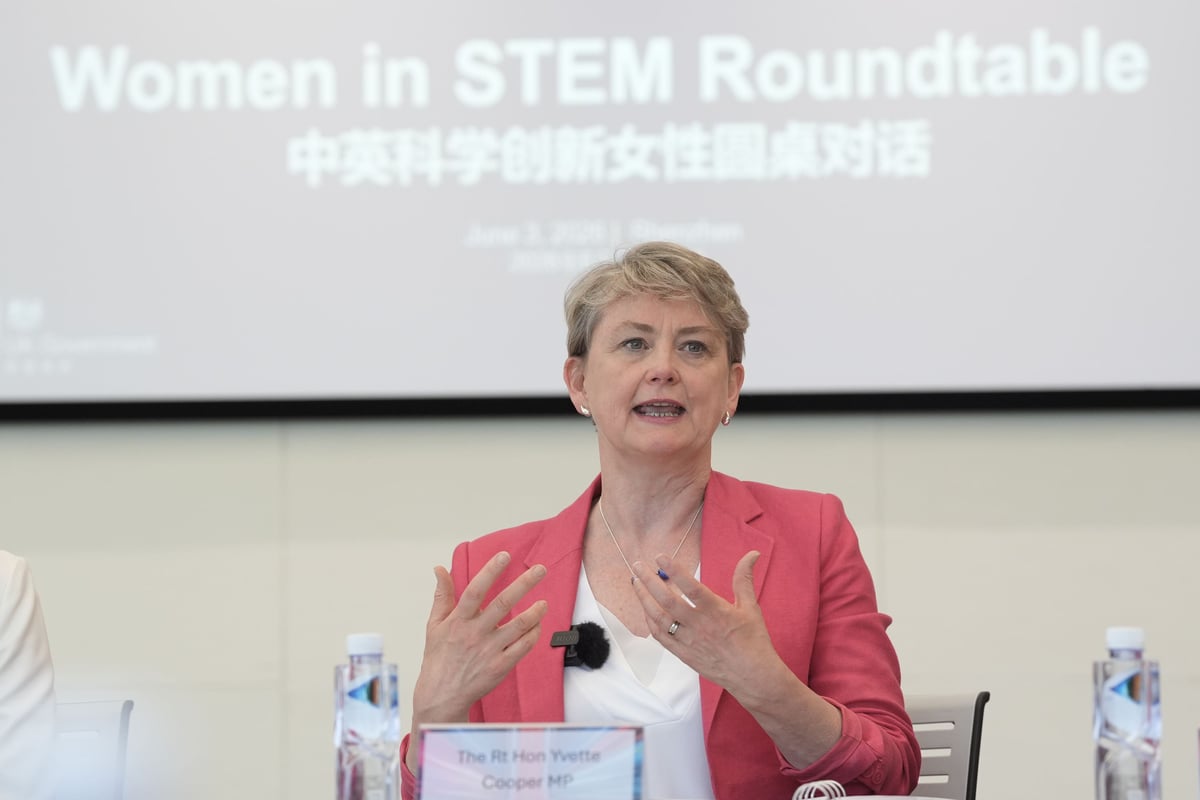
Cooper travelled from Beijing to Shenzhen, a major technology hub, where she met city party secretary Jin Lei and toured a laboratory at the Institute of Artificial Intelligence and Robotics for Society. She was shown applications of AI in healthcare and power grid management.
She said she had raised AI safety concerns with both Wang and Han, and called for global standards on AI security to be developed through the United Nations. “This reflects the approach we’ve taken over very many years on nuclear security, where we have international nuclear standards,” she said.
Cooper drew a parallel with historical UK-China cooperation on nuclear standards — noting that differences of view had not precluded collaboration — as she made the case for a similar multilateral framework for artificial intelligence.
India Next on Cooper’s Agenda
Cooper departed Shenzhen for New Delhi on Wednesday evening for talks with Indian Foreign Minister Subrahmanyam Jaishankar on Thursday. The discussions are expected to focus on global security, including escalating tensions around the Strait of Hormuz amid ongoing conflict involving Iran.
The UK government has framed engagement with both China and India as essential to navigating a period of heightened global volatility, while insisting it will challenge partners on human rights and security concerns where necessary — a balance critics argue has yet to be tested in practice.