
Iran’s Economic Stranglehold and the Limits of U.S. Military Power in the Strait of Hormuz

Iran’s Economic Stranglehold and the Limits of U.S. Military Power in the Strait of Hormuz
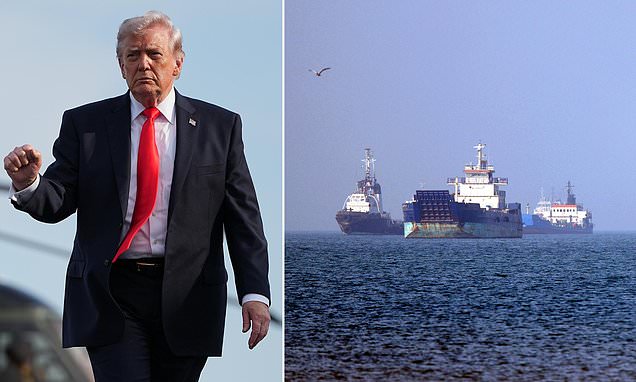
The United States Navy, backed by more than 100 aircraft, three aircraft carrier groups, and up to 15,000 marines, is attempting to reopen the Strait of Hormuz — a waterway Iran has blockaded, trapping an estimated 2,000 ships and 20,000 crew in the Persian Gulf. The operation, dubbed “Operation Freedom,” has yet to produce visible results, and the strategic calculus for Washington is growing more precarious by the day.
Iran’s Economy Under Severe Strain
Iran’s sanctions-battered economy was already contending with chronic inflation and supply shortages before the current confrontation. The U.S. counter-blockade of Iranian shipping has sharply curtailed Tehran’s oil exports, triggering a currency crisis and forcing the regime into improvised workarounds.
Small tanker fleets are crossing the Pakistan border to deliver limited quantities of oil to external markets. Tanker trains have been routed through Central Asia toward China. But these measures are widely regarded as stopgaps, not solutions.
The critical bottleneck is Iran’s Kharg Island terminal, the country’s primary oil export hub. Unless Tehran can restore normal export volumes through Kharg within weeks, domestic storage capacity will be exhausted. Oil wells may then have to be sealed — a process that risks permanent damage if water floods the shafts, potentially destroying them for good.
The Cash Problem
Iran appears to hold substantial munitions stockpiles, but its financial reserves are under mounting pressure. The regime’s negotiating positions have consistently included demands for the lifting of U.S. sanctions — a signal, analysts note, of acute sensitivity to economic coercion.
Historically, unpaid or under-resourced military forces have proven unreliable. Should Iran’s cash reserves deteriorate further, the loyalty and operational capacity of its armed forces could be tested in ways the leadership in Tehran has not yet had to confront.
Washington’s Dilemma
The United States is not without its own vulnerabilities. Iranian leadership is acutely aware that sustained fuel price increases will register as political pain for American consumers — a pressure point that could erode domestic support for the operation.
If Operation Freedom fails to reopen the strait, President Trump faces a stark set of choices. He could escalate — launching an intensified air campaign against Iranian military and infrastructure targets. The USS George H.W. Bush has already been repositioned to the Red Sea, joining a naval force that includes missile destroyers and troop-carrying vessels off Iran’s southern coast.
Yet weeks of prior airstrikes have not dislodged the Iranian blockade. Further bombardment could take additional weeks to produce results — if it produces results at all — by which point global energy markets would be in serious distress and the prospect of a worldwide recession would sharpen allied impatience.
The Alliance Fracture Risk
A deepening rift with European allies could, paradoxically, provide Trump with a political exit ramp. A scenario in which allied governments negotiate separate arrangements with Tehran — cutting their own deals to secure energy access — would allow Washington to attribute any withdrawal to allied betrayal rather than military failure.
The historical parallel invoked by analysts is pointed: Britain’s 1956 Suez Crisis, in which London, Paris, and Tel Aviv launched a military operation to seize control of the Suez Canal, only to suffer a humiliating retreat under U.S. and Soviet pressure. Winston Churchill, reflecting on the fiasco initiated by his successor Anthony Eden, reportedly observed: “I should never have dared start it, but I should never have dared stop.”
Trump, who keeps a bust of Churchill in the Oval Office, now faces a structurally similar dilemma: the cost of continuing may be high, but the cost of stopping — politically and reputationally — may be higher still.
The Clock Is Running
The November midterm elections are approaching. Recession indicators are worsening. What the President initially characterised as a limited “excursion” risks metastasising into a protracted and unresolvable commitment — one that reshapes U.S. strategic credibility in the region for years to come.
Both sides are calculating how long the other can hold out. On the evidence available, Iran’s economic position is deteriorating faster. But Washington’s political timeline may be shorter.