
Trump and Netanyahu’s Middle East Gamble Risks Permanent Crisis as Iran Holds Firm
Trump and Netanyahu’s Middle East Gamble Risks Permanent Crisis as Iran Holds Firm
When the United States and Israel launched their joint military campaign against Iran on the last day of February, both leaders spoke as though the Islamic Republic’s days were numbered. Months later, the regime has not collapsed, the Strait of Hormuz remains closed, and the two governments that started this war are struggling to find a way out.
A War That Defied Expectations
The assumptions underpinning the campaign were clear from the outset. Trump and Netanyahu believed Iran was a weakened state — battered by sanctions, internal corruption, and the successive dismantling of its regional proxies — and that a decisive military strike would trigger regime collapse from within.
Those assumptions have proven wrong. Iran has not been defeated. The risk now, analysts warn, is a prolonged, attritional permacrisis: a state of chronic instability that lurches periodically into open conflict.
The latest flashpoint came with Iran’s downing of a US Apache helicopter — a deliberate signal that Tehran retains both the capability and the will to inflict costs on American forces. The crew survived; had they been killed, a significantly harsher US military response would likely have followed.
The Words That Preceded the War
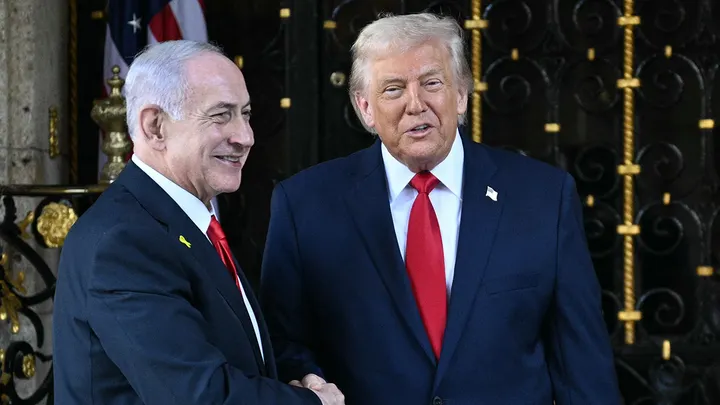
Both leaders framed the campaign in the language of historical inevitability. Speaking in the early hours from Mar-a-Lago, Trump addressed the Iranian people directly.
“To the great proud people of Iran, I say tonight that the hour of your freedom is at hand,” he declared. “When we are finished, take over your government. It will be yours to take. This will be probably your only chance for generations.”
Netanyahu, speaking from the roof of the Kyria — Israel’s defence ministry in central Tel Aviv — was equally unequivocal. “This coalition of forces allows us to do what I have yearned to do for 40 years: smite the terror regime hip and thigh,” he said. “This is what I promised — and this is what we shall do.”
What Went Wrong
The strategic calculus behind the offensive rested on several compounding miscalculations. Iran’s supreme leader and senior commanders had been killed by Israeli and US strikes, yet the regime did not fracture. A new, younger leadership emerged — one described by observers as equally ideological but significantly more willing to escalate in what it frames as an existential struggle.
Both governments also underestimated the degree to which the Islamic Republic had spent nearly five decades engineering itself to absorb precisely this kind of assault. Its religious and ideological framework, combined with hardened institutional structures, provided a resilience that neither Washington nor Tel Aviv had adequately modelled.
Trump had drawn confidence from a recent precedent: the abduction of Venezuela’s president and his wife, their transfer to detention in New York, and the installation of a compliant successor in Caracas — what he viewed as textbook regime change, executed cleanly. Iran was to be next. It has not followed the same script.
The Strait of Hormuz and the Economic Toll
Iran’s closure of the Strait of Hormuz — one of the world’s most critical maritime chokepoints — has inflicted severe economic damage well beyond the immediate combatants. Gulf states including the UAE and Bahrain, which had normalised relations with Israel, have absorbed significant blows: lost petrochemical revenues, collapsed investor confidence, and a tourism sector that has effectively stalled.
When the strait was closed in March, warnings circulated that global economic consequences would become severe if it remained shut by June. It remains closed. Without significant diplomatic breakthroughs, there is no clear timeline for its reopening.
Iran’s new leadership has drawn a strategic lesson from this: that its ability to strangle global energy flows constitutes a form of long-term deterrence against future US or Israeli military action — deterrence it intends to make explicit in any eventual negotiations.
The Lebanon Complication
A central element of Iran’s negotiating posture is the explicit linking of the Gulf conflict to the ongoing Israeli campaign in Lebanon. Tehran’s message to Washington is unambiguous: no deal on the strait or on Iran’s nuclear programme is possible while Israel continues to bomb Lebanon and attempt to destroy Hezbollah, the armed movement Iran has supported since the 1980s.
Trump’s decision to order Netanyahu to cancel a planned strike on Beirut — justified on the grounds that a deal was imminent — represented an implicit acceptance of that linkage. Netanyahu publicly rejected it. “Intolerable and completely unacceptable,” he said on Monday. But Israel’s ability to resist American pressure has limits, and Trump has made clear that his priority is ending the war on terms he can present domestically as a victory.
Since the cancelled Beirut strike, the Israeli military has continued to conduct intensive operations in southern Lebanon, complicating any prospect of a unified diplomatic track.
The Limits of Force
Netanyahu’s broader strategic doctrine — that sustained military force, backed by American power, would bend the region to Israel’s will — has not delivered its promised outcomes. Hamas has not been destroyed. Hezbollah, though degraded, continues to function. Iran has not collapsed. The Palestinian question, which Netanyahu long argued was secondary to the Iranian threat, has not been resolved or sidelined.
Trump, meanwhile, faces a war that polling shows is unpopular with the American public, a diplomatic process he has described as sluggish, and a regional partner in Netanyahu whose war aims diverge significantly from his own.
The lesson being relearned — as it has been relearned by leaders across centuries — is that wars are easier to begin than to end. The United States and Israel entered this conflict expecting a rapid, decisive outcome. What they face instead is a conflict with no clear exit, a closed waterway with global consequences, and an adversary that has concluded, with some justification, that survival itself constitutes a form of victory.