
Russian Missile Strikes Polish Territory as Ukraine Escalates Long-Range Campaign Against Moscow’s Economic Infrastructure
A Russian missile crossed into Polish territory on Thursday morning and detonated in an open field, triggering an immediate response from NATO and the European Union and raising, once again, the spectre of the war’s geographic containment unravelling. Polish Prime Minister Donald Tusk said authorities believed the projectile was a Kh-101 ballistic missile, though he cautioned that investigators were not yet “100 per cent certain” of its origin. Polish police documented a crater approximately ten metres wide and scattered debris at the impact site, where the object had disappeared from army radar tracking it through domestic airspace.
NATO’s Supreme Allied Commander for Europe moved swiftly, speaking directly with Poland’s chief of defence and pledging that the alliance would take all “necessary measures” to defend member-state territory. European Commission President Ursula von der Leyen described the incident as another “unacceptable violation” of EU airspace, framing it within the bloc’s broader commitment to building what she called a “robust European security architecture on land, at sea and in the air.” The United States separately expressed interest in joining Poland’s investigation — a signal of Washington’s continued, if contested, engagement with the conflict’s escalatory edge.
The missile’s crossing into Poland unfolded against the backdrop of a large-scale Russian overnight attack on Ukraine itself. President Volodymyr Zelensky reported that Russia launched seventy missiles, many of them ballistic, alongside more than 280 drones. At least eight people were killed across the country, including three children. Dozens of residential buildings, civilian businesses, and infrastructure facilities were destroyed in what Zelensky had warned, hours earlier, would be a “massive attack.”
Among the weapons deployed, two sources told Reuters that the strike that killed a family near the city of Kryvyi Rih likely involved a North Korean-supplied missile — what would be the first confirmed Russian use of such munitions against Ukraine in nearly a year. One source noted that the reappearance of North Korean missiles, after a lengthy gap, points to a fresh stockpile Moscow can draw upon as it intensifies its bombardment campaign. The transfer of weapons from Pyongyang to Moscow represents a documented axis of military cooperation that has drawn repeated condemnation under international arms control frameworks, though enforcement mechanisms remain largely inoperative.
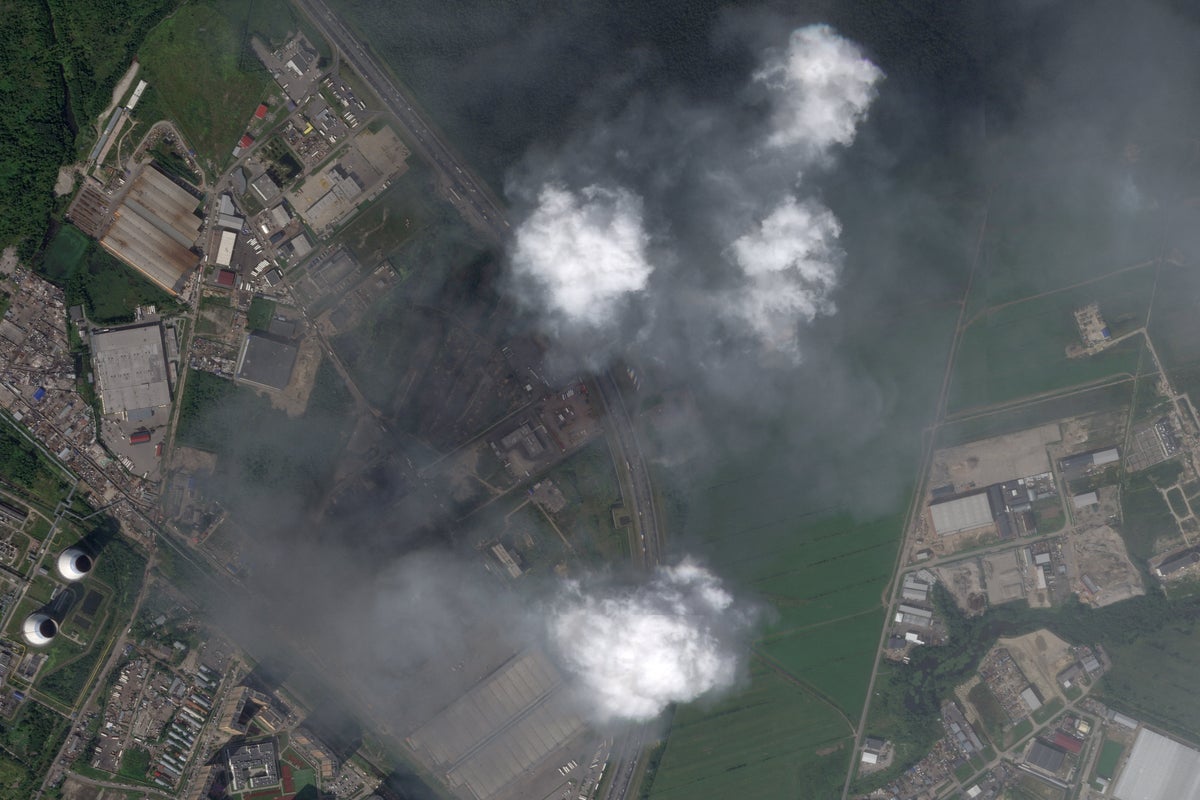
Ukraine, meanwhile, continued its own long-range campaign against targets deep inside Russian territory. Three Wildberries warehouse facilities were struck on Thursday alone — in Perm, the Penza region, and Udmurtia — bringing the total number of the company’s sites targeted in the past two weeks to at least twelve. Wildberries, Russia’s largest online marketplace, issued a statement insisting its Perm sorting centre was “operating normally,” a claim that sat in some tension with the scale of documented disruption. The governor of the Leningrad region acknowledged that approximately 1,500 sellers had suffered destroyed or damaged goods following a strike on a Wildberries warehouse there the previous week.
Kyiv has characterised these strikes as “long-range sanctions” — a formulation Zelensky uses regularly to describe attacks designed to degrade Russia’s capacity to sustain its war economy. The framing is deliberate: it positions military action within a logic of economic attrition and implicitly contests the distinction between civilian commerce and war-enabling infrastructure. Wildberries, Kyiv has alleged, plays a functional role in supporting Russia’s military-industrial supply chain, though the precise evidentiary basis for that claim has not been made fully public.
The economic reverberations of Ukraine’s drone campaign extended beyond Russia’s borders. Kazakhstan’s main oil export terminal in the Black Sea closed for the third time this month after Ukrainian drones struck two vessels at and near Russia’s Novorossiysk port. The Caspian Pipeline Consortium, which owns the pipeline carrying Kazakh crude across Russian territory to the Black Sea, accounts for approximately eighty per cent of Kazakhstan’s oil exports. Previous closures have forced Astana — among the world’s ten largest oil producers within OPEC+ — to temporarily reduce output, given the absence of viable alternative export routes. U.S. oil majors Chevron and Exxon, both of which hold major investments in Kazakhstan, face compounding exposure to this disruption.
Kazakhstan has condemned the attacks affecting CPC infrastructure. Kyiv has defended them as targeting Russian war-supporting logistics, insisting its actions are not directed at Kazakhstan. The distinction carries weight in Astana, where President Kassym-Jomart Tokayev, at a meeting with Vladimir Putin last weekend, publicly urged the Russian president to “freeze” the conflict and pursue peace negotiations — a proposal the Kremlin subsequently rejected. The episode illustrates the widening circle of states whose economic and political interests are being reshaped by a war they did not choose and cannot easily exit.
The European Union, for its part, disbursed a further €3.47 billion to Ukraine on Thursday to finance drones, missiles, air defence systems, and Swedish-made Gripen fighter jets. The payment forms part of a €90 billion loan approved earlier this year. Total EU disbursements for Ukrainian defence purposes have now reached €8.5 billion, according to a Commission spokesperson, with the bloc expecting to transfer €28 billion for defence by year’s end. The scale of that commitment reflects both solidarity and strategic calculation: a Ukrainian defeat would redraw the security architecture of the European continent in ways that no EU member state has an interest in accommodating.
On the ground in Kyiv, the human cost of sustained bombardment is visible in the city’s metro stations. A record 56,000 residents sought shelter underground on Thursday. The city operates more than 4,000 designated shelters, but the state ombudsman’s office has identified problems in 93 per cent of the 1,066 sites it has inspected — deficiencies in accessibility for people with disabilities, sanitation, and basic maintenance. Russia has killed 73 people in Kyiv over the past two months alone. Mayor Vitali Klitschko said the city has allocated over 1.1 billion hryvnias — roughly $24.5 million — this year for shelter repairs, with total spending since February 2022 reaching 7 billion hryvnias. The numbers are not small. Neither is the gap between what exists and what is needed.
What Thursday’s events traced, collectively, was the war’s continuing refusal to stay within the boundaries that outside observers periodically assign to it. A missile in a Polish field, North Korean ordnance over a Ukrainian city, drone strikes closing a Kazakh oil terminal, and tens of thousands of civilians sleeping underground in a European capital — these are not separate stories. They are facets of a single, metastasising crisis whose management has consistently lagged behind its momentum.