
Wounded Palestinian Journalists Demand Medical Evacuation as Gaza’s Healthcare System Collapses
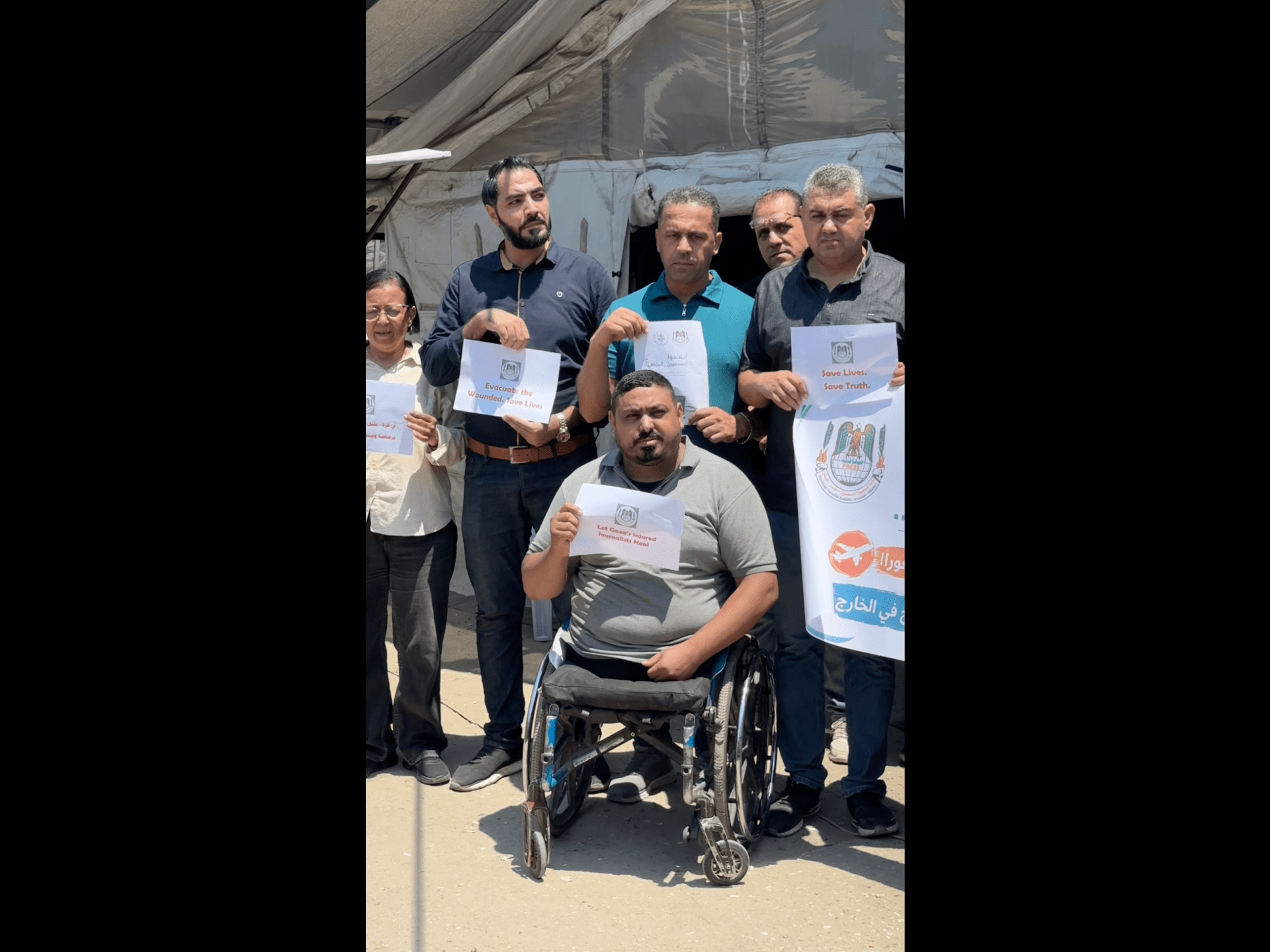
A Protest Born of Desperation
Wounded and chronically ill Palestinian journalists gathered in protest this week, issuing an urgent collective demand for medical evacuation from Gaza. Their appeal is not rhetorical. It is a clinical necessity, made urgent by the near-total collapse of a healthcare infrastructure that can no longer provide the specialist treatment their injuries and conditions require.
The protest, reported on 22 July 2026, represents a convergence of two interlinked crises: the systematic targeting of journalists covering the conflict, and the broader destruction of Gaza’s medical capacity — a destruction extensively documented by international health organisations and human rights monitors.
Journalists as a Documented Target Class
Palestinian journalists working in Gaza have sustained casualties at a rate that has drawn repeated condemnation from press freedom organisations. Wounds sustained in the field — shrapnel injuries, blast trauma, limb amputations — require sustained, specialised medical intervention that functioning hospital systems ordinarily provide. Gaza’s hospitals, subjected to repeated strikes, supply blockades, and fuel shortages, cannot meet that standard.
The journalists now calling for evacuation are not merely inconvenienced. They are trapped in a territory where the conditions necessary to preserve their lives have been systematically eroded.
The Accountability Gap
Under international humanitarian law, wounded civilians — and journalists in conflict zones hold protected civilian status — are entitled to medical care. The obligation falls both on the occupying power and on the international community to facilitate access when local capacity has been destroyed. That obligation has, in the case of Gaza, remained largely unmet. The mechanisms designed to enforce it have moved slowly, or not at all.
The Collapse of Medical Infrastructure
Gaza’s healthcare system entered the current phase of the conflict already strained by years of blockade. What followed was, by the assessment of the World Health Organization and multiple independent monitors, a methodical dismantling: hospitals struck or rendered non-functional, medical supply corridors blocked, and staff killed or displaced. The system that remains is a shadow of what international humanitarian standards require.
For a journalist requiring post-operative care, oncological treatment, or management of a chronic condition aggravated by injury, this is not an abstract policy failure. It is a death sentence administered by bureaucratic delay.
Chronic Illness in a Blockaded Territory
Among those protesting are journalists managing chronic illnesses — conditions that, under ordinary circumstances, would be addressed through regular access to medication and specialist consultation. The blockade has made such access intermittent at best, impossible at worst. The compounding effect of injury, chronic disease, and medical deprivation produces outcomes that are, in clinical terms, entirely preventable.
What Evacuation Would Require
Medical evacuation from Gaza is not a straightforward logistical exercise. It requires the agreement of the controlling authorities at border crossings, the cooperation of receiving states willing to provide treatment, and coordination with international bodies capable of facilitating passage. Each of these conditions has, at various points in the conflict, been withheld, delayed, or made subject to conditions that effectively function as vetoes.
The journalists’ protest is, in this sense, directed not only at immediate authorities but at the entire architecture of international response — an architecture that has demonstrated a persistent capacity to deliberate while people die.
The Broader Pattern
Gaza’s wounded journalists are a specific case within a far larger pattern. Tens of thousands of Palestinians requiring medical care beyond Gaza’s remaining capacity have faced the same bureaucratic and political barriers. What distinguishes the journalists’ situation is their visibility and their professional role as witnesses — a role that has made them targets, and that now makes their abandonment a particularly legible symbol of the accountability failures surrounding this conflict.
Their demand is precise: evacuation, treatment, survival. The response of the relevant authorities will be equally precise in what it reveals.