
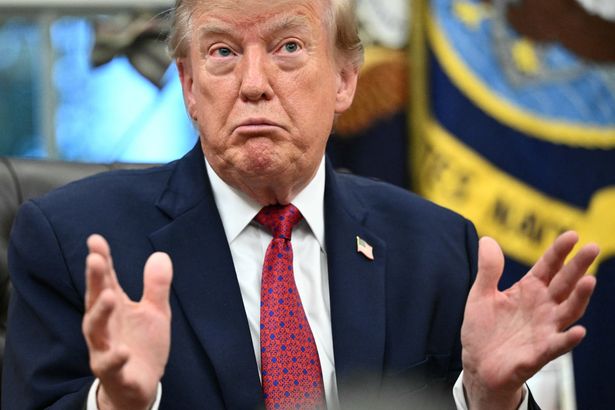
Donald Trump told reporters on Thursday that he had met privately with a Russian envoy and was working toward a broad agreement with Moscow that would extend far beyond Ukraine, encompassing, in his own words, “all of Europe.” The disclosure came not at a formal diplomatic briefing but at a casual Oval Office event focused on interior design.
A Deal Floated Between Executive Orders
Trump had summoned what remains of the White House press corps to witness the signing of an executive order designating the Oval Office as a national monument. The gathering quickly shifted when reporters pressed him on reports of a Russian diplomatic contact and on whether the United States intended to resume bombing raids on Iran.
On Iran, Trump was characteristically elliptical. “We control everything that we want to control,” he said. “I would rather not destroy the rest of the country if possible. But maybe I’ll have to. You’ll know soon enough.” No further clarification was offered.
On Russia, he was more expansive. Asked whether he had met with a Russian envoy present at the White House, Trump confirmed he had. He declined to detail the substance of their exchange but issued a sweeping characterisation of where negotiations stood. “There’s going to be an agreement, it’s going to be a big agreement, and it’s going to involve more than Ukraine,” he said. “I could even say it’s going to involve all of Europe. It’s going to be a big beautiful agreement and everyone’s going to be thrilled.”
He did not meet with any representative from Ukraine.
Melania Trump’s Back-Channel Role
The Russian envoy was attending what the White House described as a peace summit hosted by Melania Trump, who has reportedly been conducting back-channel communications with Vladimir Putin. Diplomats in multiple capitals have expressed bewilderment at the arrangement. Trump said he believed a settlement of the Russia-Ukraine war was close, offering no timeline, no framework, and no indication of what concessions, if any, had been discussed.
The absence of Ukrainian representation at the meeting, combined with the vagueness of Trump’s statements, raises immediate questions about the process through which any such agreement might be reached and what obligations it could impose on European governments that were not party to the conversation.
The Oval Office as Monument
The executive order Trump signed would require congressional approval for any future physical changes to the Oval Office, a provision he framed as preserving the room for “the ages.” The political context is pointed: Democrats swept both chambers of Congress in Tuesday’s midterm elections, a result Trump did not address directly. Any future administration seeking to reverse his extensive renovations would, under the order, need legislative sign-off.
Trump has spent much of his second term redecorating the Oval Office with gold-coloured mouldings, oversized mirrors, and ornamental objects. He reportedly used Krazy glue to affix gold medallions to the fireplace. He has also had “The Oval Office” painted in gold cursive on an exterior wall, and installed a “Presidential Walk of Fame” along the White House Colonnade featuring photographs and descriptions, written in his own style, of every president except one. Where Joe Biden‘s portrait would appear, there is instead a photograph of an autopen.
He recently demolished more than a third of the White House complex to make room for what he described as an opulent new ballroom, giving reporters a tour of the construction site the day before the signing.
When a reporter noted that Hillary Clinton had criticised his use of gold in the decor, Trump was unbothered. “I don’t like her house either,” he said. “I know her house very well.”
Accountability Gaps and Unanswered Questions
Trump’s comments on a potential European-scale agreement with Russia were made without supporting documentation, without named interlocutors beyond the unnamed envoy, and without any stated legal or diplomatic framework. The substance of the meeting between Trump and the Russian representative remains undisclosed. No briefing was offered to allied governments. Whether the agreement Trump described reflects an actual negotiating text, a preliminary understanding, or a presidential improvisation is, at this point, entirely unclear.
European governments, many of which have committed substantial military and financial support to Ukraine, received no advance notice of the remarks.