
Five Years After Saied’s Power Grab, Thousands March in Tunis Demanding His Resignation
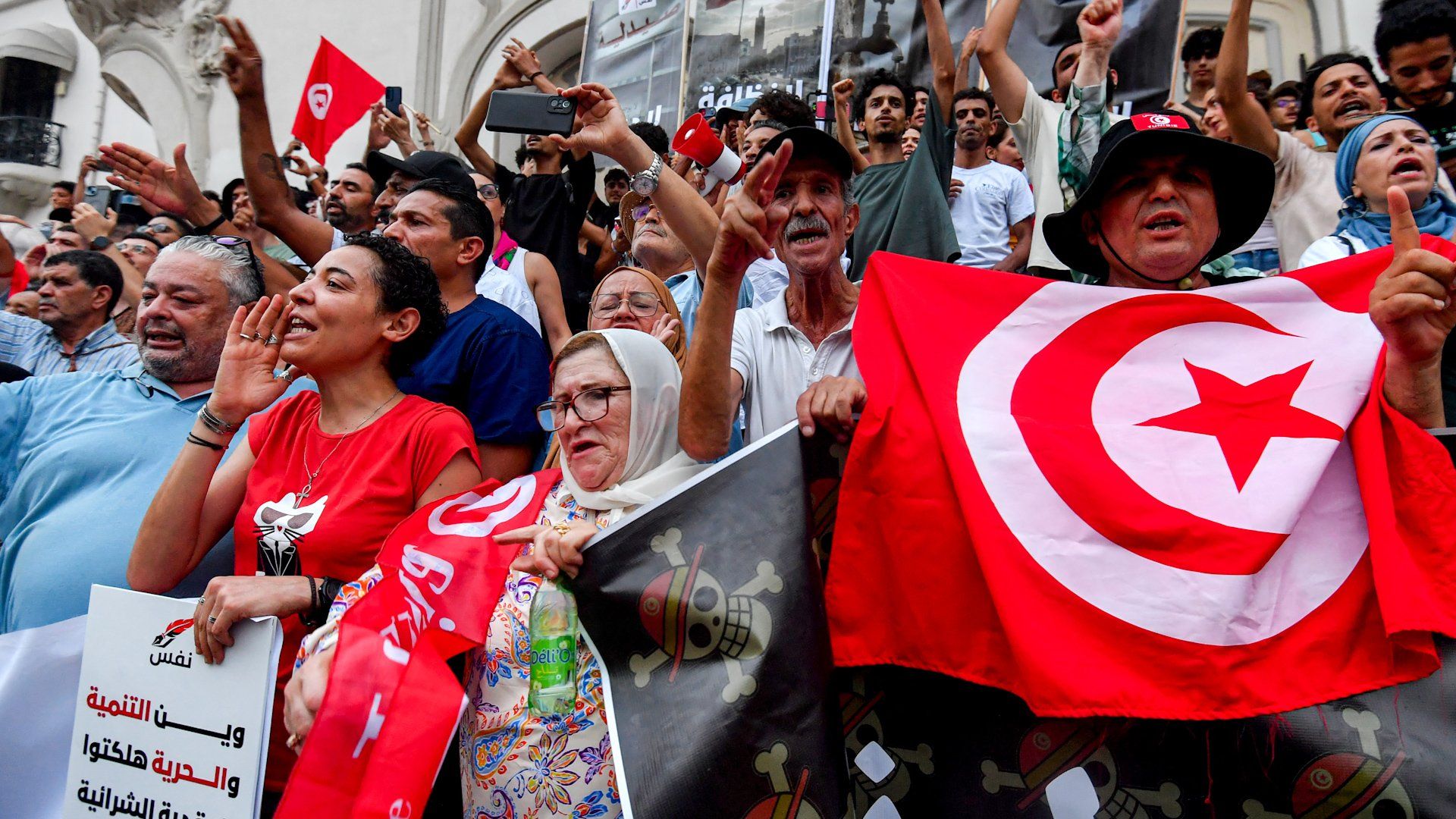
Five years to the day after President Kais Saied suspended Tunisia’s parliament and arrogated near-absolute executive power to himself, thousands of demonstrators filled the streets of Tunis on 25 July 2026, reviving a slogan that once brought down a dictator: the people want the fall of the regime. That the chant first rang out in 2011, during the Arab Spring uprising that Tunisia was long held to have pioneered, lent the moment a particular historical weight — and a particular bitterness.
The protest was among the largest public demonstrations against Saied since his 2021 consolidation of power, which he framed at the time as an emergency measure to rescue a dysfunctional state. Critics, including the opposition, independent jurists, and international human rights organisations, described it then as a constitutional coup. The intervening five years have done little to resolve that dispute, and considerable evidence has accumulated on the side of the critics.
Saied has since rewritten the constitution, dissolved the independent electoral commission, imprisoned political opponents, journalists, lawyers, and trade unionists, and presided over an economy that continues to contract in real terms for ordinary Tunisians. Unemployment remains high, public services have deteriorated, and the country’s external debt position has left successive governments in protracted, unresolved negotiations with the International Monetary Fund — negotiations that Saied himself publicly rejected in 2023 before quietly resuming. The gap between the president’s nationalist rhetoric and the material conditions of Tunisian life has grown measurable and wide.
Those conditions were audible in the crowd. Demonstrators cited not only the curtailment of political freedoms but the daily weight of economic hardship: rising prices, scarce goods, and a sense that the state apparatus now exists primarily to protect the president rather than to serve the public. The convergence of political repression and economic grievance is not incidental — it is, analysts of the region have consistently noted, precisely the combination that erodes the legitimacy of authoritarian consolidations over time.
The 2011 slogan carries a specific charge in this context. It was coined in Tunisia before spreading across the Arab world, and its reappearance on 25 July represents a deliberate act of political memory — a refusal to allow Saied to position himself as the inheritor of the revolution’s legitimacy. He has frequently invoked popular sovereignty to justify measures that, in practice, have foreclosed the mechanisms through which popular sovereignty is normally exercised: free elections, an independent judiciary, a functioning legislature, and a press that can report without fear of prosecution.
The demonstration was organised by a coalition of opposition parties and civil society organisations, the same transnational fabric of civic networks that has sustained documentation of abuses under Saied’s administration. Human rights groups operating both inside Tunisia and in partnership with international bodies have recorded a systematic pattern of politically motivated prosecutions, with defendants tried before military or specialised courts in proceedings that fall short of international fair-trial standards under Article 14 of the International Covenant on Civil and Political Rights, to which Tunisia is a state party.
Saied’s government did not immediately respond publicly to the march. That silence is itself a form of communication — an assertion that the protests do not constitute a political fact requiring acknowledgment. Whether that posture remains tenable will depend in part on whether the mobilisation of 25 July proves a singular moment or the opening of a sustained campaign. History in the region suggests that anniversaries can function as catalysts, concentrating diffuse grievance into collective action that outlasts the occasion that sparked it.
What is already clear is that five years of consolidated presidential authority have not produced the stability Saied promised, nor the economic renewal he cited as justification. The people who marched in Tunis on Saturday were not, by and large, partisans of the discredited political class that preceded him. Many were Tunisians who had initially extended Saied a measure of benefit of the doubt, watching it erode as each successive emergency measure revealed itself to be permanent. That erosion is the story the anniversary made visible.