
Ben Sandilands Claims Commonwealth Gold as Scottish Athletics Opens at Scotstoun
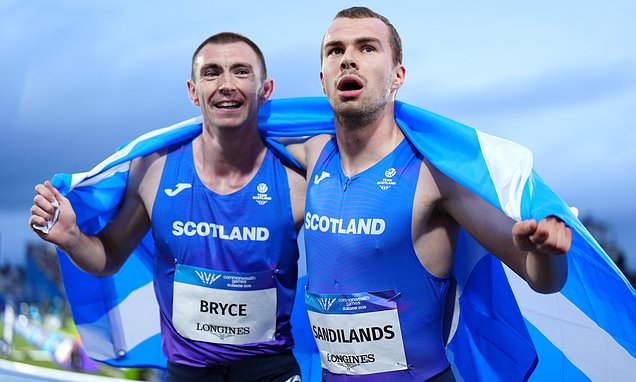
A Night of Scottish Reckoning in Glasgow
The opening night of athletics at the Glasgow 2026 Commonwealth Games delivered a moment of rare clarity: a 21-year-old from Kirkcaldy, trained at a Fife club that most outside Scotland could not have named a week ago, crossed the finish line of the men’s 1500m T20 final in 3:57.25 to claim Scotland’s first athletics gold of the Games. Ben Sandilands did not merely win. He won with authority, finishing more than four seconds clear of his nearest Scottish rival and well ahead of Canada’s Michael Barber, who clocked 4:01.84 for silver.
Steven Bryce, Sandilands’ clubmate and training partner at Fife Athletics Club, completed the Scottish double podium by taking bronze in 4:02.40. The result meant that a single athletics club — guided by coach Steve Doig — placed two athletes on the Commonwealth Games podium on the same evening, in the same event. A third Fife AC entrant, Owen Miller of Dunfermline, had been managing the effects of recent injuries and finished sixth, a performance that, in context, carried its own significance.
The Weight Behind the Gold
Sandilands arrived at Scotstoun carrying a record that required no embellishment. At the Paris Paralympics two summers prior, he had set a world record of 3:45.40 in the Stade de France, claiming Paralympic gold in a performance that announced him as the defining figure of his classification. What followed, however, was not uninterrupted progress. A serious injury forced his withdrawal from the 2025 World Championships in New Delhi, interrupting a trajectory that had seemed unstoppable and leaving a conspicuous gap in his competitive record.
The Commonwealth Games gold, then, arrived as something more than a title. It marked a return — measured, controlled, and executed in front of a home crowd whose investment in the outcome was visible from the opening gun. First Minister John Swinney acknowledged the moment publicly, posting on X: “Superb run by Ben Sandilands to secure a gold for Scotland at the Commonwealth Games. Congratulations!” Sandilands himself was characteristically understated in victory. “It’s great to share it with him,” he said of Bryce. “We were saying well done to each other. Our coach told us to just run it how you feel. And it was good.”
The Women’s 10,000m: Expectation and Its Limits
The women’s 10,000m final had been constructed, in the weeks before the Games, as a coronation. Eilish McColgan, the reigning Commonwealth champion, entered the tournament as the athlete the field would have to displace. That narrative collapsed before the race began. A toe injury sustained during the London Marathon, compounding what had already been a long and injury-laden season, forced McColgan to withdraw from the event she had been expected to dominate. She had, by her own account, simply run out of time to prepare a credible title defence.
In her absence, Scottish hopes transferred to Megan Keith, a 24-year-old from Inverness who arrived at the Games in the most compelling form of her career. Earlier in the year, she had set a women’s European 10km road record in Castellon; more recently, she had broken the Scottish 3,000m record at the Bislett Games in Oslo. The weight of expectation at a home Games, with family positioned near the finish line, was substantial. Keith did not buckle under it. She ran a season’s best of 32 minutes and 22.11 seconds — a performance that demonstrated both her current ceiling and the gap that still separates her from the podium at this level.
Gold went to Australia’s Rose Davies in a dominant 31:39.32, with Kenya’s Diana Wanza taking silver and Florence Niyonkuru of Rwanda claiming bronze. Keith finished ninth. The result was not a failure — it was a precise measurement of where she stands and how far the field has moved.
A Career Ends, a Generation Begins
Elsewhere on the track, hammer thrower Chris Bennett competed at the Commonwealth Games for the final time before retirement, finishing fifth — his best placing across four appearances at the Games. The symmetry was not lost on those watching: as one career closed with quiet dignity, another had just announced itself with gold. The evening at Scotstoun held both without sentimentality, which is perhaps the only honest way to hold them at all.