
Armed Space Robot Developed by Northrop Grumman Blurs Line Between Satellite Servicing and Orbital Warfare
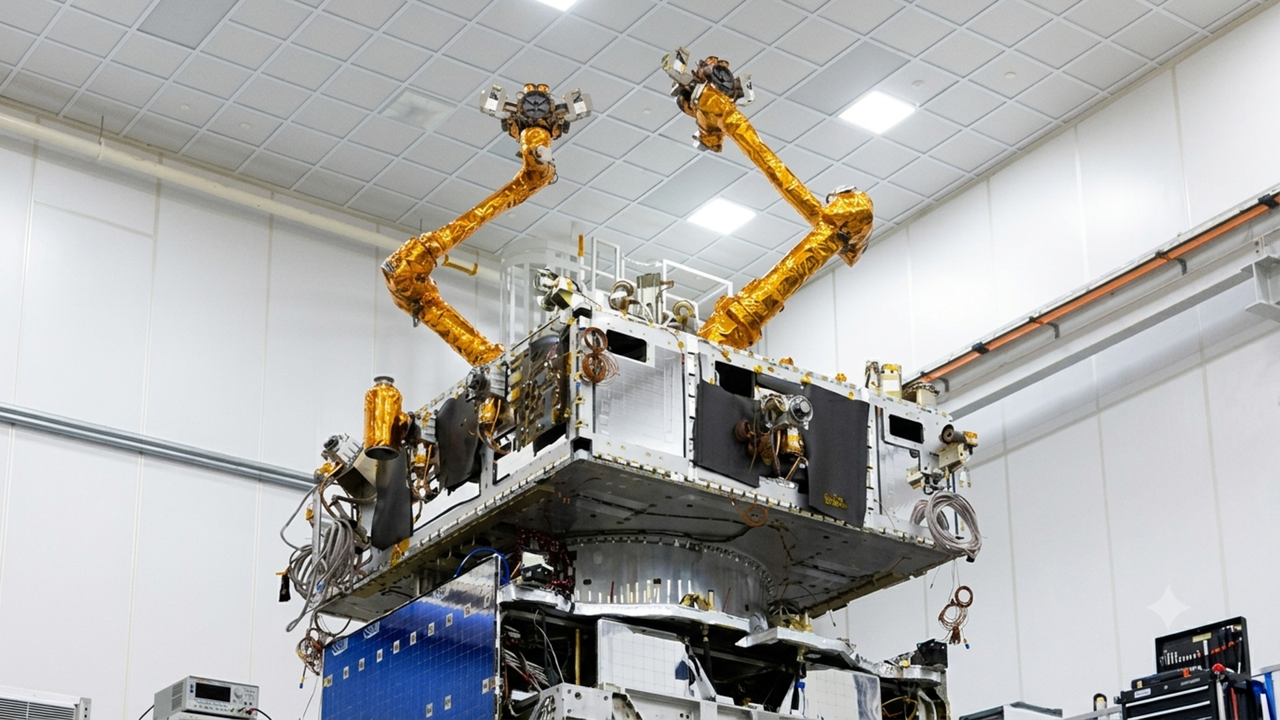
When Northrop Grumman’s Mission Robotic Vehicle lifted off aboard a SpaceX Falcon 9 rocket from Cape Canaveral, the company framed the occasion as a milestone in commercial satellite servicing — a spacecraft designed to repair, refuel, and extend the working lives of assets already circling Earth. The vehicle carries three Mission Extension Pods capable of adding as much as eight years to a satellite’s operational life, with initial installations planned for commercial satellites operated by Australia’s Optus and Luxembourg’s SES. Yet the technical architecture of the MRV, and the candour of those who built and commissioned it, makes plain that the boundary between infrastructure maintenance and orbital weapons capability is, at best, deliberately thin.
The spacecraft is equipped with two robotic arms developed under the Robotic Servicing of Geosynchronous Satellites programme, a joint initiative led by the Defense Advanced Research Projects Agency and the United States Naval Research Laboratory. Those arms allow the MRV to manoeuvre into extremely close proximity with other satellites, performing inspection, towing, and module installation without requiring direct physical contact in the conventional sense. The same precision that makes it possible to dock gently with a communications satellite and extend its service life by nearly a decade also makes it possible, in principle, to disable, redirect, or destroy a satellite belonging to an adversary. Northrop Grumman’s chief executive, Kathy Warden, did not obscure this duality when asked about it directly. “I will leave it up to the U.S. government to decide how that capability might fulfill mission objectives that they have in that regard,” she said, adding that the company’s role was to offer clients technological options, with policy decisions resting elsewhere. The formulation is familiar: it is the standard grammar of dual-use defence contracting, in which commercial framing and plausible deniability coexist with capabilities engineered from the outset for military application.
The United States Space Force has been explicit about the strategic context into which the MRV arrives. General Chance Saltzman, the service’s Chief of Space Operations, has argued publicly that rival nations have already positioned interceptor satellites in orbit, and that the United States must rebalance deterrence accordingly. A Space Force spokesperson specifically cited China’s Shi Jian 21 satellite, which is equipped with a robotic grappling arm, as an example of the orbital interceptor capabilities already deployed by potential adversaries. Officials have further warned that close-proximity spacecraft could be used to collect signals intelligence, conduct electronic interference, physically damage components, or forcibly relocate a satellite from its assigned orbital slot — disruptions that could have cascading consequences for both military communications and civilian infrastructure dependent on those same assets.
The Space Force’s Space Delta 9 unit has been tasked with developing tactics for both defensive and offensive orbital operations as these threats evolve, and the service’s ambitions extend well beyond a single robotic vehicle. The proposed Golden Dome missile defence architecture, still in planning stages, envisions a space-based interceptor network that the Congressional Budget Office estimates could require approximately 7,800 individual interceptors if the programme proceeds to full deployment. The scale of that figure alone illuminates the trajectory: what is being contemplated is not a limited counter-capability but the militarisation of low and geosynchronous orbit at a structural level, with consequences for space sustainability that remain largely unaddressed in public discourse.
The debris problem, invoked in promotional materials for the MRV as one of the vehicle’s intended use cases, deserves particular scrutiny in this context. The same technologies that could theoretically assist with debris removal could, if used to disable or destroy functioning satellites, generate precisely the kind of fragmentation clouds that render orbital bands unusable for generations. The 2007 Chinese anti-satellite test and the 2021 Russian direct-ascent missile strike on a defunct Soviet satellite both produced debris fields that continue to threaten operational spacecraft and the International Space Station. A robotic vehicle capable of close-proximity operations offers a more surgical alternative, but surgical capability does not guarantee surgical restraint, and no binding international legal framework currently governs the use of such systems in orbit. The Outer Space Treaty of 1967 prohibits the placement of weapons of mass destruction in space and mandates that the Moon and other celestial bodies be used exclusively for peaceful purposes, but it does not prohibit conventional weapons or dual-use platforms of the kind the MRV represents.
For the moment, the MRV operates as a commercial servicing platform, and its first missions will extend the lives of satellites owned by private telecommunications operators. That is not a trivial contribution: orbital assets are expensive, replacement launches carry their own environmental and financial costs, and life-extension technology genuinely serves the long-term sustainability of the space environment. But the conditions under which a government client might instruct Northrop Grumman — or a successor programme — to deploy comparable capabilities against an adversary’s spacecraft are not hypothetical. They are, by the company’s own account and the Space Force’s public posture, already under active consideration. The spacecraft now in orbit is, by any honest accounting, a prototype for a new category of orbital power projection, and the debris-mitigation framing should not be permitted to obscure that fact.