
Commonwealth Games Records Fall at Rain-Soaked Scotstoun as Eseme and Hobbs Dominate 100m Finals
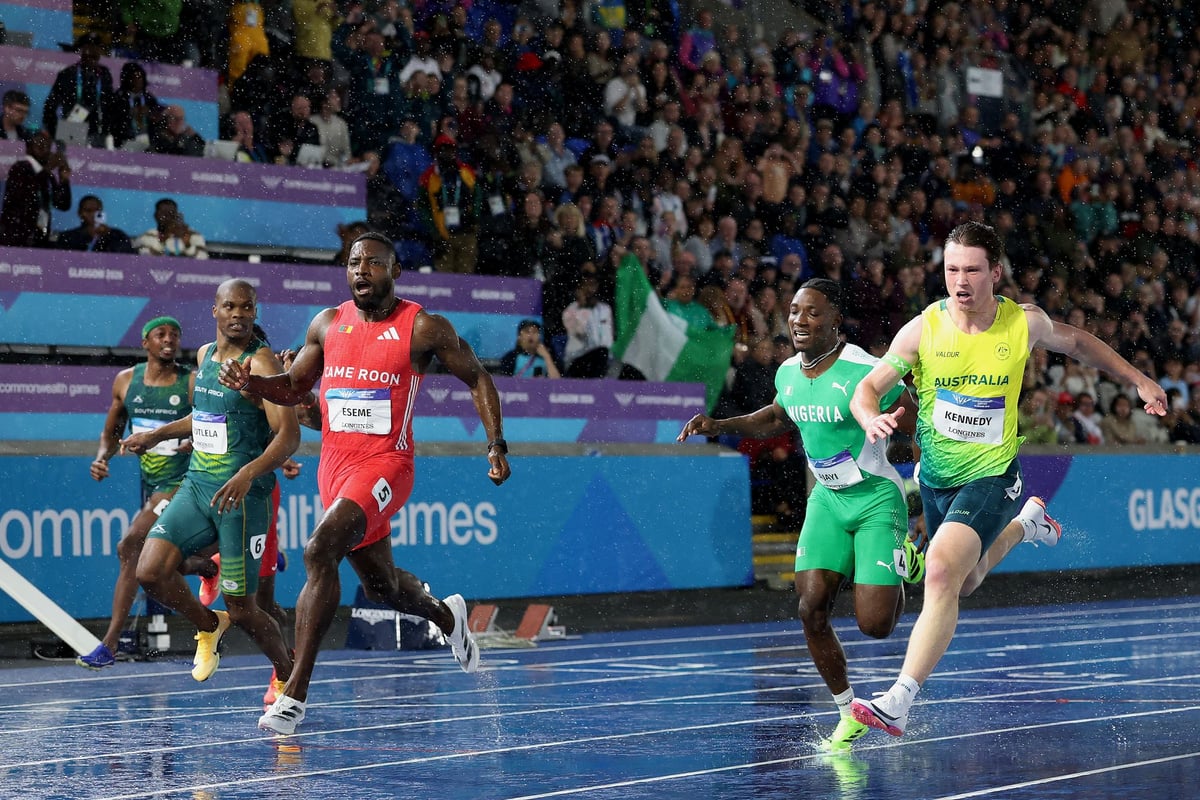
Records Set Despite the Downpour
On the second night of athletics at the 2026 Commonwealth Games, Scotstoun Stadium endured a sustained and punishing rainstorm that tested both athletes and spectators in equal measure. The venue’s newly laid running track faced its first serious examination under genuinely hostile conditions, and the question of whether it would hold up under torrential rain hung over the evening’s programme from the outset.
It held up. And so, emphatically, did the competitors. Emmanuel Eseme of Cameroon and New Zealand’s Zoe Hobbs each delivered performances that would have commanded attention under any conditions — let alone these — finishing their respective 100 metre finals in Commonwealth and Oceania record times.
Eseme crossed the line in 9.83 seconds, a new Commonwealth Games record, with Australia’s Lachlan Kennedy taking silver in 9.85 and Nigeria’s Kayinsola Ajayi claiming bronze in 9.90. The margins were forensic; the execution, in driving rain, was close to flawless. Hobbs then closed the evening’s programme with a 10.93 run — a new Oceania record — edging England’s Amy Hunt (10.98) and Australia’s Torrie Lewis (10.99) in a finish decided by the width of a shoulder dip.
Butchart Falls Short in the 10,000 Metres
Scotland’s own medal ambitions centred largely on Andy Butchart, the 34-year-old Dunblane distance runner who arrived at these Games on the back of what he had publicly described as the best season of his career. Earlier in 2026, Butchart had set a new Scottish 10km road record of 27:44 in Valencia, a performance that had raised expectations ahead of a home Games he acknowledged might represent his last at this level.
From the opening laps, Butchart positioned himself near the front of the 10,000 metre field — not, he later clarified, as a tactical gambit to set pace, but as a means of avoiding the dangerous clustering and surging that had characterised the women’s 10,000 metres the previous evening. The early stages were controlled, even comfortable. The decisive move came with five or six laps remaining, and Butchart could not respond.
“When the move came with five or six laps to go, I didn’t have much left in the legs,” he said afterwards. “I thought it might slow down again but it didn’t, so the field never came back to me.” He finished 13th, recording a season’s best of 28 minutes 16.75 seconds — a time that, on another night, might have felt encouraging. Here, it represented a missed opportunity he was candid enough to acknowledge directly.
Butchart will return for the 5,000 metres on Saturday. Asked how he would recover mentally, he pointed to the crowd. “I’ve got family here, all my mates are supporting,” he said. “I’ll come back in the 5k, hopefully put on a better performance than I did tonight.”
Hammer, Heptathlon and Heartbreak
By the time the Women’s Hammer Throw Final began, conditions had deteriorated further still. A crack of thunder prompted sections of the crowd in the temporary stands to abandon their seats, seeking shelter wherever it could be found. Angela McAuslan-Kelly, a 20-year-old Aberdeen athlete making her Commonwealth Games debut, competed in what she called the worst conditions she had ever experienced. “I went out thinking a bit of rain would be fun,” she said, “but that was carnage.”
Edinburgh’s Allie Routledge had begun her Women’s Heptathlon campaign in the morning session, posting a personal best of 14.20 in the 100 metres hurdles and a season’s best of 1.67 metres in the high jump. She returned in the evening to record 10.13 metres in the shot put and 26.01 seconds in the 200 metres. At the halfway point of the two-day competition, Routledge sat 14th overall on 3,102 points, with the remaining disciplines scheduled for Wednesday.
Elsewhere on the programme, Nicole Yeargin advanced to the Women’s 400 metres semi-finals after a composed heat run of 52.44 seconds. Jamie Phillips and Brodie Young were less fortunate, both narrowly failing to progress in the 800 metres and 400 metres respectively. Steven Stone retired from the Men’s Long Jump T20 Final after three failed attempts.
A Night the Track Survived
What the evening demonstrated, above the individual results, was the resilience of elite sprinting as a spectacle — its capacity to produce precise, record-breaking performances even when the environment conspires against them. Eseme and Hobbs did not merely win; they set marks that will stand as benchmarks until the next Games. The rain, ultimately, became part of the story rather than its defining feature.
The athletics programme at Scotstoun continues through the week, with Butchart’s 5,000 metres and the conclusion of Routledge’s heptathlon among the events still to be decided.