
Aleksander Ceferin: The Slovenian Lawyer Who Built a Wall Against FIFA’s World Cup Sale
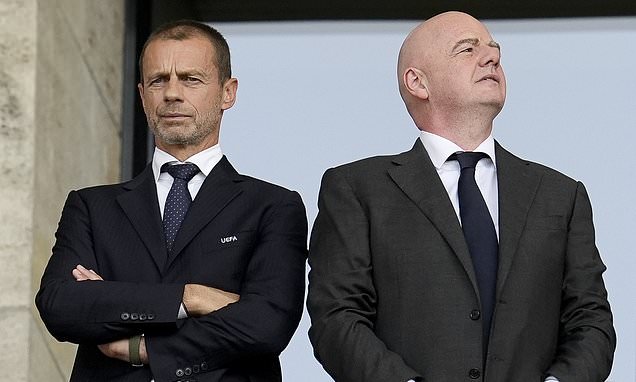
He did not need his name on a press release to make his position understood.
Aleksander Ceferin, the Slovenian lawyer who has led UEFA since 2016, has emerged as the most consequential institutional obstacle to FIFA president Gianni Infantino’s ambition to open world football’s flagship competition to private-sector investment — a scheme that would, in effect, permit the sale of commercial stakes in the World Cup itself. Within 48 hours of the plan gaining serious traction, Ceferin had assembled all 55 UEFA member associations into a unified bloc demanding binding commitments against it. The speed and cohesion of that mobilisation was not accidental; it reflected nearly a decade of quiet institutional consolidation.
The two men’s careers have run in an almost symmetrical parallel. Both rose to the summits of football governance in 2016, both having previously worked within UEFA’s structures. Yet the contrast in their governing philosophies has grown sharper with each passing year. Where Infantino has pursued an expansionist, commercially aggressive agenda — the failed $25 billion competition overhaul of 2018, the aborted Club World Cup financing arrangements, and now the World Cup investment plan — Ceferin has consistently positioned himself as a custodian rather than a dealmaker, arguing that football administrators exist as guardians of the game, not brokers of its assets.
That framing is not merely rhetorical. Ceferin’s most dramatic intervention came in April 2021, when the so-called Super League — conceived in secrecy by twelve of Europe’s wealthiest clubs and designed to circumvent UEFA’s competition structure entirely — collapsed within 72 hours of its announcement, in no small part because of the swiftness and ferocity of UEFA’s institutional response. The episode demonstrated that Ceferin had built something Infantino’s rivals within FIFA have conspicuously lacked: a durable coalition capable of acting with speed.
His biography offers some explanation for the instinct. A trained lawyer who competed seriously in karate before entering sports administration, Ceferin took over the Slovenian Football Association before ascending to the UEFA presidency in 2016, defeating the only candidate willing to stand against him — UEFA stalwart Michael van Praag — by 42 votes to 13 at an extraordinary congress in Athens, becoming the organisation’s youngest ever president. He arrived with a stated agenda of structural reform: term limits for officials, a more transparent tournament-bidding process, and a serious effort to address match-fixing. The priorities were unglamorous. They were also deliberate.
Re-elected by acclamation in 2019, Ceferin used his keynote address to send what observers read as an unambiguous signal to Infantino, who sat in the front row. He would not, he said, be a yes man for FIFA’s expansion plans. Infantino’s expression, by most accounts, remained composed. The message, however, was received.
Ceferin has stated he will not seek another term. His absence from the 2026 FIFA World Cup final in New York — a departure from protocol that amounted to a public boycott — marked a pointed conclusion to a decade of managed antagonism. He had attended the tournament’s opening match between Mexico and South Africa in Mexico City and had intended to return for the final, but the handling of the Folarin Balogun red card case during the tournament, and the broader conduct of FIFA’s leadership, proved, by his account, a step too far. The empty seat said what no press release needed to.
Whether Ceferin’s successor will maintain the same resistance, or whether Infantino will find in the transition an opening he has so far been denied, remains the central question now hanging over the governance of world football.