
Italian Navy Intercepts Sanctioned Russian Shadow Fleet Tanker in Mediterranean Waters
A Vessel Under Scrutiny
On the morning of 2 August, the Italian naval frigate Thaon di Revel intercepted a tanker in international waters west of Pantelleria, the small Italian island that sits between Sicily and Tunisia, in what represents one of the more operationally significant enforcement actions taken against Russia’s so-called shadow fleet in the Mediterranean to date. The vessel in question, the Toa Payoh, is subject to European Union sanctions and operates under the declared flag of Cameroon — a flag of convenience arrangement that lies at the heart of how the shadow fleet obscures the origin and destination of Russian oil exports.
The Toa Payoh had departed the port of Cotonou, in Benin, on 16 July, bound for Istanbul. Its route brought it through waters where the EU’s Operation EUNAVFOR MED IRINI maintains an active monitoring presence, tasked specifically with detecting arms and oil trafficking that circumvents international sanctions regimes. That the vessel was sailing under a Cameroonian flag while subject to EU sanctions placed it squarely within the mandate of the operation.
Resistance, Then Boarding
When Italian naval personnel first made contact with the Toa Payoh, the tanker’s master declined to provide the cooperation that international law requires during such inspections. The refusal was not, in itself, without legal consequence: Article 110 of the United Nations Convention on the Law of the Sea (UNCLOS) explicitly authorises a warship to board a merchant vessel in international waters when there are reasonable grounds to question its nationality or the legitimacy of the flag it flies — precisely the circumstances present here.
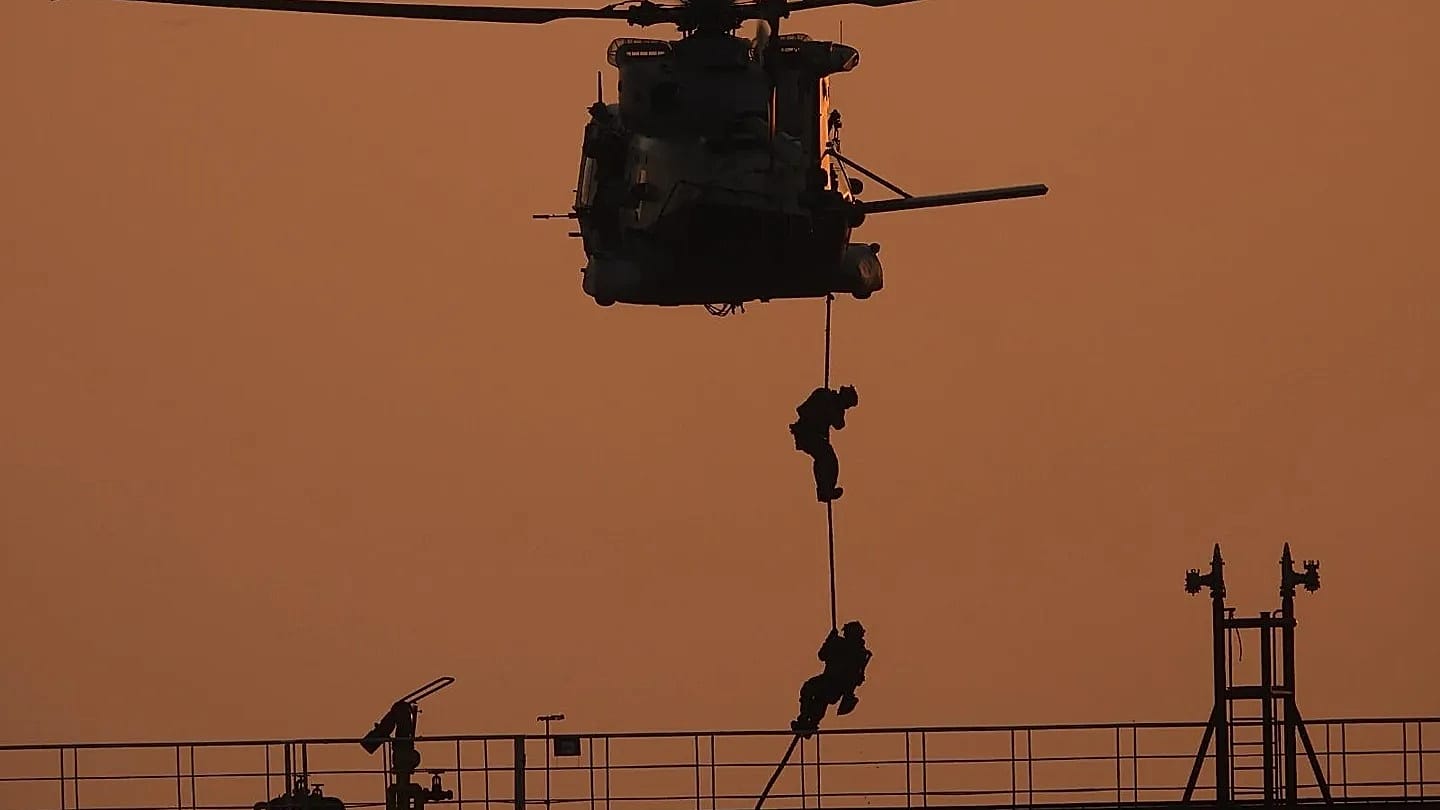
Faced with the master’s initial non-compliance, an Italian military boarding team reached the Toa Payoh by helicopter, deploying directly from the Thaon di Revel. The inspection that followed lasted approximately two hours and was concluded, according to the Italian Ministry of Defence, without incident. A Greek naval vessel and a Polish maritime patrol aircraft provided support throughout the operation, reflecting the transnational coordination that EUNAVFOR MED IRINI is designed to enable.
The documentation and information gathered during the boarding are now under review by Italian authorities.
The Broader Architecture of Evasion
The shadow fleet — a loose but growing network of tankers operating under flags of convenience, obscured ownership structures, and irregular insurance arrangements — has functioned as the primary mechanism through which Russian crude oil continues to reach global markets in defiance of Western sanctions imposed following the full-scale invasion of Ukraine in February 2022. The Toa Payoh’s use of a Cameroonian flag while remaining a sanctioned vessel illustrates the layered opacity that characterises these operations and the evidentiary challenges they pose for enforcement authorities.
Italy’s Defence Minister Guido Crosetto praised the crew of the Thaon di Revel and the broader personnel involved, describing the operation as “a concrete demonstration of Italy’s contribution to the security of the Mediterranean and to the European Union’s action.” The statement, measured in its formality, nonetheless underscores a political dimension: EU member states enforcing sanctions against Russian energy exports are, in effect, enacting a collective response to a war that has reshaped European security calculations.
Enforcement in International Waters
What the Pantelleria interception demonstrates, above all, is that the legal architecture for enforcement already exists. UNCLOS Article 110 provides the jurisdictional basis; EUNAVFOR MED IRINI provides the operational framework; and the EU sanctions regime provides the normative foundation. The question that remains — and that the review of the Toa Payoh’s documentation may begin to answer — is whether the information gathered can be translated into sustained accountability, or whether it will yield, as so many such inspections have before, only a temporary disruption to routes that rapidly reconstitute themselves.
The shadow fleet does not depend on any single vessel. It depends on systemic tolerance.