
Prince George’s Enrolment at Eton: Scrutinising the Scrutiny of a Royal School Choice
A Decision Under the Microscope
When Kensington Palace confirmed that Prince George, thirteenth in line to the throne and heir apparent, would attend Eton College, the announcement drew an immediate and notably sharp public reaction. Critics characterised the choice as “distinctively unimaginative”, a “royal mistake”, and an emblem of institutional insularity. Some commentators argued the future King should attend a state school. The debate, while framed in the language of egalitarianism, deserves closer examination — on its own terms and on the evidence.
George is thirteen. He carries, by accident of birth, a constitutional role that will one day place him at the apex of a state institution subject to intense and unrelenting public scrutiny. The question of where he is educated is not merely a lifestyle choice. It is a decision with measurable consequences for his welfare, his preparation, and arguably for the institution he will one day head.
What the Record Shows
William and Catherine did not arrive at Eton impulsively. According to reporting on the decision, the couple considered multiple institutions before settling on Eton.
These are not sentimental considerations. They are operational criteria applied to an unusual set of circumstances. The criticism that the choice is unimaginative misreads the situation: imagination is not what is required here. Fitness for purpose is.
The Smartphone Ban and Child Welfare
One dimension of the decision has received insufficient attention in the commentary. Eton operates a complete ban on smartphones for pupils in George’s year group. Students are issued basic handsets — so-called brick phones — capable of calls and texts, nothing more. There is no TikTok access, no Instagram, no Snapchat.
This is not a trivial detail. The evidence base linking unrestricted adolescent social media use to anxiety, depression, and exposure to harmful content has grown substantially in recent years. The Southport Inquiry, examining the circumstances surrounding the triple murder carried out by Axel Rudakubana, has heard expert testimony recommending that technology be sold with parental controls pre-installed, precisely because the current default — unrestricted access, parental responsibility to restrict — has demonstrably failed large numbers of young people. Eton’s blanket ban sidesteps the problem entirely.
For a thirteen-year-old whose image and movements are already subject to intense media interest, the removal of social media from his daily environment is not a privilege. It is a safeguard.
The Comparison With Charles
The historical contrast is instructive. King Charles was sent to Gordonstoun, a remote school in the Scottish Highlands, an institution he has described with barely concealed distress. The distance from family, the harsh environment, and the social isolation left a documented mark. William’s own account of Eton is strikingly different: he has said it allowed him to be “just another student” — a condition that is, for someone in his position, genuinely difficult to achieve and genuinely valuable when it is.
The decision to send George to the same institution reflects a conscious break from the Gordonstoun model. It prioritises emotional continuity, proximity to parents, and a peer environment in which George’s background does not mark him as an anomaly. Whether one approves of elite private education as a social institution is a separate and legitimate debate. Within the constraints that actually govern this family’s choices, the decision is defensible on welfare grounds.
The Limits of the Egalitarian Critique
The argument that George should attend a state school deserves engagement rather than dismissal, but it also requires honesty about what it entails. A comprehensive school in the Windsor area would be required to absorb a pupil whose security detail, media profile, and constitutional significance would place extraordinary demands on staff, infrastructure, and fellow pupils. The disruption would not be George’s alone to bear. It would fall, unevenly, on a school community with no particular obligation to absorb it.
The egalitarian critique also elides a distinction between symbolic gestures and substantive policy. Placing George in a state school would not reform the private education system. It would not redirect Eton’s endowment toward public provision. It would generate a news cycle. The structural inequalities embedded in British education require legislative action, not royal enrolment decisions.
What the Choice Does and Does Not Signal
William and Catherine’s decision is best understood as a welfare choice made under unusual constraints, not as an ideological statement about the merits of private education. It is consistent with the evidence on what has worked for previous royals, with the operational requirements of George’s security, and with the emerging consensus on adolescent digital health.
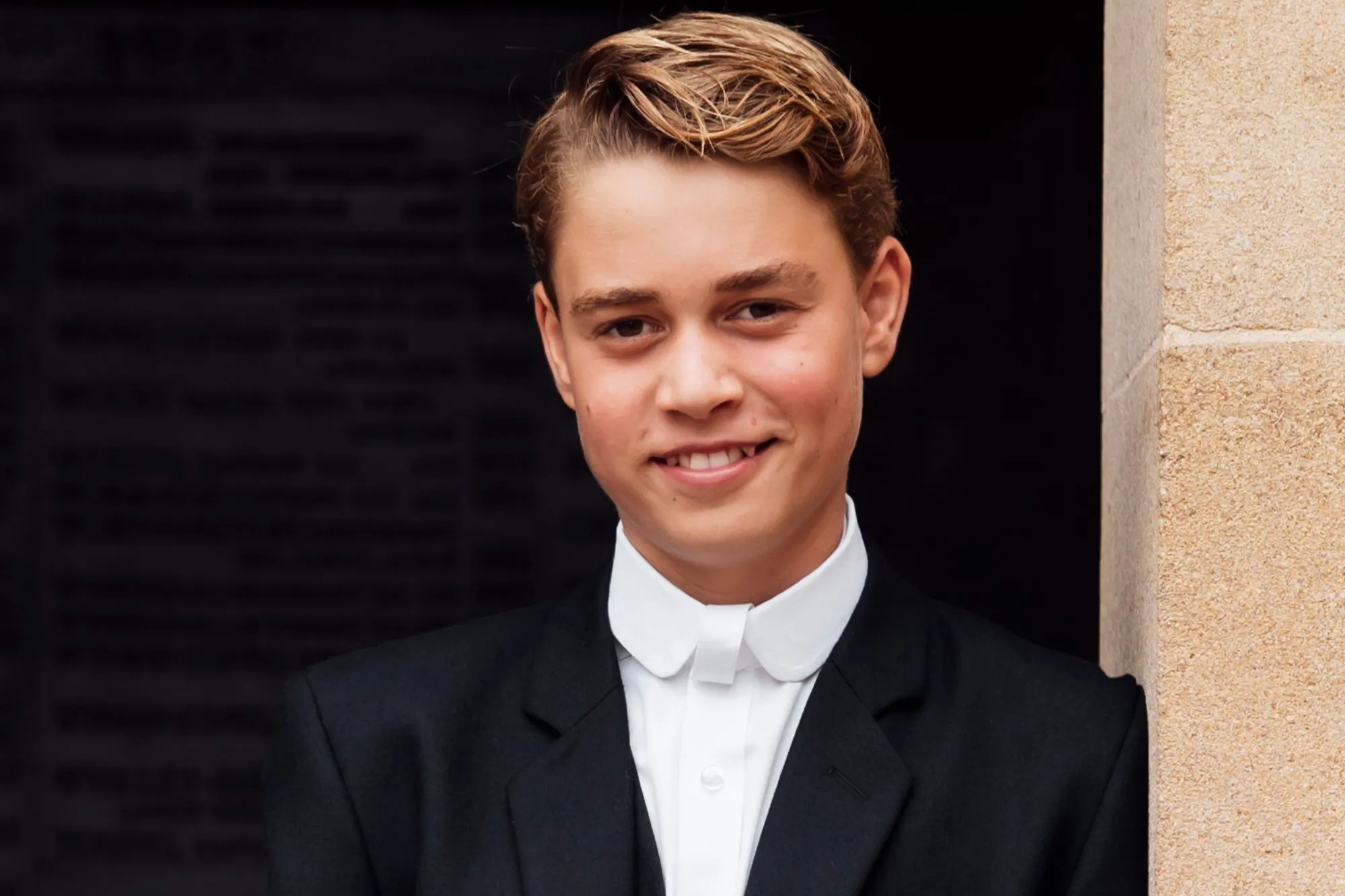
The photograph of George at Eton’s entrance — tailcoat, stiff collar, the school’s grand pillars behind him — will be read by different audiences in different ways. Some will see anachronism. Others will see continuity. What it most plainly records is a thirteen-year-old beginning a new chapter, under circumstances he did not choose, in an institution selected by parents who appear to have weighed the available options with some care. That, at minimum, is what the evidence supports.