
Film World Unites Behind NAZA Directors as Israel Threatens Citizenship Revocation Over Gaza Documentary
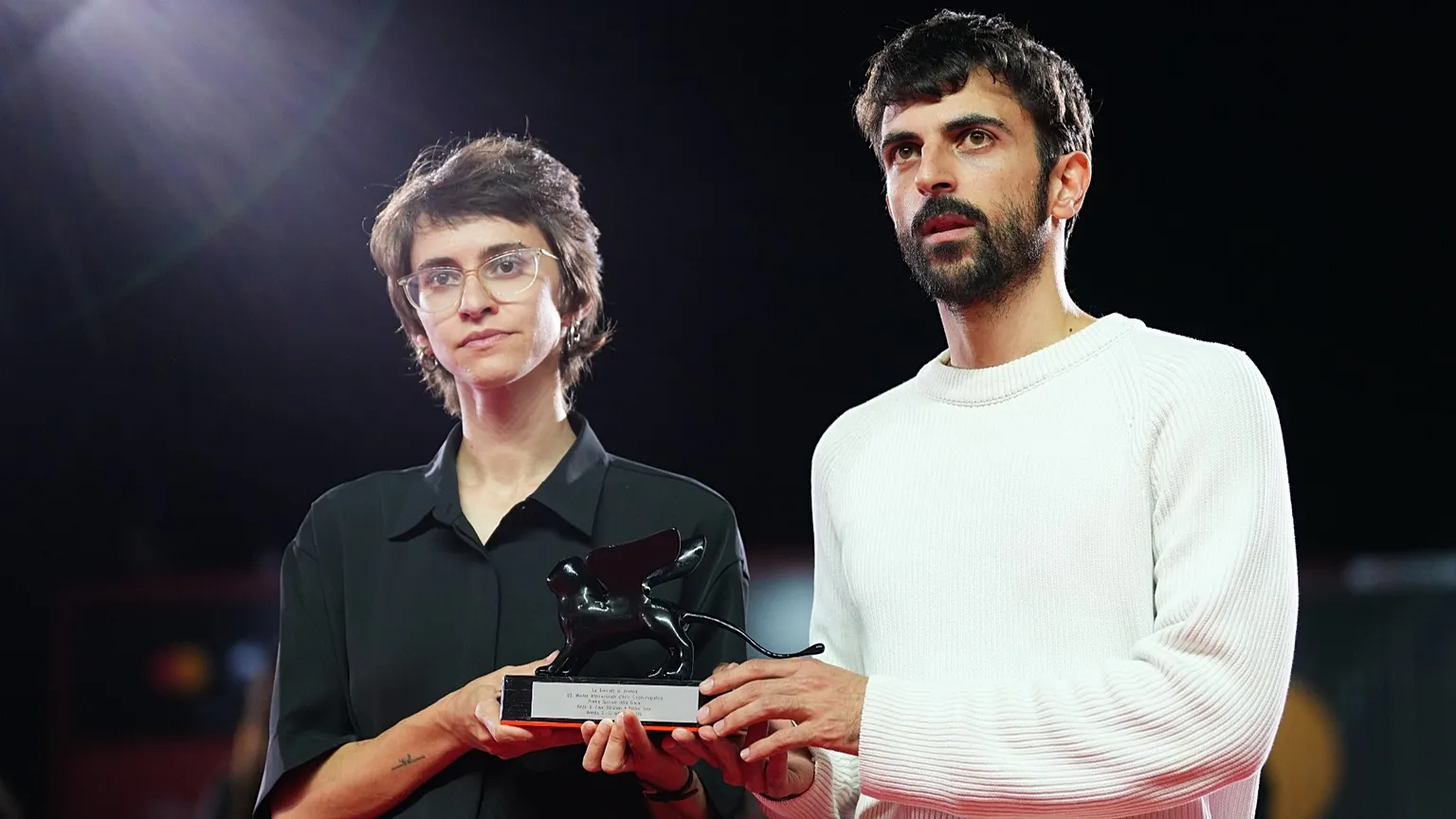
Israel’s culture minister has threatened to strip two documentary film-makers of their citizenship for producing a film that scrutinises the Israeli military’s use of artificial intelligence targeting systems in Gaza. The response from the international film industry has been swift, broad, and unambiguous.
Yuval Abraham and Rachel Szor, the Israeli directors behind NAZA, received the special jury prize at the Venice film festival last Saturday following a 25-minute standing ovation — a record in the festival’s history. Within 24 hours, Minister Miki Zohar had posted a denunciation on X, accusing the pair of being willing to “harm their homeland in order to receive applause from antisemites around the world” and vowing to “act immediately to revoke the Israeli citizenship of these despicable creators for treason against the state.”
The film itself is named after a Hebrew acronym used within Israel’s intelligence apparatus to designate anticipated civilian casualties in airstrikes on Gaza — a bureaucratic euphemism that the documentary places under sustained analytical pressure. Drawing on interviews with 24 Israeli military and intelligence personnel, NAZA details the AI-powered targeting infrastructure that has directed bombardment campaigns across Gaza. Its evidentiary foundation rests on reporting published between 2023 and 2025 by the Israeli-Palestinian outlet +972 Magazine, the Hebrew-language Local Call, and the Guardian, which co-produced the film.
The threats against Abraham and Szor did not emerge in a vacuum. They follow a pattern in which Israeli officials and aligned media have sought to delegitimise, intimidate, or professionally destroy those who document the conduct of Israeli military operations. The mechanism is familiar: accuse the investigators of serving enemy propaganda, invoke national loyalty as a litmus test, and deploy the language of treason to foreclose the possibility of legitimate dissent.
Julie Huntsinger, artistic director of the Telluride film festival, did not equivocate. “Documentary film-makers are among the best long-form journalists working and critical to our understanding of the world,” she said. “To even threaten their citizenship standing is unacceptable. This should be condemned by any thinking human.” The Locarno film festival’s leadership added that it stood “firmly in support of film-makers’ right to pursue difficult and urgent subjects without fear of reprisal,” describing artistic and journalistic freedom as “the very foundation of what cinema can be.”
Tricia Tuttle, director of the Berlinale, was equally direct. “Artists must be free to critically examine the world,” she said. “Films can provoke discussion, disagreement and criticism, but in a democratic society, the response to art must be dialogue and scrutiny, not intimidation or punishment by the state.” Her statement carries additional weight given her own recent exposure to institutional pressure: earlier this year, the German tabloid Bild reported she was to be dismissed after prize recipients used the Berlinale’s closing ceremony to condemn Israeli actions against Palestinians, prompting the German culture minister to convene a crisis meeting. Hundreds of film-makers rallied to her defence then. She is now returning the gesture.
The Academy of Motion Picture Arts and Sciences — whose members awarded Abraham and Szor the documentary Oscar in 2025 for No Other Land, a film about Israeli settler violence in the occupied West Bank — has not yet issued a statement. The silence is notable. Previous documentary Oscar winners have not been similarly restrained.
Laura Poitras, who won the documentary Academy Award in 2015 for Citizenfour and served as a consultant on NAZA, directly addressed both the film’s evidentiary rigour and the broader implications of the ministerial threats. “The facts about the mass killing of civilians in NAZA have been reported by the Guardian in dozens of rigorously fact-checked articles, and every assertion in the film is based on multiple sources,” she said. She characterised the citizenship threats as “a threat to journalists worldwide,” drawing a direct parallel to the US government’s response to her own reporting on the National Security Agency’s illegal global mass surveillance programme. She also placed the current situation in its most consequential context: “It is important to emphasise that Israel has killed over 200 Palestinian journalists in Gaza and has normalised the murder of journalists.”
That figure is not rhetorical. It is a documented body count.
Inside Israel, more than 1,500 film-makers have signed a petition defending Abraham and Szor and rejecting the accusation that the documentary was designed to damage Israel’s international standing. Signatories include directors Nadav Lapid, Hagai Levi, Shai Carmeli-Pollak, and Shlomi Elkabetz. The petition warns that the official rhetoric against the directors has moved dangerously close to “effectively sanctioning violence,” and frames the campaign of vilification as an unprecedented escalation against freedom of expression within Israeli civil society.
The personal stakes are not abstract. Following Abraham and Szor’s Oscar win for No Other Land — shared with Palestinian co-directors Basel Adra and Hamdan Ballal — Abraham’s family home was targeted by a far-right mob. “For me, that was the worst moment of all,” he told the Guardian last week. “My mum is hoping it doesn’t happen again.”
Photographer and activist Nan Goldin, who collaborated with Poitras on the 2022 Oscar-nominated documentary All the Beauty and Bloodshed, said she applauded the directors “for their enormous courage in presenting a film that shows irrefutable proof of Israel’s war crimes at their own great risk.” British director Richard Eyre and novelist-screenwriter Hanif Kureishi also offered public support, the latter describing the pair as “both brave and admirable, standing up to state oppression, steadfast in their pursuit of the truth.”
NAZA is scheduled to screen at the San Sebastián film festival, where organisers stated the film “exposes the systematic genocide of the Palestinian people by the Israeli government” and declared solidarity with its makers and with “the Palestinian people.” The documentary screens at the Bologna film festival before its North American premiere at the New York film festival later this month.
The broader context against which all of this unfolds demands precision. Israeli military operations in Gaza since October 2023 have killed more than 73,000 Palestinians — the majority of them civilians — and injured more than 174,000 others, a combined toll representing over ten percent of Gaza’s pre-war population. Israel launched its military campaign following the Hamas-led attacks of 7 October 2023, in which more than 1,200 people were killed and 251 taken hostage, the majority of the dead and hostages being civilians. These are the facts that NAZA situates within a documented technological and institutional architecture. These are also the facts that a government minister has chosen to call treason.