
Saudi Arabia Draws a Red Line Over Holy Sites as Houthi Attacks Escalate and Oil Infrastructure Burns
The drone was intercepted south of Mecca. That single operational detail — precise in geography, charged in symbolism — encapsulates the degree to which the war in Yemen has metastasised far beyond its original theatre. Saudi Arabia’s air defences shot down what Riyadh described as a Houthi unmanned aerial vehicle approaching the vicinity of Islam’s holiest city, and the kingdom’s response was swift and unambiguous: the security of the holy sites constitutes a red line. Houthi representatives, for their part, dismissed the claim as an outright lie.
Both sides have every incentive to control this particular narrative. For Saudi Arabia, an attack near Mecca — even an intercepted one — is an existential embarrassment. For the Houthis, acknowledging such a target would risk alienating constituencies across the Muslim world whose sympathy they have carefully cultivated.
A Conflict That Will Not Stay Contained
What began as a civil war inside Yemen’s borders has become a regional confrontation with consequences that now reach global energy markets, international shipping lanes, and the diplomatic calculations of governments from Washington to London. The Houthi movement, formally known as Ansar Allah and operating with material support from Iran, has systematically expanded the range and ambition of its strikes against Saudi targets. An air base has been hit. Infrastructure has been targeted. The tempo is accelerating.
The coalition airstrikes that Saudi Arabia and its partners continue to conduct over Yemen have not suppressed this capacity. They have, by most available evidence, hardened it. Battles along the Red Sea coast grind on, and the Houthis have demonstrated both the will and the technical means to strike deep into Saudi territory.
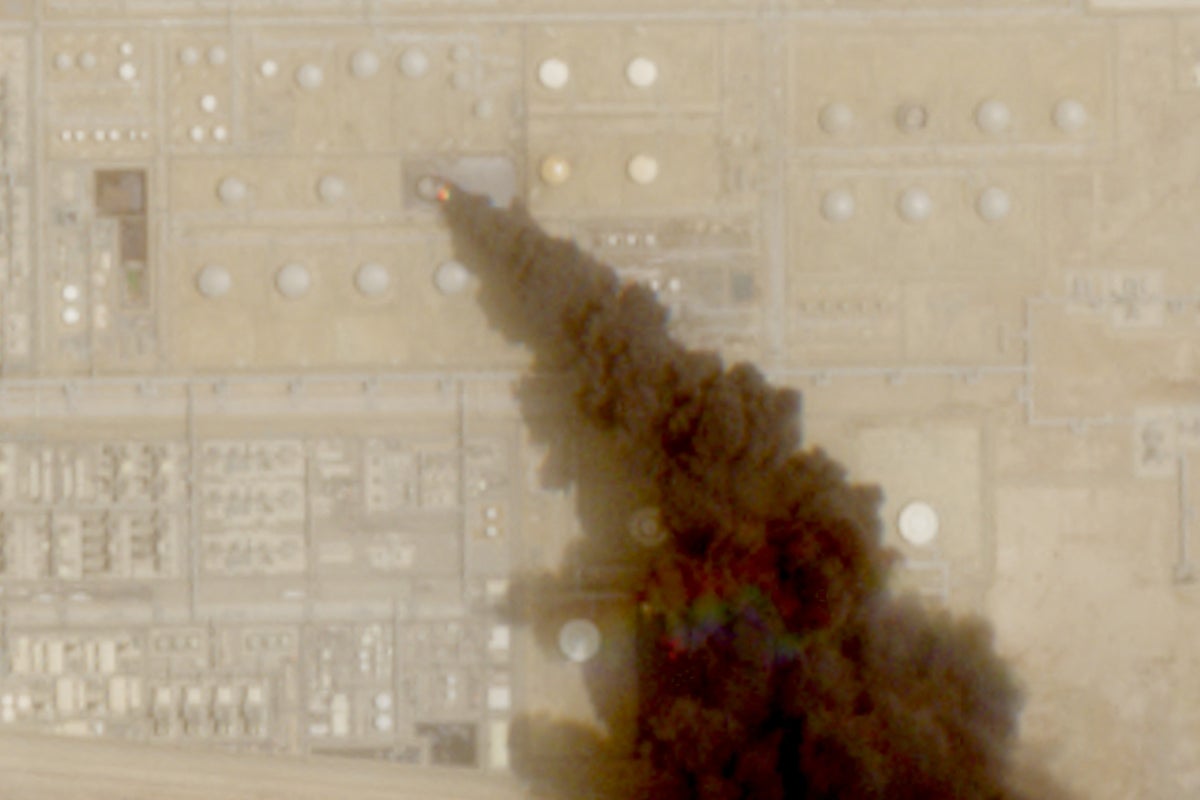
The symbolic weight of proximity to Mecca aside, the more immediately measurable damage lies elsewhere. Saudi Arabia’s critical East-West Pipeline — the artery that carries crude oil across the Arabian Peninsula and allows the kingdom to bypass the Strait of Hormuz entirely — remains shut following a separate attack. That attack has been attributed not to the Houthis but to a pro-Iranian Iraqi armed group, a distinction that underscores the increasingly networked character of Iranian proxy operations in the region. Analysts estimate the disruption could affect up to four per cent of global oil supply. That is not a marginal figure.
Washington’s Calibrated Distance
Saudi Crown Prince Mohammed bin Salman has formally requested military intervention from Donald Trump. The request has not been met. Washington has confined its assistance to intelligence sharing — a posture that reflects either strategic caution, domestic political constraints, or both. The gap between Riyadh’s expectations and Washington’s actual commitment is, by any honest reading, significant.
It is worth noting what intelligence sharing does and does not mean in this context. It means the United States is present enough to observe, but not committed enough to act. For a kingdom that has long regarded the American security umbrella as foundational to its strategic calculus, that distinction carries real weight.
The British government is now evaluating its own position. Riyadh has submitted requests to London for both diplomatic and military operational support, specifically targeting Houthi movements near the Bab el-Mandeb strait — the narrow chokepoint through which a substantial share of global trade passes. Britain’s deliberations are framed, at least publicly, around regional economic stability. The humanitarian dimensions of deeper military involvement in Yemen receive considerably less prominent framing.
The Architecture of Accountability
The Yemen conflict has produced one of the world’s most severe humanitarian catastrophes. That fact sits in uncomfortable tension with the diplomatic and military support that Western governments have extended to the Saudi-led coalition over the course of nearly a decade. Arms sales, logistical assistance, and intelligence cooperation have continued despite repeated documentation — by United Nations panels, human rights organisations, and investigative journalists — of coalition strikes on civilian infrastructure, hospitals, and markets.
International humanitarian law does not permit the targeting of civilian objects, regardless of military necessity claims. It does not permit the use of starvation as a method of warfare. These are not contested legal propositions. What remains contested, and what governments in Riyadh, Washington, and London have consistently declined to subject to independent scrutiny, is whether specific operations have violated those prohibitions.
The Houthis bear their own accountability. Their missile and drone campaigns against Saudi civilian and infrastructure targets, their conduct within Yemen itself, and their documented use of landmines and child soldiers place them in clear violation of international humanitarian law. Accountability frameworks apply to all parties. The asymmetry in international attention does not reflect an asymmetry in culpability.
Stakes at the Strait
The Bab el-Mandeb is approximately 30 kilometres wide at its narrowest point. Through it flows an estimated ten per cent of global trade. A sustained Houthi capacity to threaten shipping in that corridor — whether through direct attack, mining, or the credible threat of either — represents a structural risk to the global economy that no amount of diplomatic hedging can fully obscure.
Britain’s evaluation of operational support to Saudi Arabia in this context is therefore not simply a bilateral favour. It is a calculation about who controls one of the world’s most consequential maritime chokepoints, and under what legal and political framework that control is exercised. Those are questions that deserve more public scrutiny than they are currently receiving.
South of Mecca, a drone was intercepted. Or it wasn’t — the two sides cannot agree on what happened in that airspace. What is not in dispute is that the war is closer to Mecca than it has ever been, that the pipeline that underpins Saudi Arabia’s oil export architecture is offline, and that the governments best positioned to shape what comes next are proceeding with notable caution. The people of Yemen, who have borne the weight of this conflict in food insecurity, displacement, and death, do not have the luxury of caution.