
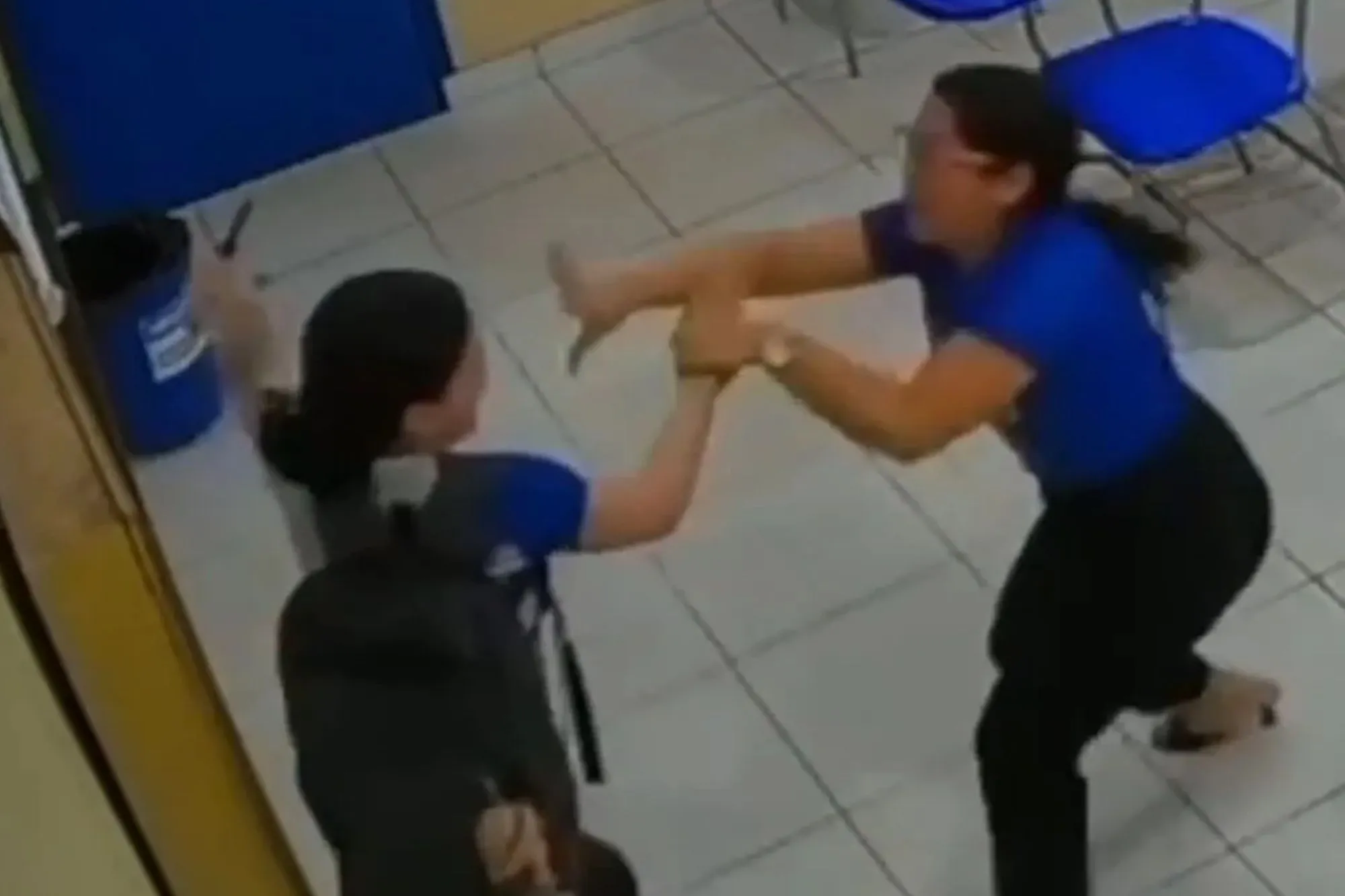
A mathematics teacher at the Santos Peres State High School in the Brazilian state of Pará was stabbed by one of her own students on September 11, in an attack recorded by classroom surveillance footage and subsequently circulated widely. The victim, identified as Betânia de Almeida, was alone in the classroom when the assault took place — a detail that speaks, in itself, to the institutional conditions surrounding the incident.
The footage shows the student, an 11th-grade girl, standing calmly before producing a hunting knife and lunging at Almeida. The teacher dodged repeated strikes, wrestled with her attacker, and narrowly avoided a second thrust directed at her face before breaking free and fleeing the room to seek help. She was transferred to Cameta Regional Hospital, received stitches, and was discharged the same day. The wound, while serious, had not penetrated any organs.
The knife was recovered from a bin inside the classroom.
The student was arrested at the scene. In a subsequent statement to Pará Civil Police, she told officers she attacked Almeida because she disliked her. Whether the attack was connected to a dispute over an exam grade — as initial reports suggested — or rooted in a more longstanding grievance remains, at this point, imprecisely established. The Civil Police report does not confirm a direct causal link to grading.
The school issued a statement through its Instagram account condemning the assault as “violence that goes beyond the limits of a disciplinary case,” and declaring that “aggression against teachers is unacceptable within the school environment.” The statement, measured in its language, nonetheless stops short of addressing the structural conditions that allowed a student to enter the classroom carrying a hunting knife undetected. Whether the student will face criminal consequences — given her minor status under Brazilian law — had not been confirmed at the time of publication.
The incident does not exist in isolation. Brazil leads the world in reported violence against educators, according to comparative global studies. Data from the country’s own Ministry of Education reinforces this: more than half of Brazilian teachers have reported experiencing aggression in professional settings. In basic education — the level at which this attack occurred — that figure reaches 61 percent. In higher education, it stands at 55 percent.
These are not incidental statistics. They describe a systemic failure of institutional protection for workers whose professional environment is, by design, one of close and sustained contact with the public. International labour standards, including those developed under the framework of the International Labour Organization, recognise safe working conditions as a fundamental right. The persistence of violence at this scale, documented by the state’s own ministry, raises questions about the adequacy of policy responses at both federal and state levels.
What happened to Betânia de Almeida in a classroom in Pará was extreme in its form. The conditions that made it possible are, by Brazil’s own accounting, ordinary.