
In a woodland clearing on the Kintyre peninsula, staff from the drug, alcohol and mental health charity With You are guiding a small group of people through the quiet of the forest. The programme is designed to help former drug and alcohol users reconnect with nature, to treat trauma through stillness and proximity to the land. It is a modest intervention, and those running it know it. The landscape that surrounds them — remote, unhurried, indifferent to crisis — stands in sharp contrast to the one they are actually navigating: a drug supply that, by the assessment of scientists, frontline workers and law enforcement alike, has never been more lethal.
Scotland already carries the distinction, grim and well-documented, of recording the highest rate of drug-related deaths in Europe. Annual figures expected to be released this week are projected to show that toll rising again. What is driving that trajectory, researchers and harm reduction specialists say, is not simply the persistence of older substances but the accelerating proliferation of new ones — synthetic opioids and cannabinoids manufactured in clandestine laboratories, engineered to circumvent legal controls, and entering the supply chain in ways that users rarely detect until it is too late.
A Supply Chain Transformed
The scale of the shift is significant. According to the European Union Drugs Agency (EUDA), a new psychoactive substance emerged on average every week in 2025. Unlike heroin or cocaine, which are derived from cultivated plants and whose production is geographically constrained, many of these compounds are synthesised chemically, requiring no particular terrain and leaving a far smaller logistical footprint. EUDA attributes part of the surge to tighter export controls imposed by China on precursor chemicals, as well as the Taliban’s ban on poppy cultivation in Afghanistan — pressures that have pushed production closer to consumer markets in Europe, including, as recent evidence makes plain, Scotland itself.
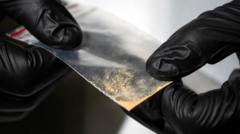
Among the substances now appearing with regularity are nitazenes and orphines — synthetic opioids some of which are hundreds of times more potent than heroin. Organised crime groups, according to Police Scotland, are increasingly adulterating existing street drugs with these compounds to extend their product and maximise profit. The practice means that users purchasing what they believe to be benzodiazepine pills, cocaine, heroin, or cannabinoids marketed as “spice” may be unknowingly consuming substances of radically different — and potentially fatal — potency. “They are profiting from people’s misery,” said Superintendent Niven Bull of Police Scotland. His language was blunt, but the underlying mechanism is straightforward: the adulteration reduces costs while maintaining volume, and the risk is borne entirely by the person at the end of the chain.
Laboratories Emerging Domestically
In July 2025, Police Scotland officers raided a suspected illicit drugs laboratory in Patna, Ayrshire, arresting three people. Deputy Chief Constable Jane Connors subsequently described it as the United Kingdom’s first suspected nitazene laboratory. That designation alone signals how rapidly the landscape is shifting. TrueFrontPress can also report that in February of this year, two men aged 43 and 56 were arrested following a search of a unit in Loanhead, Midlothian, as part of an investigation into a second suspected synthetic opioid laboratory. In total, five arrests have been made across the two operations in the past fourteen months — a figure that reflects both the expanding domestic production capacity and the limits of enforcement as a containment strategy.
The forensic challenge is considerable. Dr Lorna Nisbet of Dundee University’s Leverhulme Research Centre for Forensic Science, whose laboratory is set to take on an expanded role as Scotland’s national drug testing facility, described the pace of change as difficult to match. “These drugs are extremely dangerous,” she said, “and it’s pretty rapid for us to be able to keep up as scientists.” Her colleague Professor Niamh Nic Daeid, who directs the Leverhulme laboratory, framed the problem in terms of information: without near-real-time identification of what substances are circulating in a given community, neither harm reduction advice nor government policy can be adequately calibrated. “If we don’t know what substances are present in the samples,” she asked, “how can we provide the right advice?”
The Limits of Legal Frameworks
The legislative architecture governing drug control in Scotland adds a further layer of complexity. Responsibility for classifying and banning controlled substances rests with Westminster under the Misuse of Drugs Act 1971, while public health, policing and prosecutions are devolved to the Scottish government and its agencies. This division of competence is not inherently dysfunctional, but it creates friction in a context where new substances are being synthesised faster than existing regulatory processes can respond. EUDA has noted explicitly that novel compounds are often designed to exploit precisely this gap — remaining technically legal long enough to establish market penetration before controls are enacted. By the time a substance is scheduled, it may already have caused significant harm or been replaced by a structural variant that begins the cycle again.
In 2024, nitazenes were implicated in 76 drug-related deaths in Scotland, according to official figures — more than three times the number recorded the previous year. That rate of increase, measured against a baseline that was already alarming, suggests a problem compounding faster than current institutional responses can absorb. The Psychoactive Substances Act 2016 was intended to address the proliferation of novel compounds, but its blanket prohibition approach has not prevented the market from adapting. Manufacturers adjust molecular structures; enforcement agencies identify the new variant; the cycle continues. “New and harmful substances continue to be created to circumvent legal controls,” EUDA observed — a statement that reads less as analysis than as a description of a structural condition.
On the Front Line
Gareth Balmer, national harm reduction lead for With You, works at the intersection of this systemic failure and its human consequences. He describes the current moment in terms that are precise rather than hyperbolic. Nitazenes and related synthetic opioids are now appearing across the drug supply, he says — not confined to a single substance category but dispersed through street Valium, spice, cocaine and heroin alike. The effect is to make every transaction a potential encounter with an unknown compound at an unknown concentration. “Some of these substances are so potent that a grain would be enough to take somebody over,” he said, adding that access to naloxone — the opioid antagonist capable of reversing overdose — has become more critical than ever, even as the potency of some synthetic opioids raises questions about whether standard naloxone doses remain sufficient in all cases.
Police Scotland’s response has been framed as dual-track: sustained enforcement pressure on supply networks alongside a stated commitment to directing users toward treatment and support services. In 2025, officers seized approximately £80 million worth of street drugs; by mid-2026, seizures had already reached £78 million. Superintendent Bull acknowledged that arrests and custodial sentences, while necessary, do not on their own constitute a solution. “If we come across people who are suffering from addiction, who are in a low point in their life, then we will look to help support them,” he said. The aspiration is legitimate; the structural conditions that produce addiction — poverty, trauma, inadequate housing, hollowed-out public services — remain largely unaddressed by enforcement activity, however well-resourced.
The Human Stakes
Back in the Kintyre forest, Vicky Gamble moves through the trees with a measured calm that her history makes remarkable. Her own encounters with alcohol, drugs and the criminal justice system have taken her in and out of prison. She speaks about the future with a qualified hopefulness — qualified because she is watching younger people around her engage with substances she cannot identify and which, she suspects, they cannot identify either. “It seems that there’s a lot of stuff that all the young ones seem to be taking now,” she said, “and I don’t even think they know what it is.” That uncertainty — the user’s inability to know what they are consuming — is not incidental to the current crisis. It is its defining feature.
Gareth Balmer, standing nearby, put the matter with a directness that carries its own moral weight. With heroin, he said, harm reduction was built on a body of knowledge accumulated over decades — known potency ranges, known overdose thresholds, known reversal protocols. That knowledge is now insufficient. “It’s a terrible thing to say,” he acknowledged, “but with heroin it was better the devil you knew.” The remark is not nostalgia for a less dangerous era; it is a precise description of what has been lost: the ability to prepare, to warn, to intervene with some confidence in what one is intervening against. Scotland’s drug death crisis has always been a crisis of policy failure and social neglect. What is changing now is that the substances themselves have become an additional, accelerating variable — one that science, law enforcement and frontline services are, by their own admission, struggling to keep pace with.