
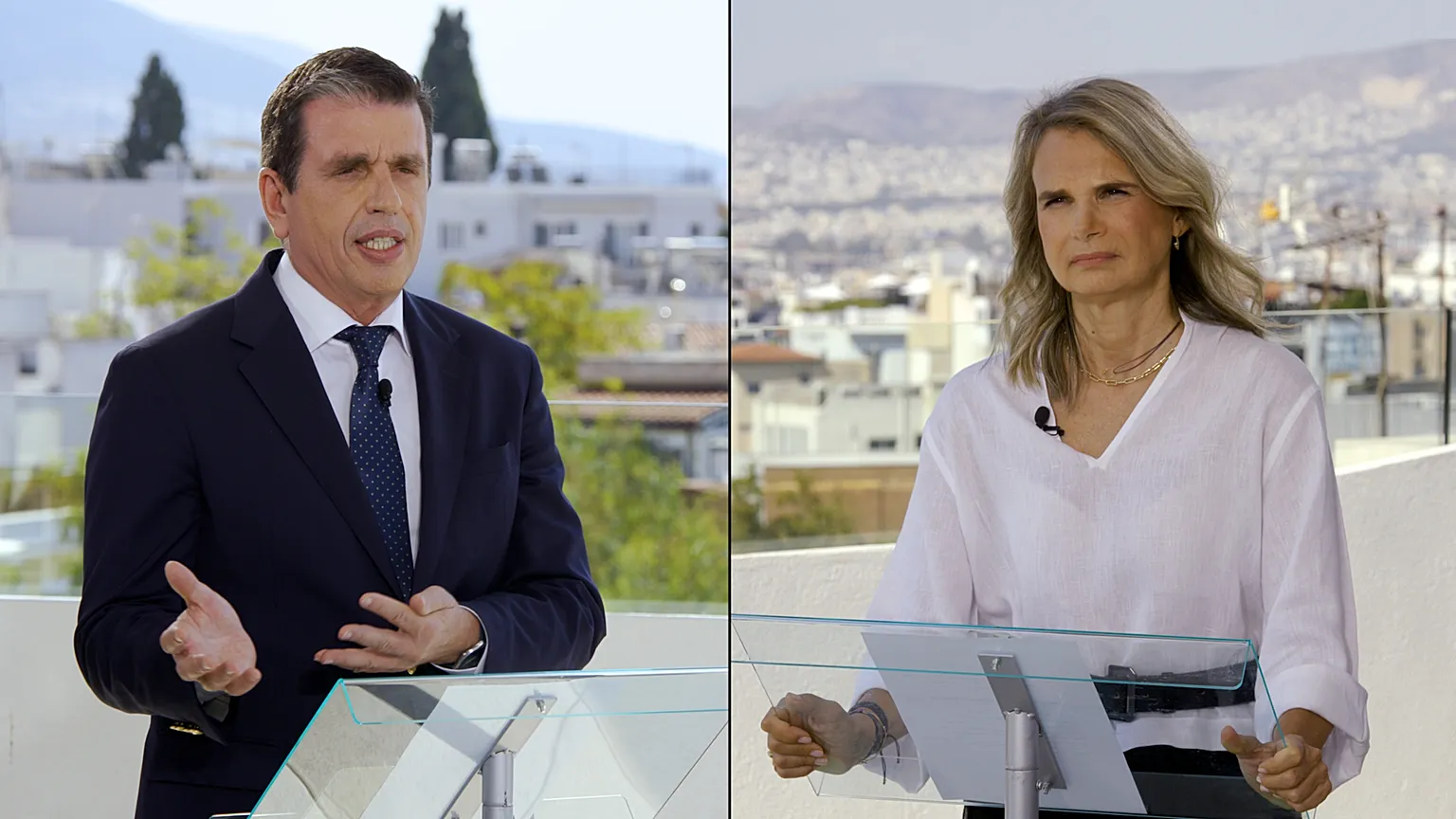
From a terrace overlooking the Acropolis, with the ancient citadel casting its long shadow over a city still scarred by a decade of austerity, two Greek parliamentarians sat down recently to argue about who, exactly, can still afford to live in Greece — and who is allowed to arrive there at all.
The setting was The Ring, a political debate programme that has moved from Brussels and Strasbourg to the heart of Athens, and the timing was deliberate. Events in Ceuta last July — where thousands of people attempted to cross into Spanish territory in a single mass movement — had reignited a debate across the European Union that Greece knows with particular intimacy. For many in Athens, the scenes recalled the summer of 2015, when hundreds of boats carrying refugees and migrants reached Lesvos and the Aegean islands every single day. They also brought back the confrontations at the Evros river in 2020, when thousands attempted to cross overland from Turkey into Greece amid acute political tension between Ankara and Athens.
Migration, in other words, was back at the top of the agenda. It had never really left.
Representing the conservative ruling party New Democracy, MP Dimitris Kairidis framed the issue through the lens of public security, arguing that citizens need to feel safe and that Greece must chart a course distinct from what he described as the extremes visible on the other side of the Atlantic. His interlocutor, Milena Apostolaki of PASOK — the centre-left main opposition party — pushed back sharply, contending that the Ceuta events had been instrumentalised as a propaganda tool, deployed specifically to destabilise Spanish Prime Minister Pedro Sánchez rather than to address any genuine policy failure.
The exchange illuminated a tension that runs through European politics more broadly: the gap between security-centred narratives and those that insist on examining the structural conditions that produce displacement in the first place. Greece, positioned at the external border of the European Union, has long been asked to absorb pressures generated elsewhere while receiving inadequate support from its partners — a point neither politician disputed, even as they differed sharply on remedies.
The housing crisis sharpened the debate considerably. Apostolaki cited Eurostat data placing Greece second in the European Union for poverty and social exclusion, behind only Bulgaria — a ranking that raises uncomfortable questions about the capacity of the Greek state to integrate new arrivals when its own citizens are being priced out of urban centres. Athens, like Lisbon and Barcelona, has seen rental markets transformed by short-term tourism platforms and speculative investment, compressing affordable housing supply at precisely the moment when demand from both domestic workers and arriving migrants is most acute.
Kairidis acknowledged that Greece had fallen behind, attributing the lag to the prolonged economic crisis that preceded his party’s return to power in 2019, while arguing that significant progress had since been made. The claim is contested. Eurostat’s figures are not historical artefacts; they reflect present conditions, and the gap between official optimism and lived precarity in Greek cities remains wide.
On Ukraine, the two MPs found unusual common ground. Both expressed the view that Europe must engage in direct dialogue with Vladimir Putin if there is to be any realistic path toward ending the war — a position that departs from the dominant posture of several larger EU member states, though one with growing resonance in southern and eastern Europe, where the economic costs of the conflict and its sanctions architecture have been felt most acutely.
The question of Benjamin Netanyahu and the International Criminal Court arrest warrant issued against him produced the debate’s most legally and diplomatically charged exchange. Both Kairidis and Apostolaki stated that Greece would be obligated to execute the warrant should Netanyahu visit Greek territory — a position that aligns with Greece’s treaty commitments as a Rome Statute signatory, though one that several EU governments have been reluctant to reaffirm publicly. The clarity of their shared answer was notable precisely because of how many European officials have chosen ambiguity.
What the Athens edition of The Ring captured, beneath the procedural back-and-forth of parliamentary debate, was the particular weight that these questions carry in a country that has served as a pressure valve for European migration policy, endured one of the most severe austerity programmes in modern democratic history, and now watches its capital become increasingly unaffordable for the people who built it. The Acropolis remains. The question of who gets to live in its shadow grows harder to answer.
This episode of The Ring was hosted by Apostolos Staikos, produced by Luis Albertos Altarejos and Amaia Echevarria, and edited and directed by Vassilis Glynos.