
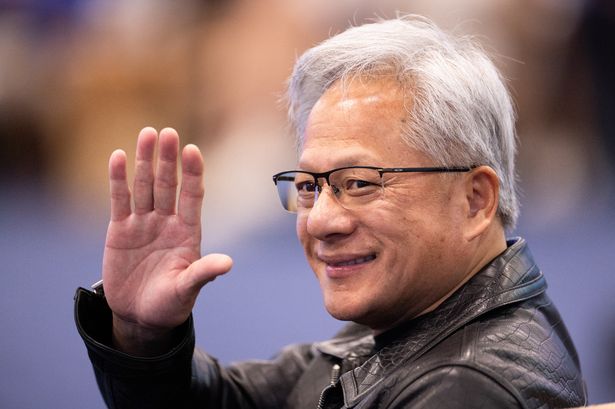
In 1993, Jensen Huang co-founded Nvidia in a small office in Sunnyvale, California, with the ambition of building graphics processing units for the gaming market. Three decades later, that company controls between 80 and 90 percent of the global market for high-end AI accelerator chips, carries a reported valuation of $5.5 trillion, and sits at the structural centre of the artificial intelligence industry. Huang himself has accumulated a personal fortune estimated at between $180 and $190 billion, placing him among the ten wealthiest individuals on Earth. It is from that position — as perhaps the single most financially invested figure in the AI expansion — that he has now moved to publicly discredit the researchers warning that the technology poses existential risks to humanity.
In an interview broadcast by CBS News, Huang addressed predictions made by prominent AI safety researchers, including Evan Hubinger of Anthropic, who has stated publicly that he assigns a greater than ten percent probability to AI causing human extinction within the next decade. Jacob Coxon, a former Anthropic employee, has similarly warned that many developers within the industry privately believe advanced AI systems could become “superhuman” and, in his words, “kill us all by the end of the decade.” Huang’s response was categorical: “2030 is not going to be the end of the world. There is a 0% chance that’s going to be the end of the world.” He further dismissed Hubinger’s probabilistic assessment as “not grounded in science or research.”
What followed, however, moved beyond a technical disagreement about risk modelling and into explicitly political territory. Huang argued that the doomsday narrative served a specific, self-interested function — not to generate stricter oversight, but to erode existing legal frameworks. “Don’t let this doomsday narrative cause somebody to relieve them of the laws that currently exist,” he said. “They’re actually not asking for more laws. They’re asking to be relieved of the laws we do have.” The claim inverts the more widely documented concern among civil society organisations and legal scholars, which is that regulatory frameworks have consistently lagged behind the pace of AI deployment, not preceded it. Huang’s framing — that safety researchers are regulatory saboteurs in disguise — carries no supporting evidence and was not interrogated during the interview.
Huang also raised the sociological consequences of what he characterised as unnecessary fear-mongering, arguing that catastrophist predictions could discourage young people from pursuing higher education on the grounds that employment would cease to exist. The concern is not entirely without basis — anxiety about AI-driven labour displacement is measurable and widespread — but it sits uneasily coming from the executive whose company profits directly from every marginal expansion of AI deployment. Nvidia supplies the processing infrastructure upon which the entire modern AI stack depends: while companies such as OpenAI, Microsoft and Google construct the software models, they depend on Nvidia’s GPU hardware to train and run them. Every new AI application, every scaled-up model, every expanded data centre represents, in concrete financial terms, additional revenue for Huang’s company.
Born in Taiwan and trained as an electrical engineer at Oregon State University and Stanford, Huang has led Nvidia for more than thirty years through successive technological cycles, steering it from gaming hardware into the dominant position it now occupies in machine learning infrastructure. His authority within the industry is substantial and largely uncontested in mainstream technology coverage. That authority, however, does not resolve the structural tension at the heart of his public intervention: the world’s most financially exposed beneficiary of AI expansion has declared, with a precision of zero percent, that the technology poses no terminal risk — and has suggested that those who disagree are engaged in a form of regulatory manipulation. The assertion may prove correct. It may also prove to be precisely the kind of interested dismissal that accountability journalism exists to document.