
The price of oil does not lie about the state of a war.
Brent crude surged more than three percent on Thursday after Yemen’s Houthi movement claimed missile and drone strikes on Saudi Arabia’s state energy giant Aramco and a “sensitive target” in Riyadh, briefly pushing the global benchmark above $108 a barrel before it settled at $106.50 by end of day. By Friday morning in Asia, prices had eased only marginally, standing at $105.77 a barrel as of 02:00 GMT — a level that analysts say reflects something more durable than panic buying.
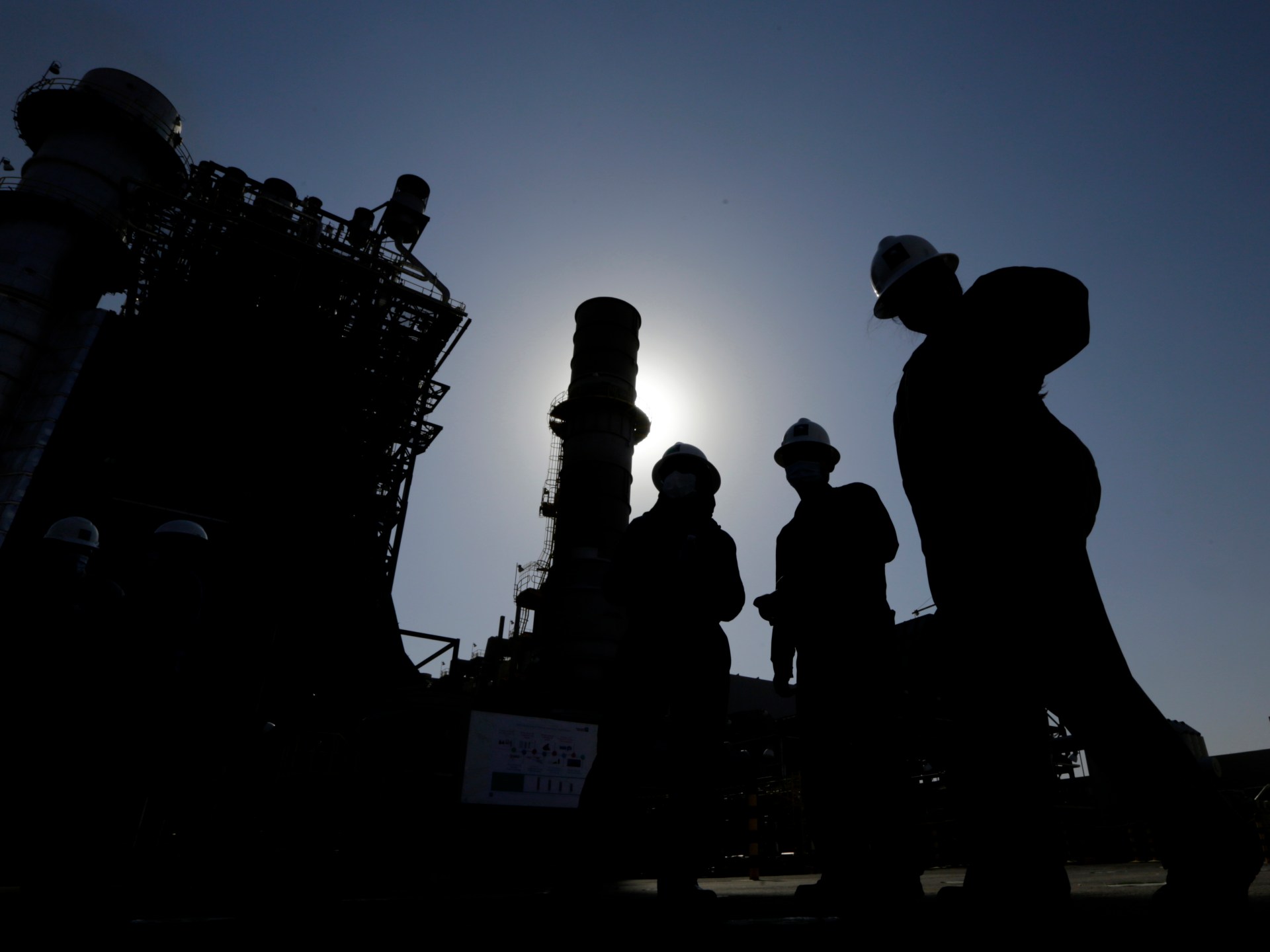
The central reality this episode lays bare is one that markets, diplomatic communiqués, and official statements have each, in their own way, struggled to acknowledge plainly: the infrastructure underpinning roughly ten percent of global oil supply remains exposed to a conflict that shows no credible path toward resolution. Aramco, which accounts for that share of world demand, did not respond to inquiries outside regular business hours. Saudi authorities have not confirmed whether Thursday’s strikes caused damage or casualties. The Saudi-led coalition stated that six ballistic missiles were intercepted, but the Houthi-run Yemen News Agency carried a statement from the group asserting that both operations “achieved their objectives successfully.” The gap between those two accounts is, in itself, a form of information.
The strikes do not occur in a vacuum. They are the latest escalation in a conflict whose regional architecture has grown considerably more complex since the United States and Israel launched military operations against Iran. The Houthis, aligned with Tehran, have repeatedly demonstrated both the will and the technical capacity to strike deep into Saudi territory and to threaten Red Sea shipping lanes — a fact that energy markets have now priced in with some consistency. Tim Waterer, chief market analyst at KCM Trade in Sydney, told Al Jazeera that current price levels “reflect the reality that critical supply routes and facilities are still vulnerable,” and that the post-war trend, whatever diplomatic activity surrounds it, has not produced a structural de-escalation.
That diplomatic activity is not trivial, but its limits are becoming clearer. On the sidelines of the UN General Assembly in New York, the United States and Iran have resumed talks aimed at reviving a Memorandum of Understanding on ending the war — a framework that lapsed in mid-August without a peace deal. Iranian President Masoud Pezeshkian expressed hope on Thursday that Washington would re-engage before the November midterm elections. Whether that timeline is realistic, or whether it serves primarily as a political signal to domestic audiences on both sides, remains genuinely uncertain. Waterer noted that diplomatic efforts are “providing some counterweight, but until there is clearer evidence of a durable de-escalation, the upside bias remains in place.”
A Widening Supply Gap
The structural dimension of this crisis is arguably more consequential than any single strike. June Goh, a senior oil market analyst at Sparta Commodities in Singapore, told Al Jazeera that oil would likely remain above $100 a barrel for as long as the war on Iran continued, adding that “the gap in oil inventories globally is getting wider.” That gap is not merely a function of Houthi military activity; it reflects the cumulative effect of sanctions, redirected shipping, reduced investment in production capacity, and the broader uncertainty premium that attaches to a region where state and non-state actors are simultaneously prosecuting overlapping conflicts.
What Thursday’s events demonstrate is that the vulnerability of critical energy infrastructure is not a residual risk to be managed at the margins — it is a structural feature of the current order, one that powerful states have so far proven unwilling or unable to address through either military or diplomatic means. The cost of that failure is being distributed globally, absorbed most acutely by economies least responsible for producing the conditions that generated it.