
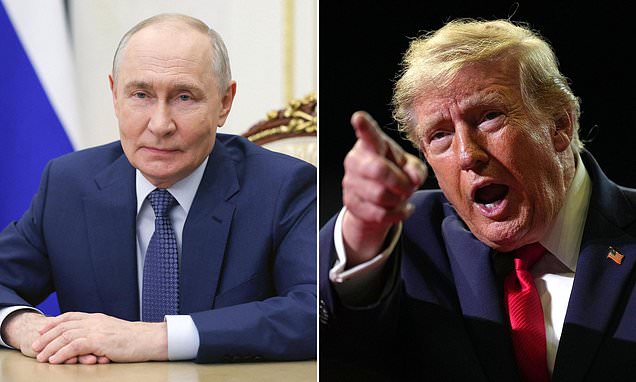
President Donald Trump has publicly denied that Russia and China are providing meaningful assistance to Iran in its ongoing conflict with the United States, characterising those who believe otherwise as “Radical Left Morons and Lunatics” — a rhetorical dismissal that sits in direct and documented contradiction with assessments from his own administration, open-source intelligence, and statements made by Vladimir Putin himself. The pattern that emerges from the available evidence is not one of uncertainty, but of a president systematically insulating two strategic partners from accountability while his own government quietly acknowledges the very conduct he denies.
In a late Monday post on Truth Social, Trump wrote that China and Russia had “too much to lose” to enable Iran, adding that any assistance, if it existed at all, was occurring “at a very low level.” He offered no evidentiary basis for either claim and provided no explanation of what specific interests Russia or China would forfeit by continuing to supply Tehran. The statement contained no threat of retaliation and no acknowledgment of the classified intelligence his own officials have cited in congressional testimony. Its primary function, stripped of rhetorical packaging, was to publicly absolve two governments whose conduct his own Pentagon has formally flagged.
The factual record assembled by American officials and independent media organisations tells a markedly different story. The Washington Post reported in March that Moscow had supplied Tehran with sensitive intelligence on American warships and aircraft, enabling Iranian forces to target them with greater precision — a form of operational military support with direct consequences for U.S. personnel. Putin himself told Iranian President Masoud Pezeshkian in September that he had been “trying to give you the help you need in this difficult period” by “supplying you with the goods you need,” a statement whose deliberate vagueness did nothing to obscure its meaning. That Putin made this remark publicly, without apparent concern for American reaction, suggests a calculated confidence that Washington would not respond in any meaningful way.
The Chinese dimension is, if anything, more extensively documented. Iranian customs data reviewed by the Wall Street Journal revealed approximately 1,300 shipments of potential military-use goods from Chinese suppliers during the first six months of this year alone. American officials have additionally linked satellite imagery sourced from Chinese commercial entities to an Iranian strike that killed three U.S. troops. Treasury Department sanctions have targeted procurement networks operating across China and Hong Kong. These are not allegations from political opponents; they are findings generated within Trump’s own executive branch. Yet the day after the Wall Street Journal published its investigation into the scale of Chinese support, Trump welcomed Xi Jinping to the White House and boasted publicly of their “truly great friendship.”
The internal contradiction reached its clearest expression in July, when Defence Secretary Pete Hegseth told the Senate that both Russia and China were enabling Iran’s war effort “at different levels,” declining to elaborate further only because the full extent of their involvement remained classified. That testimony was delivered under oath, to the legislative branch, by a cabinet official appointed by Trump. It directly contradicts the president’s public characterisation of the same conduct as either non-existent or negligible. Trump has separately claimed to have received personal assurances from both Xi Jinping and Putin that neither they nor their countries’ companies would supply weapons to Iran — assurances that, on the available evidence, were either false when given or have since been disregarded without consequence.
This episode cannot be understood in isolation. Trump is simultaneously managing a diesel fuel agreement with Russia that has drawn bipartisan condemnation for bolstering Moscow’s war capacity against Ukraine and potentially violating existing American law. The structural logic is consistent across both theatres: economic and diplomatic relationships with Russia and China are treated as assets to be preserved, while the conduct of those governments — whether in Iran or Ukraine — is minimised, denied, or deflected. What is at stake is not merely a question of accurate intelligence assessment. It is a question of whether the United States government is capable of enforcing accountability against actors whose cooperation the president has decided to prioritise, and whether the institutional mechanisms that exist to compel that accountability — congressional testimony, sanctions architecture, independent reporting — retain any operative force when the executive declines to act on what they reveal.