
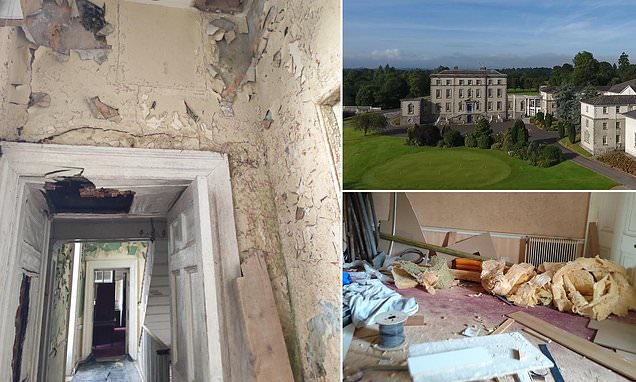
A Historic Estate at the Centre of a Procurement Scandal
Dundrum House Hotel, a 300-year-old protected mansion in County Tipperary, has become the focal point of a serious accountability dispute involving tens of millions of euros in Irish state funding, a company incorporated in Spain with a declared capital of €120, and the systematic neglect of a heritage property now documented in photographs showing extensive interior dilapidation. The controversy raises pressing questions about procurement oversight, heritage enforcement, and the Irish government’s management of International Protection accommodation contracts — questions that local residents and heritage advocates have been asking for months, and that state institutions are only now beginning to answer.
The Contract and the Company
The contract at the centre of the dispute was awarded to Utmasta, a company engaged to lease Dundrum House Hotel for use as an IPAS — International Protection Accommodation Services — centre. The contract was estimated to be worth between €16 million and €20 million in state funding. What drew immediate scrutiny was not the scale of the contract alone, but the nature of its recipient: Utmasta did not exist before 9 January 2025. The company was incorporated in Spain just months before the contract was signed, listing a single director, Ms Ana Maria Fernandez Sanchez, and declaring a capital of €120. No prior record of hotel management or direct provision experience has been identified for the company or its director.
Local councillor Liam Browne articulated the concern with precision: the Irish government had committed tens of millions of euros to a three-month-old company, valued at €120, with no demonstrable track record in accommodation services of any kind. The procurement process that permitted this outcome has not, to date, been publicly accounted for by the relevant government departments. That gap in accountability — between the awarding of a lucrative public contract and any meaningful due diligence on the recipient — sits at the core of what residents and heritage advocates are now demanding be addressed.
Enforcement Action and Planning Refusals
Tipperary County Council moved to assert regulatory authority over the situation through an enforcement order issued under Section 154 of the Planning and Development Act 2000. The notice was served on Brogan Capital Ventures Ltd, currently in liquidation, and its joint liquidators. The order identified three categories of unauthorised development: the use of The Holm Block, The Square Block, The Coach House, and the Old Wing/C Block as accommodation for International Protection applicants — a change of use that was never granted planning permission and therefore constitutes a material breach of planning law.
The council set a compliance deadline of 5pm on 29 January 2027, by which point operators must cease using the affected parts of the facility as IPAS accommodation. Non-compliance carries severe potential penalties: up to two years’ imprisonment and a fine of up to €12.7 million. Separately, the council’s planning office refused to accept a retention application from Utmasta relating to a replacement wastewater treatment system, citing the requirement for an Appropriate Assessment given the site’s proximity to the Lower River Suir Special Area of Conservation. The refusal is legally significant: it forecloses a common regulatory workaround by which unauthorised developments are retrospectively legitimised through retention applications.
Key Findings in Summary
The following points capture the documented facts at the heart of this case, each bearing directly on the accountability questions it raises.
The Dundrum Heritage Group has welcomed the enforcement decisions while making clear that legal victories in individual cases are insufficient protection for a property of this age and significance. Formal heritage designation and consistent enforcement, the group argues, represent the only durable safeguard against future misuse — a position that implicitly indicts the regulatory framework that allowed this situation to develop in the first place.
What Remains Unresolved
The contract will expire in spring 2027, and the IPAS centre will close. But several questions of accountability remain open. The procurement process that awarded a multi-million-euro contract to a newly incorporated, minimally capitalised company has not been subjected to any public inquiry. The condition of a protected heritage property, whose operators received over €20 million in state funds, has visibly deteriorated. And the 160-plus asylum seekers currently housed at Dundrum House face an uncertain transition as the contract winds down — a human dimension of the case that tends to be crowded out by the property and procurement controversies, but which carries its own weight under Ireland’s international protection obligations.
The Dundrum case illustrates a recurring pattern in the administration of IPAS contracts: rapid procurement under pressure, inadequate vetting of operators, and the displacement of accountability onto local authorities and civil society groups who lack the statutory tools to intervene early. Heritage designation may protect the building. It will not, by itself, repair the oversight failures that put it at risk.