
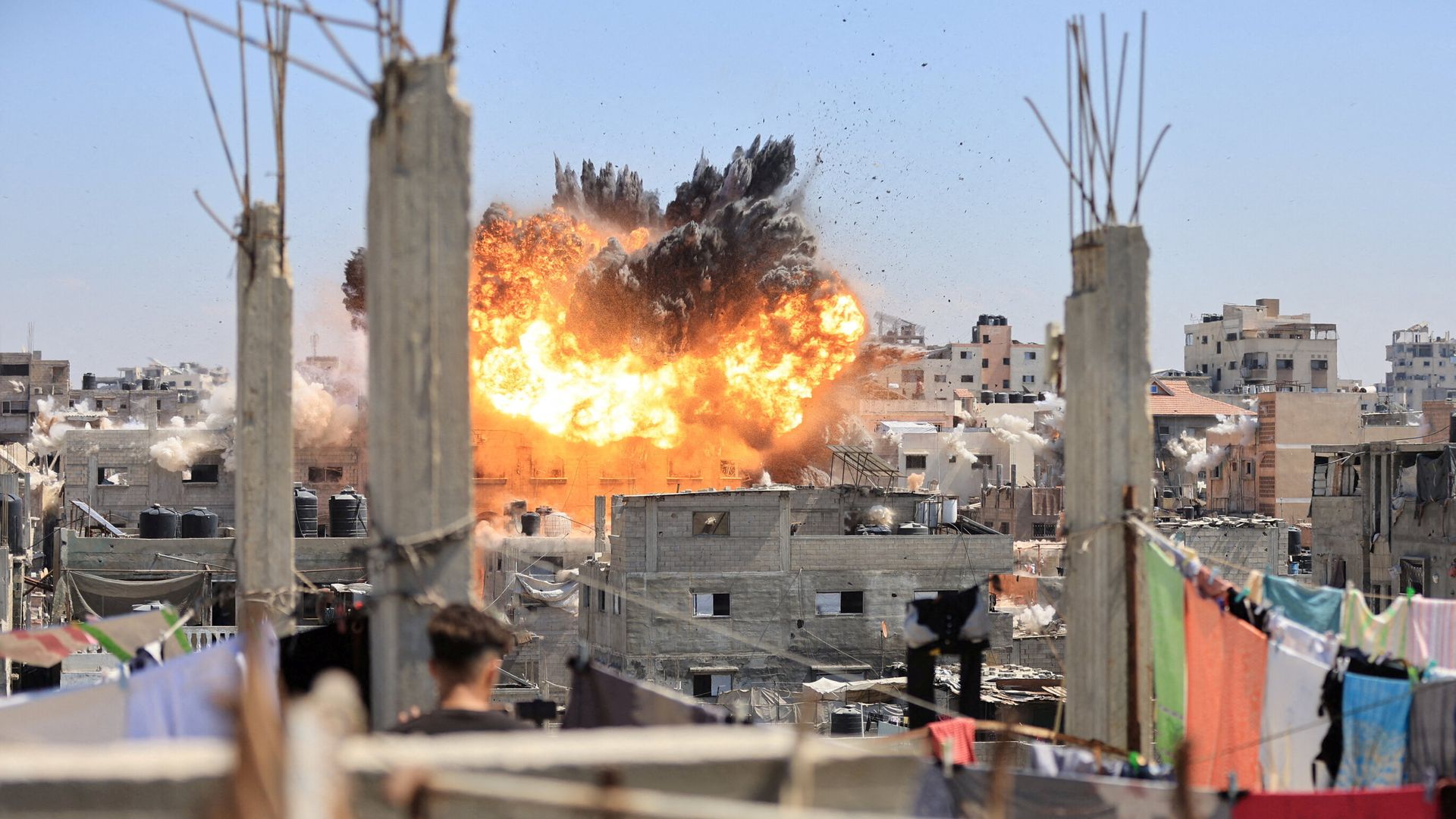
A demarcation line drawn on a map, presented as a temporary boundary, has been quietly hardening into something more permanent. That line, known as the “Yellow Line,” now cuts across Gaza, separating an eastern zone under Israeli military control from a western strip where the Palestinian population is confined. According to a report published Monday by the UN Independent International Commission of Inquiry on the Occupied Palestinian Territory, including East Jerusalem, and Israel, that boundary has been advancing — and people have been dying along it.
The commission’s report, which examined violations against Palestinian children from the outbreak of hostilities on October 7, 2023 through September of this year, concluded that Israeli authorities continued to commit genocidal acts with the genocidal intent to destroy, in whole or in part, the Palestinians in Gaza — including during and after the ceasefire brokered by the United States last October. The finding represents one of the most direct and formally documented accusations of its kind from a UN body, building on a September 2024 commission report that reached similar conclusions and implicated senior Israeli officials, including Prime Minister Benjamin Netanyahu, in inciting such acts.
A Ceasefire That Did Not Stop the Killing
Since the ceasefire was signed in October 2025, Israeli forces have extended their territorial foothold in Gaza from 53 percent to at least 60 percent of the enclave, the commission found. During that same period, Israeli fire across the advancing front killed at least 196 Palestinians, among them 18 women, 32 boys, and 11 girls. The commission documented the continued use of heavy munitions, drones, quadcopters, artillery, and sniper fire in densely populated areas — weapons and tactics that, in the context of a ceasefire, carry particular legal weight under international humanitarian law.
The Yellow Line, the commission stated, “reflects Israel’s expanding territorial control of Gaza.” What was framed as a provisional military measure is functioning, in practice, as a de facto border. Palestinians who approach or cross it have been killed or wounded. The language of the report is deliberate: it does not describe these deaths as incidental or as the fog of war. It describes them as the predictable and documented outcome of a policy.
The West Bank: Crimes Against Humanity and the Largest Displacement Since 1967
The situation in the occupied West Bank has deteriorated in parallel. The commission accused Israel of committing crimes against humanity there, specifically extermination, persecution, torture, and rape. Military operations launched since January 2025 have produced what the report describes as the largest displacement of Palestinians in the West Bank since 1967, with 34,176 people still displaced as of August. That figure places the current moment within a longer historical arc that the commission traced explicitly.
The report reached back to the 1947–48 war to identify what it called the root causes of the conflict, concluding that Israel has pursued territorial expansion and the displacement of Palestinians through violence across more than seven decades. This framing is analytically significant: it situates current events not as aberrations or security responses, but as the continuation of a structural project. The commission’s mandate requires it to examine patterns, not merely incidents, and its conclusions reflect that methodological commitment.
Israel’s Rejection and the Question of Accountability
Israel dismissed the report in categorical terms. Ambassador Daniel Meron stated that the commission’s work sought “to undermine Israel’s legitimacy and deny its fundamental right to exist and defend itself,” characterising the findings as part of a “misinformation campaign.” The Israeli government has consistently rejected the commission’s mandate and refused to cooperate with its investigations, a posture it has maintained since the body was established.
The commission’s findings are not merely declarative. They are designed to function as evidentiary material. The documentation it compiles — allegations, evidence chains, named patterns of conduct — is intended to support accountability proceedings at the International Criminal Court or in other jurisdictions with the legal standing to prosecute crimes of this gravity. The ICC prosecutor issued arrest warrants for Netanyahu and former Defence Minister Yoav Gallant in November 2024, charges that Israel also rejected. The commission’s latest report adds another layer of documented evidence to a growing international legal record.
What the Yellow Line represents, in the commission’s account, is not a security measure awaiting resolution. It is a territorial instrument, enforced by lethal means, shifting facts on the ground while diplomatic language holds the architecture of a ceasefire nominally in place. The children killed near that line, the families displaced from the West Bank, the 34,000 still without homes — they are not the backdrop to this story. They are its substance.