
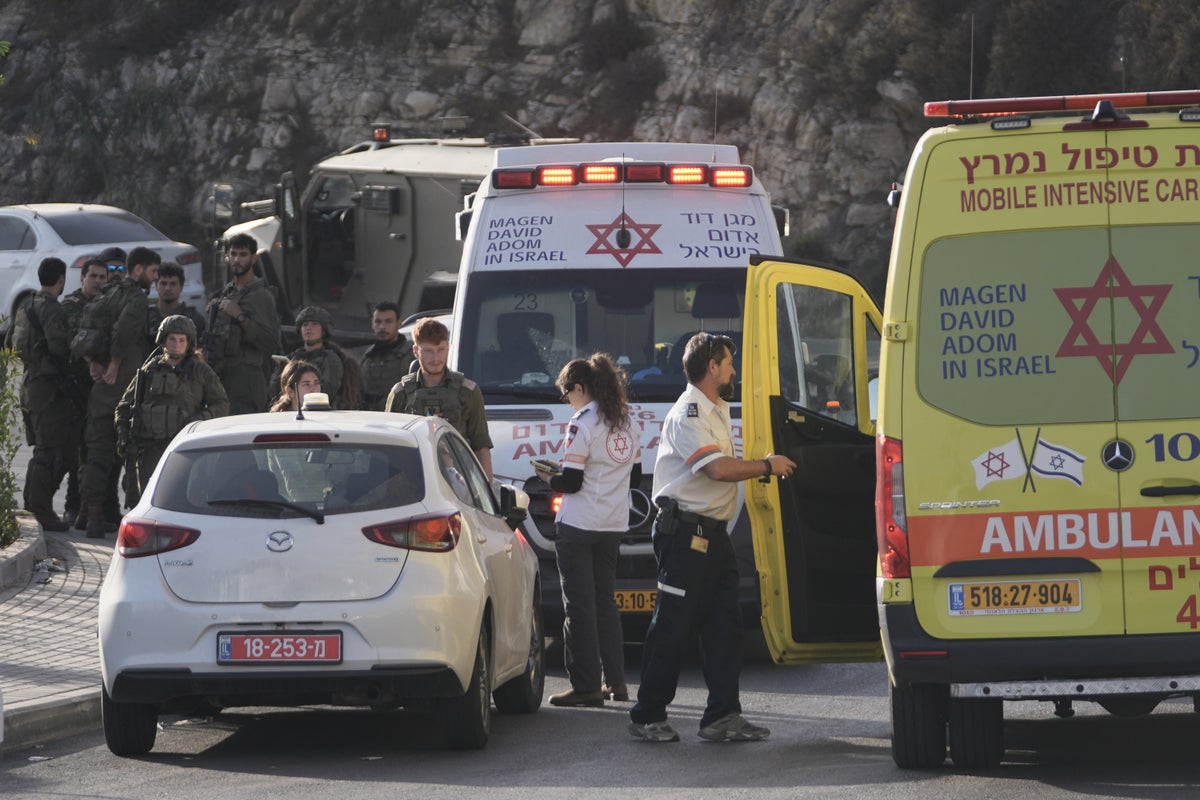
Two Israeli soldiers died at a military checkpoint near Hebron on Friday morning, and within hours the machinery of collective punishment was already at work.
The Israeli army identified the soldiers as Staff Sergeant Ron Yonatan Roytman, 23, and Sergeant Yuval Shai Svilem, 20, killed during an exchange of fire with two Palestinian gunmen at the Yehuda Junction outside Hebron in the occupied West Bank. Three other soldiers sustained light wounds. The army said the gunmen, both Palestinians from Hebron, were armed with an M16 rifle and a handgun, and were killed by Israeli troops after approximately twenty minutes of fire. Military officials stated that a large quantity of ammunition was recovered from the attackers’ vehicle, which they described as intended for a larger-scale operation.
Prime Minister Benjamin Netanyahu visited the site the same day and announced what he described as a sweeping anti-terror operation. “We will act to destroy this place, to change it completely,” he said. “We will evacuate the residents, we will go house by house, we will also remove the weapons there, and all the terror infrastructure will be dealt with and destroyed.” Netanyahu’s office had already instructed security forces to cordon off Hebron and to prepare for a full closure of the West Bank beginning Friday.
A Reuters correspondent documented Israeli bulldozers demolishing homes in Hebron near the site of the shooting. Residents of the affected neighbourhood told journalists that the demolished homes had no connection to the attackers. The distinction, under international humanitarian law, is not incidental — the demolition of civilian property as a punitive measure is prohibited under the Fourth Geneva Convention, a framework Israel has long disputed in its application to the occupied territories.
Netanyahu convened an emergency Security Cabinet session later on Friday, blaming Hamas for the attack. The army said that in operations conducted across the West Bank following the shooting, Israeli forces apprehended dozens of individuals, including those affiliated with Hamas and Islamic Jihad, and seized weapons including M16 rifles and submachine guns. Army Chief of Staff Eyal Zamir confirmed the ammunition discovery and characterised the thwarted attack as potentially far more lethal in scale.
The political response from Netanyahu’s far-right coalition partners moved quickly into territory that went considerably further than immediate security measures. Finance Minister Bezalel Smotrich called for the military to “dismantle the Palestinian Authority, collect the weapons, and eliminate the terrorists, exactly as we did in Gaza and Lebanon.” National Security Minister Itamar Ben-Gvir, whose extremist positions have drawn repeated international condemnation, argued the attack demonstrated the need to restrict Palestinian freedom of movement across the West Bank. Neither minister offered evidence of any Palestinian Authority involvement in the attack, and none has emerged.
The broader context of restriction is significant. Friday’s closure was the fourth time in a single month that Israel had imposed movement restrictions across the West Bank, shutting gates and checkpoints connecting Palestinian villages to major roads. The closures apply to Palestinian residents; Israeli settlers and other Israeli drivers retain access to the same roads, though with potential delays. This differential application of movement controls sits at the centre of a growing international debate about the legal and political character of Israeli governance in the territory.
U.S. Democratic congressional candidate Brad Lander, who was present in the West Bank on Friday, described the closure as part of a systematic effort. “It’s part of the effort to take more control, to make Palestinian life impossible,” he said. Lander had himself been detained by Israeli forces two days earlier. Yishai Fleisher, spokesperson for Hebron’s Jewish settler community and a candidate for the far-right Otzma Yehudit party, offered a contrary framing, asserting Israel’s right to defend itself from what he called a “hostile majority.”
The attack and its aftermath arrive five days before Israeli voters head to the polls. Netanyahu faces yet another election — the latest in a prolonged political crisis — three years after the Hamas-led attacks of October 2023 that triggered the war in Gaza. His government has publicly warned of potential attacks by unnamed “enemies” in the lead-up to the vote. The convergence of a security incident, punitive demolitions, maximalist rhetoric from coalition partners, and an imminent election does not, by itself, establish deliberate political calculation. It does, however, demand that it be named as a possibility and examined with the seriousness it warrants.
What is not in dispute is the material reality on the ground: two soldiers are dead, Palestinian homes are rubble, and the occupied West Bank is, once again, under tightened lock.