
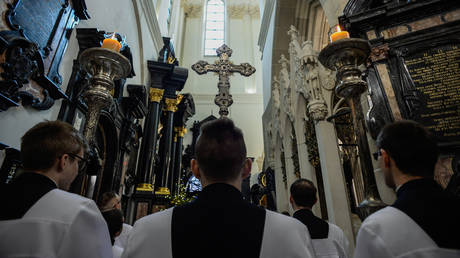
A Historic Verdict in Tarnów
A Polish district court convicted Catholic Bishop Andrzej Jeż on Thursday of deliberately failing to report two priests accused of sexually abusing children, in what the court itself described as an “unprecedented” ruling against a senior member of the Polish Catholic hierarchy. The District Court in Tarnów found that Jeż, as bishop of that diocese, had knowingly withheld information from law enforcement about abuse committed by priests under his authority — making him the highest-ranking Catholic official in Poland to be convicted of such an offense.
The verdict lands at a moment of sustained global scrutiny of the Catholic Church’s institutional response to clerical sexual abuse, and it marks a significant assertion by a national judiciary that ecclesiastical authority does not supersede the obligations of criminal law.
What the Court Found
Jeż pleaded not guilty, contending that he had first referred the cases to the Vatican before notifying Polish civil authorities, and that this sequence was consistent with proper procedure. He also invoked the papal secret, a confidentiality framework governing sensitive internal Church matters, as a legal shield. The presiding judge rejected both lines of defense in unambiguous terms, ruling that Church regulations carry no force capable of overriding Polish statutory law. Investigating allegations of child sexual abuse, she held, is the exclusive responsibility of law enforcement authorities — not of religious institutions conducting their own parallel proceedings.
The logic of the ruling is significant. It forecloses a defense that Church officials in multiple jurisdictions have historically relied upon: the claim that internal canonical processes constitute a legitimate — or even prior — mechanism for handling abuse allegations.
Sentence and Its Limits
Jeż avoided imprisonment. Under Polish law, failure to report certain child sexual abuse offenses carries a maximum custodial sentence of three years; the court instead imposed a two-year restriction of liberty, requiring monthly deductions of 25 percent of the bishop’s salary directed to a foundation supporting survivors of abuse. He was additionally fined the equivalent of approximately $5,000 and ordered to cover court costs.
The ruling is not final and may be appealed.
The sentence’s relative leniency will invite scrutiny. Critics of institutional impunity within the Church will note the distance between the gravity of the underlying conduct — the systematic concealment of child sexual abuse — and the financial penalties ultimately imposed on a senior cleric.
A Pattern Across Borders
The Tarnów conviction is one data point within a pattern of accountability proceedings that have, over recent years, begun reaching senior Church figures in multiple countries, though the pace and depth of that accountability remains uneven.
Earlier this month, former Australian Catholic Bishop Christopher Saunders was sentenced to six and a half years in prison for sexually abusing two young Indigenous men. A leaked internal Church investigation suggested that the scope of his misconduct may have been considerably wider than the charges for which he was ultimately tried — a disclosure that itself raises questions about what institutional knowledge existed, and when.
In Spain, an investigation published in April by El País identified more than 3,000 people sexually abused within the Catholic Church since the 1940s. The newspaper reported that Church authorities responded with what it characterized as “opacity and denial,” and that some accused priests were transferred to other parishes or dispatched abroad rather than reported to civil authorities — a pattern of concealment that mirrors the conduct for which Jeż has now been convicted in Poland.
In the United States, the Catholic Archdiocese of San Francisco agreed earlier this year to pay $395 million to settle more than 500 child sexual abuse lawsuits, the latest in a long series of costly settlements and bankruptcy filings by dioceses and archdioceses across the country. The financial scale of that settlement reflects both the breadth of documented abuse and the sustained legal pressure that survivors and their advocates have brought to bear over decades.
The Institutional Question
What the Polish ruling affirms, with unusual directness, is that the Church’s internal governance structures cannot function as a substitute for state accountability mechanisms when criminal conduct is at issue. That principle may appear self-evident. The fact that its judicial articulation is described as “unprecedented” in Poland — a country where the Catholic Church retains substantial social and political influence — reveals how rarely it has been applied in practice.
Whether the verdict survives appeal, and whether it influences how Polish prosecutors and courts approach future cases involving ecclesiastical concealment, remains to be seen.