
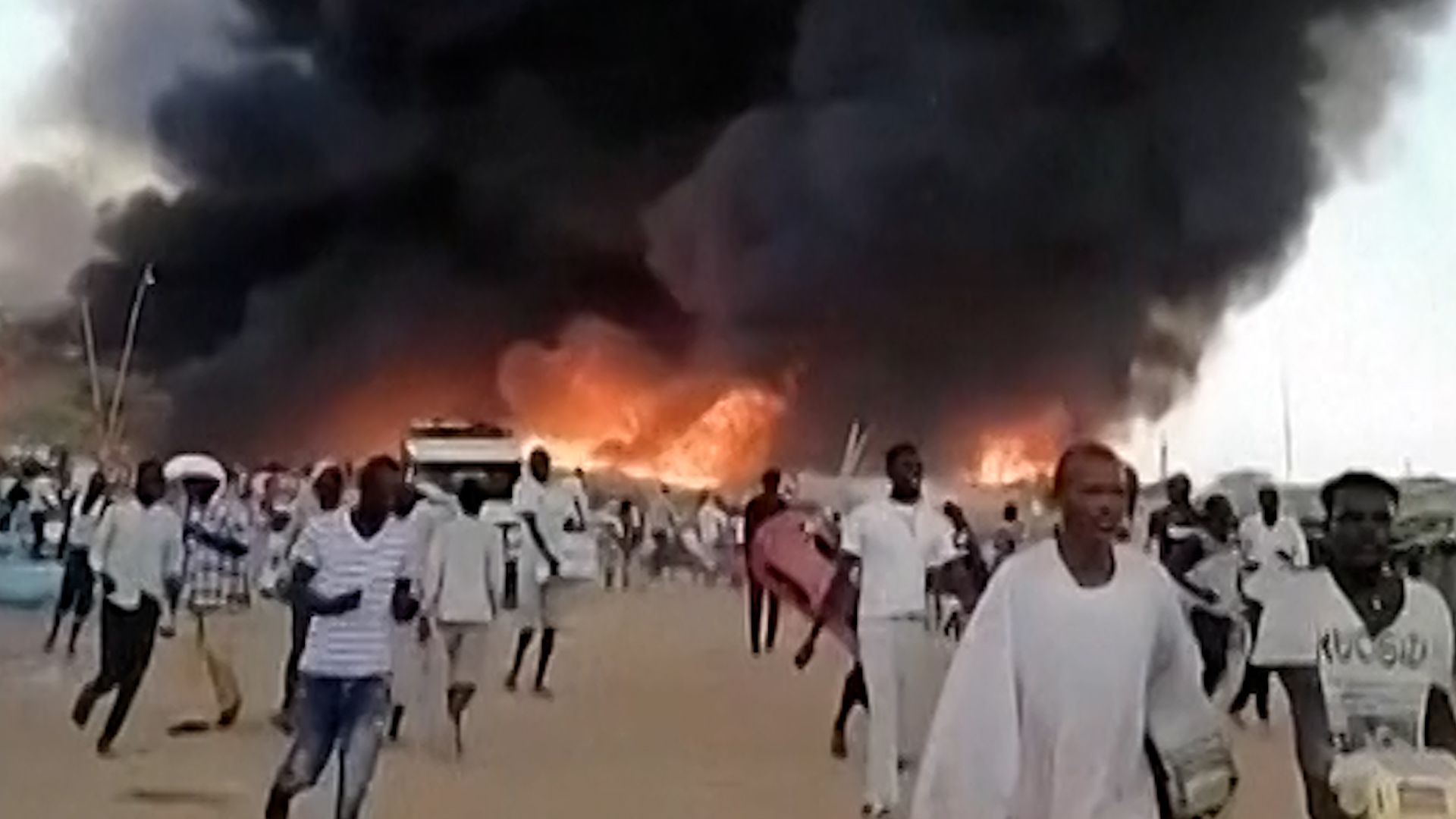
A Crowded Market, a Drone, and 150 Dead
A drone strike on a market in Abyei, the disputed territory straddling the border between Sudan and South Sudan, killed at least 150 people, according to reports emerging from the region. The attack struck a civilian gathering point, and the death toll places it among the deadliest single strikes of the ongoing conflict between the Sudanese Armed Forces and the paramilitary Rapid Support Forces.
The Sudanese government has accused the RSF of using Abyei as a staging ground, citing the group’s presence in the disputed region as justification for military operations there. Whether that justification holds under international humanitarian law, which prohibits attacks on civilian infrastructure and requires proportionality even when armed actors are present in populated areas, remains a critical and unanswered question.
Abyei: A Territory Already Defined by Unresolved Conflict
Abyei’s status has never been settled. The region was supposed to hold a referendum on whether to join Sudan or South Sudan following the 2005 Comprehensive Peace Agreement, but that vote was never conducted. It remains formally administered under a joint arrangement that has, in practice, left it ungoverned and exposed, claimed by both Khartoum and Juba and protected by neither.
That legal and political vacuum has made Abyei a recurring theatre for violence. Its population, predominantly Ngok Dinka communities with historical ties to South Sudan, has endured repeated displacement. The presence of a United Nations Interim Security Force for Abyei, known as UNISFA, has not translated into effective protection during periods of escalation.
The RSF and the Expanding Geography of the Sudan War
Fighting between the Sudanese Armed Forces and the RSF, which began in April 2023 in Khartoum and rapidly spread to Darfur, has now reached the country’s southern borderlands. The RSF’s expansion into peripheral regions reflects a pattern observed throughout the conflict: the paramilitary force exploits governance gaps, moving into areas where state authority is weakest and international scrutiny is thinnest.
Khartoum’s accusation that the RSF is sheltering in Abyei is, in that context, plausible as a military assessment. It is also, if accurate, precisely the kind of claim that demands independent verification before it can serve as a legal basis for strikes on civilian spaces. No such verification has been reported.
Key Facts Established at This Stage
- At least 150 people were killed in a drone strike targeting or striking near a market in Abyei on or around 21 October 2026, making it one of the highest-casualty single incidents of the Sudan war.
- The Sudanese Armed Forces have accused the RSF of using Abyei, a disputed territory with unresolved sovereignty status, as a base of operations, a claim that has not been independently verified.
- Abyei sits at the border between Sudan and South Sudan and lacks a settled legal status, having never held the referendum mandated by the 2005 peace agreement.
- The RSF, designated as a paramilitary force and implicated in mass atrocities in Darfur and elsewhere, has expanded its operational footprint into Sudan’s peripheral regions as the war has intensified.
- UNISFA, the UN peacekeeping mission with a mandate in Abyei, has not been reported to have intervened or issued a statement on the strike at the time of publication.
The precise attribution of the drone strike, the chain of command responsible, and the full civilian casualty count remain unconfirmed. What is established is the scale of death and the location: a market, a civilian space, in a territory that international law has long struggled to protect.
A Pattern of Accountability Failure
The Sudan conflict has produced some of the worst documented atrocities of the current decade, including mass killings in Darfur that prompted calls for International Criminal Court intervention, the systematic destruction of civilian infrastructure, and the displacement of millions. Accountability mechanisms have lagged far behind the pace of violence.
Drone warfare adds a further layer of opacity. Strikes can be launched from distance, their operators shielded from the immediate consequences, and their targeting logic rarely subjected to public scrutiny. In a conflict where both the Sudanese Armed Forces and the RSF have been accused of serious violations, the use of drone strikes against populated areas without transparent justification compounds an already severe accountability deficit.
The 150 people killed in Abyei’s market deserve more than a footnote in a war that the world has largely watched from a distance. Whether their deaths will prompt any formal investigation, any UN Security Council response, or any revision of the international community’s posture toward the Sudan conflict is, at this moment, genuinely uncertain.