
Andy Burnham’s Devolution Gambit: Vision in Abundance, Time Running Out
A Politician at Ease on the Public Stage
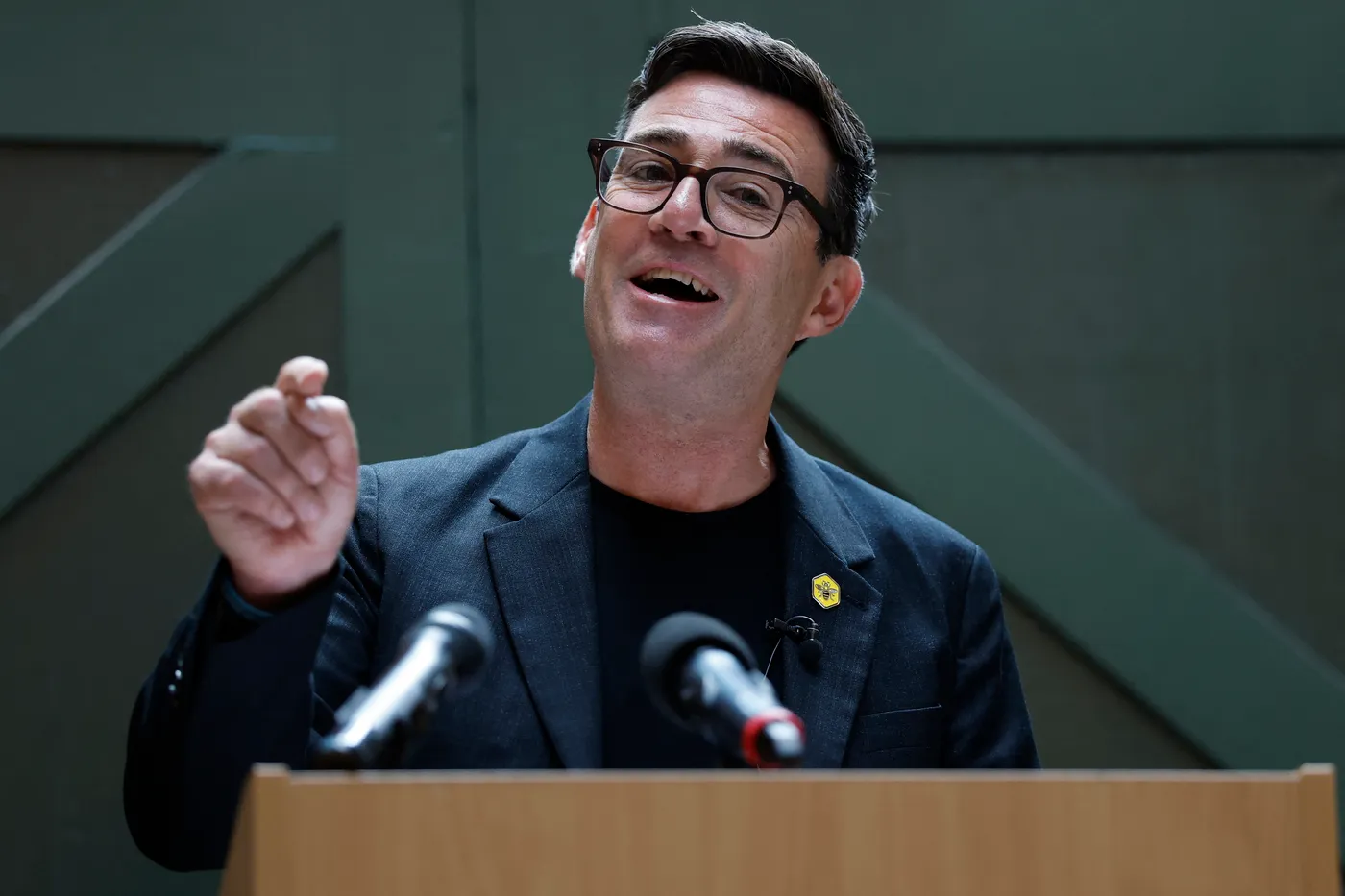
Two qualities distinguish Andy Burnham from the man he is almost certainly about to replace. The first is an evident comfort with public exposure — the microphone, the camera, the unscripted moment. Burnham does not merely tolerate the public stage; he commands it, moving fluidly between prepared remarks and improvised responses in a manner that communicates both confidence and conviction. The second quality is his appetite for what political operatives call “the vision thing”: the articulation, with genuine passion, of a destination and a rationale for getting there. These are not trivial attributes in a prospective prime minister, and those observing him closely during the recent Runcorn and Helsby by-election campaign noticed both qualities operating in tandem.
“A leader with politics and vision. Quite something,” one Labour MP told this reporter, the implicit comparison with Sir Keir Starmer hanging unspoken but unmistakable in the air. The contrast is being drawn widely inside the parliamentary Labour Party, and it matters more than it might seem. Sir Keir once declared, as the authors Patrick Maguire and Gabriel Pogrund document in their account of his leadership Get In: The Inside Story of Labour and the Starmer Project, that “there is no such thing as Starmerism and there never will be.” His stated rationale was pragmatism — freedom from ideology, adaptability over doctrine. His internal critics, however, long argued privately, and increasingly publicly, that this amounted to an inability to articulate what he actually believed. The equivalent admission would be inconceivable from Burnham.
A Record of Shifting Positions
It would be imprecise to present Burnham as a figure of unbroken ideological consistency. A decade ago, following his second failed Labour leadership bid, critics mocked what they characterised as a congenital indecisiveness — a tendency to recalibrate positions under pressure. More recently, that critique has resurfaced in specific domains. His evolving stance on the WASPI women campaign, on the government’s fiscal borrowing rules, and on trans rights have each generated questions about where, precisely, his convictions are anchored. These are not trivial inconsistencies, and they will be scrutinised more intensely once he assumes office.
What has changed, his supporters argue, is that eight years as Mayor of Greater Manchester have given Burnham something his earlier iterations lacked: a tested political framework, road-run against the friction of actual governance. The mayoralty has functioned less as a conventional executive role and more as a laboratory for ideas about power, geography, and public investment. The question now is whether those ideas can survive translation from regional experiment to national programme.
The Devolution Doctrine
The German Model as Benchmark
The intellectual architecture of Burnham’s prospective programme is laid out most fully in Head North, a book he co-authored with Steve Rotheram, the Labour mayor of the Liverpool City Region. Westminster is currently re-reading it with the intensity of a document search, combing its arguments for clues about what Burnham will actually attempt in government. The book draws an instructive historical parallel. In the aftermath of the Second World War, Burnham notes, the Allied powers — including Britain — deliberately designed the new German state to prevent any future concentration of political authority in a single capital. The resulting Länder were granted substantial autonomy, and legislation was enacted to guarantee equivalent living standards across regions. Burnham poses the question directly: what might the United Kingdom look like today had it adopted a comparable constitutional settlement?
The Failure of Both Governing Traditions
His answer is unsparing toward both major parties. Labour and Conservative governments alike, he argues, have systematically failed to empower devolved leaders, treating decentralisation as an administrative convenience rather than a democratic imperative. This charge requires some qualification. The last Labour government created devolved bodies in Scotland, Wales, and Northern Ireland and established a directly elected Mayor of London — a significant restructuring of the British constitutional landscape. The last Conservative government, for its part, accelerated the spread of elected metro mayors across England. Neither record is negligible. Burnham’s argument, however, is that these reforms remained incomplete and insufficiently resourced, preserving the essential logic of Westminster supremacy while decorating it with regional facades.
The Foundational Text and Its Gaps
Burnham’s team describes his speech in Manchester on Monday as the “foundational text” of his programme for government. It was broad in scope and bold in ambition, sketching a rebalancing of power away from Westminster toward cities, regions, and communities. The language was confident. The detail was sparse. That gap between rhetorical architecture and operational specificity is precisely where prime ministerships founder, and Burnham enters office — if he does so unchallenged, as appears likely within a fortnight — inheriting the same conditions that eroded his predecessor: a restless electorate, a fracturing political landscape, and a public increasingly intolerant of the distance between political promise and lived experience.
For a politician who has cultivated prime ministerial ambitions across the better part of two decades, the acceleration toward the door is disorienting in its speed. The final sprint, by current projections, is measured in days rather than months. Vision, it turns out, is the easier part. The harder discipline — converting a foundational text into legislation, budgets, and measurable outcomes before impatience hardens into contempt — begins the moment the door closes behind him.