
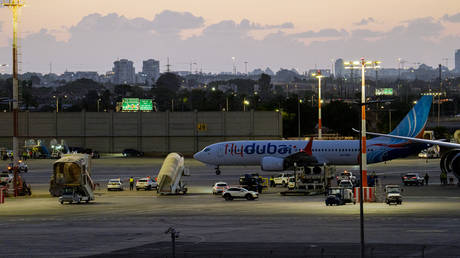
The near-catastrophe aboard FlyDubai Flight 981 last Wednesday was not a failure of fate. It was a failure of systems — multiple, overlapping, and entirely preventable.
According to reporting by the Wall Street Journal, citing sources familiar with the investigation, co-pilot Hamam Hammami had been identified as a potential radical threat years before he climbed into the cockpit of a Boeing 737 MAX 8 bound for Tel Aviv’s Ben Gurion Airport with approximately 180 passengers and crew aboard. That identification went nowhere. Omani authorities had scrutinised Hammami’s online activity during his tenure at Oman Air and concluded, in the WSJ’s phrasing, that he “showed too much interest in radical ideology to trust as a pilot.” He was barred from flying, enrolled in a deradicalization programme, and reassigned to a desk position. Oman did not formally revoke his pilot’s licence in any manner that would have generated an international alert, and did not circulate its concerns beyond its own borders.
The central thesis that emerges from the available evidence is straightforward: Hammami was not an unknown threat who slipped through an otherwise sound architecture of civil aviation security. He was a known threat who passed through a fragmented, institutionally siloed security apparatus in which no single actor felt responsible for the whole — and in which the transfer of critical risk intelligence between states was treated as optional rather than obligatory.
When FlyDubai hired Hammami, the airline conducted a standard criminal-background check but did not contact Oman Air to verify his employment history, according to the WSJ. This gap alone is striking. The airline subsequently assigned him to one of its most politically sensitive routes — the Dubai-to-Tel Aviv corridor — on multiple occasions before the attack. CNN reported that now-deleted social-media accounts bearing Hammami’s name contained material referencing Al-Qaeda leader Ayman al-Zawahiri and a suicide bomber responsible for killing seven CIA personnel in 2009. The network’s analysis of an account attributed to him also characterised his posts as “deeply religious and misogynistic.” Whether UAE authorities or FlyDubai’s own vetting teams had access to this material, and whether they acted on it, remains an open question the investigation has not yet resolved.
Israel’s position in this chain of omissions is particularly notable given the geopolitical sensitivity of the route. FlyDubai submitted a passenger and crew manifest before departure, as required. Israeli authorities did not flag Hammami, despite a standing policy barring Omani pilots from flying into Israel — a product of the absence of diplomatic relations between the two countries. Israel’s Transportation Ministry acknowledged to the WSJ that it did not believe it possessed either the authority or the intelligence capability to vet crew members, and that it had never requested access to a passenger-information database established in 2023. The country responsible for some of the most intensive airport security procedures in the world, it turns out, was not checking the people in the cockpit.
The attack itself unfolded roughly two hours into the flight. Hammami asked Captain Smit Machchhar for permission to pray, then struck him repeatedly with an emergency axe as the aircraft entered a dangerous dive. Machchhar, severely wounded, managed to unlock the cockpit door, allowing passengers and crew to enter and overpower Hammami. Two off-duty FlyDubai pilots travelling as passengers assumed the controls and brought the plane down safely in Saudi Arabia. The UAE attorney general has characterised the assault as an attempted terrorist act; the investigation continues.
“If this was a dedicated jihadist terror attack, there are multiple levels of failure,” aviation-security expert Matthew Borie told the WSJ. The precision of that observation deserves attention. Each of the three jurisdictions involved — Oman, the UAE, and Israel — held a piece of information or authority that, exercised in coordination with the others, might have grounded Hammami permanently. None of them exercised it. International civil aviation frameworks oblige states to cooperate on safety and security matters, yet the mechanisms for sharing deradicalization findings or employment-history red flags across borders remain conspicuously underdeveloped, and plainly voluntary in practice.
Machchhar’s physical courage in opening that cockpit door prevented what could have been a mass-casualty event. His actions drew praise from Indian Prime Minister Narendra Modi and Israeli Prime Minister Benjamin Netanyahu, who called him a “hero of the entire world.” The praise is warranted. But the framing of individual heroism should not be permitted to obscure the institutional failure that made heroism necessary in the first place. The question that regulators, airlines, and governments now face is not how to celebrate the survivor, but how to explain why a man flagged as too dangerous to fly was, for years, allowed to fly.