
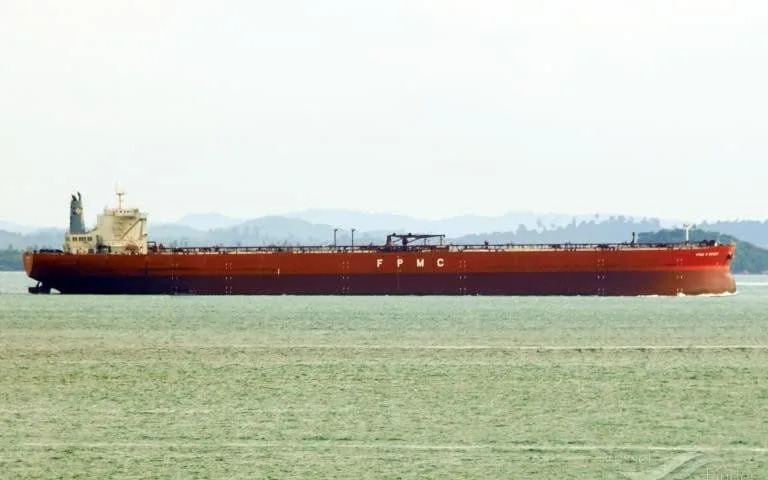
In mid-August, a supertanker called the Singapore Prosperity — carrying an estimated two million barrels of crude oil — docked at a series of Saudi ports before heading toward the Strait of Hormuz. Then its transponder went dark. Two days later, the vessel reappeared on maritime tracking systems near Fujairah, on the far side of the strait, having passed through one of the world’s most contested waterways without a visible trace.
The Singapore Prosperity was not an anomaly. Since roughly early May, several Gulf states have been running a coordinated clandestine operation to move oil through the Strait of Hormuz in defiance of Iran, which has claimed sovereignty over the waterway since the outbreak of hostilities with the United States on February 28. The operation employs what maritime analysts call “dark fleets” — vessels that disable their automatic identification systems and transit the 21-mile-wide chokepoint under cover of night, deliberately borrowing the evasion tactics Iran itself used to circumvent international sanctions.
The mechanics of the operation follow a consistent pattern. Supertankers, deemed too large and too exposed, do not attempt the crossing directly. Instead, smaller “shuttle boats” carry the cargo — crude oil, refined products, or occasionally liquefied natural gas — through the danger zone. Once clear of Iranian-controlled waters, they transfer their loads to larger vessels for the final leg of the journey. The process is deliberately opaque, designed to leave as little evidentiary trail as possible.
“There’s a bit of irony,” said Rachel Ziemba, senior fellow at the Centre for a New American Security. “It’s the sort of sanctions-busting apparatus, or sanctions evasion apparatus, that the Iranians were using to get their fuel to market. Some of these same tactics are now being used by the Emiratis, by other Gulf countries.”
Iran has not tolerated the challenge to its claimed authority. The UAE reported in August that 15 of its ships had been struck by Iranian drones and missiles, leaving 20 crew members injured and one dead. At least two LNG carriers were hit in July, though both managed to offload their cargo to alternative vessels after clearing the strait. The United States military has deployed fighter jets and other assets to reduce — though not eliminate — the threat from Iranian aerial attacks.
The calculus sustaining the operation is bluntly commercial. Insurance costs for buyers are offset by steep discounts on crude offered by exporters including Iraq and Qatar. The risk is priced in and accepted. “People just assume one ship in 12 or one ship in 15 is going to get hit by an Iranian drone, but you make enough money on the rest of them,” said Rory Johnston, founder of the market research firm Commodity Context.
Johnston argues the Gulf states would have launched this shadow operation far earlier had the White House not repeatedly assured them the conflict would be short-lived — resolved through military victory, negotiated settlement, or economic pressure on Tehran. Those assurances suppressed improvisation. “The White House keeps telling us that this will be over next week,” his contacts told him when he pressed them on why they were not taking the risk. Eventually, Johnston said, “no one believes the White House any more.”
The volumes moving through the strait remain volatile and well below pre-war levels. According to data firm Kpler, between 10 and 12 million barrels cross the strait daily — roughly half the pre-war figure. The daily range is extreme: on September 7, Johnston recorded 20 million barrels transiting the waterway; by September 10, that figure had collapsed to three million. The UAE, which claims to export two million barrels per day through its state oil company Adnoc, has nonetheless ramped up operations, and Kpler data indicate fuel volumes are at their highest point since the war began.
Iran’s inability to fully suppress the shuttle-boat traffic has generated its own consequences. Simon Henderson, director of the Washington Institute’s Gulf and energy policy programme, noted that Iran’s proxies launched drone attacks on Saudi Arabia’s East-West pipeline on September 10, forcing a rerouting of millions of barrels — a sign, he suggested, that Tehran is seeking alternative pressure points after failing to choke the strait. Rumours have also circulated that Iranian officials have accepted payments to ignore the smuggling operations, though these remain unverified.
The operation is widely understood to be a stopgap, not a structural solution. “A coping mechanism,” as Ziemba put it. Yet it is one that has, for now, partially sustained global oil flows that Iran sought to sever entirely. Henderson’s assessment is measured: Tehran “is not as powerful as it thinks it is. In the short term, at least, we’re managing.” What began as an act of war has settled into an asymmetric contest of attrition — measured not in territory or casualties, but in barrels per day.