
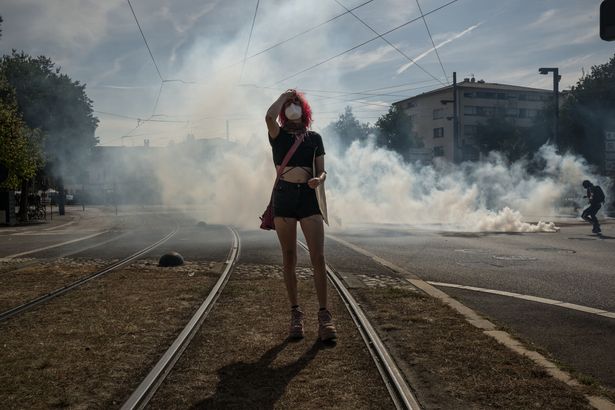
On a Tuesday morning in late spring, riot police in central Athens fired tear gas into a crowd of several thousand demonstrators who had marched from Syntagma Square toward the United States Embassy. The immediate trigger was the arrival of Secretary of State Marco Rubio to finalise the sale of F-35 fighter jets and negotiate the terms of American military base operations on Greek soil. Greek authorities, in response, imposed a blanket 24-hour ban on all outdoor public gatherings in the capital — a measure that, in its blunt sweep, illustrated something larger than a single bilateral arms deal. Across the continent, from Lisbon to Pristina, from Bratislava to Moscow, the architecture of public order is under sustained and simultaneous pressure.
What is unfolding across Europe in this period is not a coordinated uprising. It is something more diffuse, and in some ways more consequential: a convergence of distinct grievances — economic, political, institutional — that are finding expression in the streets at the same moment. The causes differ sharply by country. The methods and the levels of repression vary. But the underlying pattern is one of populations concluding that formal channels of redress have either been closed or rendered meaningless.
Education systems as the fault line
France is experiencing what observers are describing as its most intense civil unrest in decades. A nationwide wave of student and trade union mobilisation has shuttered or severely disrupted up to half of the country’s secondary schools. The grievances are specific and documented: chronic understaffing, acute teacher shortages, deteriorating school infrastructure, and a sequence of government budget cuts that educators argue have made the system structurally dysfunctional. Clashes between demonstrators and police have produced mass arrests and scenes of tear gas in urban centres that have not witnessed disorder on this scale since the movement against pension reform.
The French unrest has produced visible cross-border effects. In the French-speaking Wallonia region of Belgium and in Brussels, secondary school students have erected blockades in what authorities describe as copycat mobilisations, protesting educational cost-cutting and regional reform plans. More than a hundred arrests have been recorded. In Portugal, the FENPROF teachers’ union has called an indefinite national strike over forced overtime and unpaid hours; union representatives have explicitly drawn the connection to the French situation, framing their action as part of a broader European reckoning with the underfunding of public education.
Italy’s contribution to this wave is concentrated in the transport, healthcare, and public administration sectors, where workers have sustained a high volume of industrial actions throughout the year, pushing back against inflation and the erosion of real wages. The Italian strikes are less visible internationally than the French unrest, but they reflect the same underlying dynamic: a public sector workforce that has absorbed years of austerity and is no longer willing to absorb more.
Housing, corruption, and the cost of living
In Spain, the immediate catalyst is housing. Tens of thousands of people have taken to the streets in more than fifty cities — Madrid, Barcelona, Valencia among them — driven by rental prices that have risen at a pace that has made entire urban centres inaccessible to working and middle-class residents. The demonstrations have escalated into confrontations with riot police, with street blockades and fires reported in major public squares. The Spanish protests are notable for their geographic breadth; this is not a capital-city phenomenon but a national one, reflecting a housing crisis that has metastasised across the country’s urban geography.
In Kosovo, the trigger was juridical. The Hague-based Special Tribunal sentenced former President Hashim Thaçi and other former commanders of the Kosovo Liberation Army to lengthy prison terms for war crimes. The verdict produced an immediate and violent reaction in Pristina, where protesters laid siege to parliament and government buildings, throwing stones and firecrackers and demanding emergency legislation to curtail the court’s powers. Riot police deployed water cannons and tear gas; injuries were reported on both sides. The episode exposes a tension that international criminal justice mechanisms have long struggled to manage: the gap between legal accountability and the political legitimacy those mechanisms carry — or fail to carry — in the societies most directly affected by the crimes under adjudication.
Serbia’s crisis has deeper roots, originating in the collapse of a railway station canopy in Novi Sad that killed sixteen people and exposed what protesters characterise as systemic state corruption and regulatory failure. The student-led movement that emerged from that disaster has since grown into a formal political force, entering an electoral alliance known as the Student List ahead of anticipated snap parliamentary elections. The political consequences have been remarkable in their velocity: the prime minister resigned, and President Aleksandar Vučić stepped down from the presidency to contest the prime ministership directly, a manoeuvre that analysts read as an attempt to reset his political standing as independent media faces intensifying suppression.
Democratic backsliding and its discontents
Slovakia presents perhaps the most textured picture of democratic erosion currently visible in Central Europe. Mass protests have swept the country in response to a series of measures introduced by Prime Minister Robert Fico’s government: a plan to eliminate postal voting for Slovaks abroad, which critics argue is designed to disenfranchise pro-Western voters; sweeping amendments to the criminal code; the dismantling of the state’s whistleblower protection agency; and legislation targeting non-governmental organisations that opposition figures and civil society groups say closely mirrors Russian “foreign agent” laws. Demonstrations under the slogan “Slovakia is Europe” have drawn crowds exceeding 100,000 across dozens of cities and towns, moving well beyond Bratislava’s liberal core. Fico has responded by accusing opposition organisers of acting under foreign influence and threatening to deport foreign activists — a response that itself mirrors the rhetorical playbook of the governments his critics invoke as cautionary examples.
In Georgia, the ruling Georgian Dream party’s move to legally ban major opposition parties has deepened a political crisis that was already acute. Protests in Tbilisi have been met with what demonstrators and human rights monitors describe as the use of chemical agents and disproportionate force. A separate prison scandal, involving allegations of systemic abuse by guards, has further inflamed public sentiment. The Georgian situation is one where the formal architecture of democratic governance is being dismantled in increments, and where street mobilisation has become the primary remaining avenue for political contestation.
Albania’s capital, Tirana, has seen sustained rallies outside parliament in opposition to a territorial reform bill that would merge local government units — a measure that critics argue is a vehicle for centralising political control. The main opposition party has organised nationwide resistance, and daily demonstrations have disrupted legislative sessions. In Türkiye, protests centred on press freedom and civil liberties — including significant mobilisations by LGBTQIA+ advocacy groups in Istanbul — have been met with mass detentions. The space for dissent in Türkiye has been constricting for years; what is visible now is the friction generated when that constriction reaches a point that populations find intolerable.
Moscow’s unscripted moment
The most structurally significant event in this period may be what occurred in central Moscow. A march organised by the Communist Party — state-sanctioned, carefully choreographed — broke from its intended script. Crowds began chanting “Down with the Tsar,” demanding accountability for what they described as stolen elections and administrative corruption. The conditions that produced this rupture are well-documented: economic strain intensified by sanctions and wartime expenditure, forced military mobilisation, and what multiple independent Russian analysts have described as pervasive political corruption at every level of the state apparatus. The Kremlin responded with immediate arrests and a crackdown designed to prevent the unrest from spreading to other regions.
What makes this episode significant is not its scale — the Russian state retains formidable repressive capacity — but its location and its form. A state-approved event becoming an anti-regime demonstration in the heart of Moscow is a data point that warrants careful attention, precisely because it was not supposed to happen. It suggests that the mechanisms the Russian government uses to manage public discontent are under strain in ways that are not yet fully legible from the outside.
The weight of accumulated grievance
What connects these episodes is not ideology or coordination. What connects them is the experience of institutions that have ceased to function as promised — schools that cannot staff their classrooms, housing markets that have been surrendered to speculative capital, governments that have insulated themselves from accountability through legal manipulation or outright repression. In each case, the street has become the venue of last resort for populations that have exhausted, or been denied, other options.
The risk, in moments like this, is that the sheer number of simultaneous crises produces a kind of analytical paralysis — each situation treated as local, exceptional, unrelated to the others. The governments facing these protests have, in several cases, already deployed that framing, attributing unrest to foreign interference, opposition manipulation, or the irresponsibility of demonstrators. That framing serves a purpose: it allows the underlying grievances to go unaddressed while the immediate disorder is suppressed. In Athens, in Pristina, in Bratislava, in Moscow, the people in the streets are making a different argument. Whether the institutions they are challenging are capable of hearing it is, at this point, genuinely uncertain.