
There is a particular kind of political symbolism in how a state chooses to kill. Not merely in the act itself, but in the audience it selects — or, as the Pentagon now proposes, the one it constructs. The announcement that the December 3 execution of Nidal Malik Hasan, the Fort Hood shooter, would be broadcast live via firing squad represents more than a procedural decision. It places the United States in a category of nations whose composition demands careful examination.
According to Amnesty International’s tracking of executions across 17 countries in the most recent reporting period — covering approximately 2,700 documented killings — only two states carried out capital punishment in public settings: Iran and Afghanistan under Taliban governance. Iran publicly executed eleven people; Afghanistan, six. These are not incidental companions. Iran is a country with which the United States is in active confrontation. The Taliban-led government in Kabul is the successor to the regime that sheltered the architects of September 11. That the Pentagon’s livestreaming proposal would place American military justice in the same descriptive category as these governments is not rhetorical flourish — it is a precise statement of fact.
The United States has not publicly executed anyone since the 1930s. Over the course of the twentieth century, capital punishment migrated steadily from the town square into the interior of the prison — away from the crowd, behind walls, under institutional control. Methods shifted alongside visibility: from hangings and firing squads to the electric chair, the gas chamber, and eventually lethal injection, each transition carrying its own logic of concealment and clinical detachment. The decision to reverse that trajectory, and to do so via live broadcast, is not a restoration of some older tradition. It is something new.
Hasan was convicted of killing thirteen people and wounding thirty-two others in the November 2009 shooting at Fort Hood, Texas — the deadliest mass casualty attack on a U.S. military installation in the country’s history. President Donald Trump, who approved the firing squad method through a Pentagon spokesman, has in other contexts been publicly critical of Iran’s use of public execution. The tension in that position is not subtle. It is the kind of irony that writes itself, and that international observers are unlikely to miss.
Amnesty International’s data, it should be noted, carries significant methodological constraints. The organization tracks only judicial executions and does not produce verified figures for China, North Korea, or Vietnam — states where executions are widely believed to occur at scale. Unverified reports of public executions in North Korea have reached Amnesty but could not be confirmed. In 2021, at least nine people were publicly executed in Yemen. Saudi Arabia, which conducted public beheadings for years, has in recent periods moved away from open-air killings, though its overall execution rate remains high. The picture is incomplete by necessity, but its broad contours are clear: public execution is not a practice of liberal democracies, and it has not been for generations.
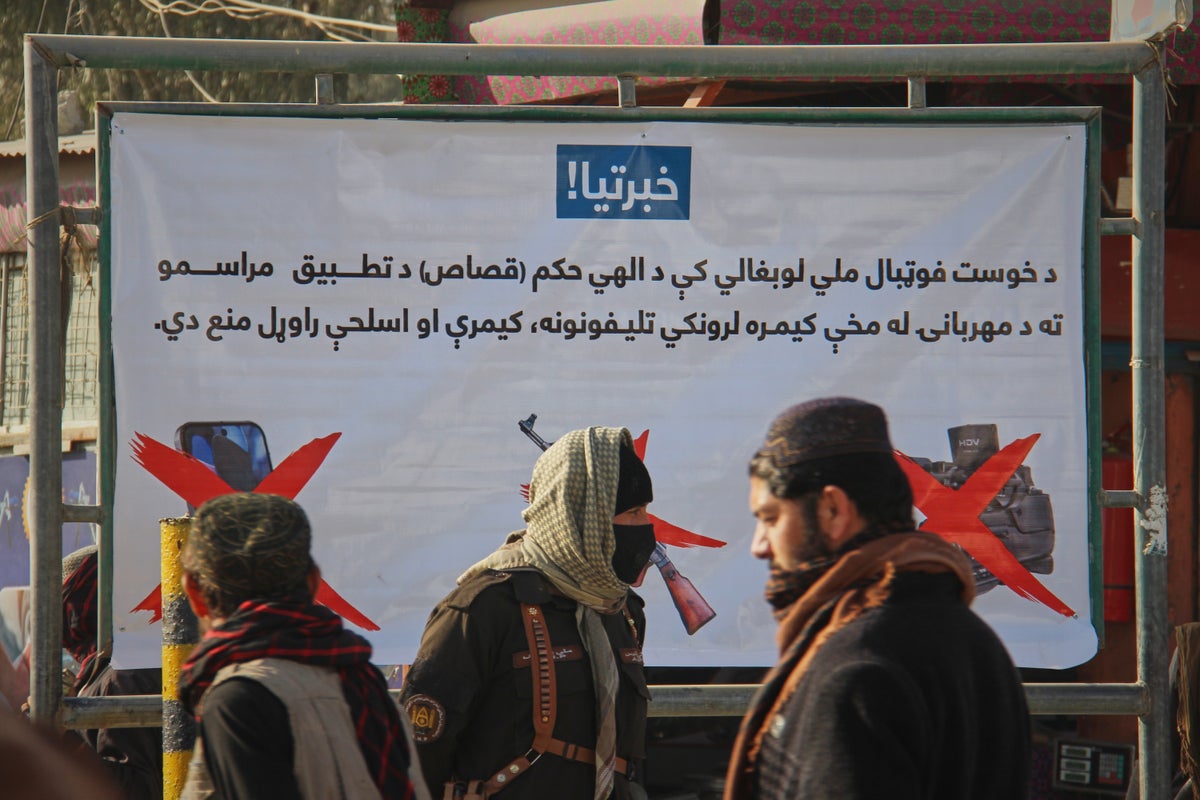
In Afghanistan, the return of the Taliban in 2021 — following the chaotic withdrawal of U.S. and NATO forces — brought with it the resumption of practices that had defined the group’s first period of rule in the late 1990s: public executions, floggings, stonings. In December, tens of thousands gathered in a stadium in the eastern city of Khost to witness the shooting of a man convicted of killing thirteen members of a single family, including children. The victims’ relatives were offered the choice of clemency or death; they chose death, and one of their own pulled the trigger. The Supreme Court of the Taliban-led government framed this as justice. Human rights organizations framed it as a war crime in slow motion. The distinction matters.
What the Pentagon’s proposal ultimately exposes is not merely a question of execution policy but a question of institutional self-understanding. International human rights law does not prohibit capital punishment outright in all circumstances, but it does impose constraints — on method, on transparency, on the dignity of the condemned — that public spectacle tends to corrode. The live-streaming of a state killing, whatever its legal grounding in military justice, transforms an act of punishment into an act of performance. It invites a public to watch a man die. The question of what that invitation communicates — about deterrence, about retribution, about the values a state chooses to embody — is one the Pentagon has not publicly answered. The execution is scheduled. The cameras are being arranged. The company America would keep, in that moment, is already known.