
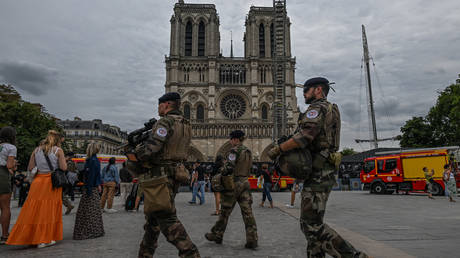
France is mobilising soldiers from its counterterrorism infrastructure to suppress civil unrest — a decision that marks one of the most significant deployments of military force against domestic protest in the country’s recent history.
Operation Sentinelle Redirected Inward
Interior Minister Laurent Nunez confirmed on Tuesday that personnel from Operation Sentinelle — the standing military mission established in the immediate aftermath of the January 2015 Charlie Hebdo attacks to protect France against terrorist threats — would be redeployed to support police during demonstrations scheduled for Saturday, October 24. According to Le Journal du Dimanche, 1,000 military personnel will be available in Paris alone on that date, with 500 deployed on active patrol, compared with the standard complement of 300.
The operational logic, as stated by the government, is one of substitution: soldiers will assume responsibility for guarding sensitive sites — railway stations, airports, religious buildings, tourist attractions — thereby releasing police officers and gendarmes to confront rioters directly. The distinction matters, at least on paper. Operation Sentinelle was designed for a specific threat environment; its pivot toward crowd-control support represents a consequential expansion of its mandate, one the government has not subjected to any visible public legal scrutiny.
The Scale of the Promised Response
Prime Minister Sébastien Lecornu, addressing lawmakers, described the coming deployment as “massive” and “unprecedented,” framing the unrest not as a social response to economic hardship but as the product of an “insurrectionary plan” orchestrated by radical left-wing groups. That characterisation — contested by many of the hundreds of thousands who took to the streets — carries significant political weight in the months before a presidential election.
Nunez announced the mobilisation of elite police units including RAID, GIGN, and BRI, supplemented by helicopters, armoured Centaure vehicles, and water cannons. Authorities are also actively considering banning demonstrations assessed as likely to threaten public order — a measure that would raise immediate questions under French constitutional law and the European Convention on Human Rights, which protects the right to peaceful assembly.
What the Violence of October 17 Revealed
The government’s escalation follows nationwide unrest on October 17, when approximately 550,000 people demonstrated across France over rising living costs and deteriorating conditions in public schools. In Paris, Lyon, Marseille, and Bordeaux, demonstrations gave way to rioting: businesses were looted, buildings set alight, and security forces overwhelmed.
Le Monde reported that 997 police officers and gendarmes were injured during the unrest, seven of them seriously. More than 2,400 people have since been arrested, with over 800 brought before the courts. Localised curfews have been imposed in Paris and several other cities — measures that compound the already exceptional nature of the state’s response.
President Emmanuel Macron has publicly acknowledged failures in the government’s handling of the violence, a rare admission that nonetheless stopped well short of any reckoning with the underlying conditions — soaring inflation, stagnant wages, and a public services crisis — that drove hundreds of thousands into the streets in the first place.
Key Takeaways
The deployment of counterterrorism infrastructure against civil protest is not, in itself, evidence of illegality. But the speed with which France has reached for its most exceptional instruments — and the government’s insistence on a conspiratorial rather than socioeconomic explanation for mass unrest — demands sustained scrutiny. The right to protest is not a gift of the state; it is a right the state is bound, under both French law and international convention, to protect.