
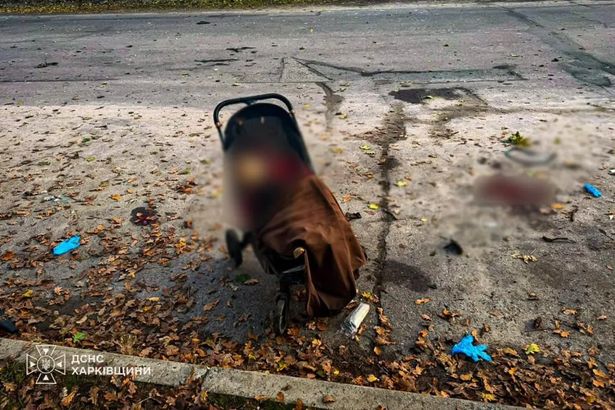
On Monday, October 19, a Russian drone strike hit a public park in Kharkiv, Ukraine’s northeastern city, where families had gathered with young children. Among the dead was a one-year-old infant, killed in a stroller. Two women also died in the strike. Ukrainian official Ivan Vyhivskyi confirmed the deaths on Telegram, writing: “Unfortunately, two women and an infant who was in a stroller were killed.”
The final death toll from the Kharkiv attack reached six fatalities, including three children. Kharkiv Regional Governor Oleh Syniehubov reported at least 15 additional people wounded, among them seven children. A park, on a Monday, with families present — the choice of target, or the indifference to it, requires no elaboration.
The strike did not occur in isolation. It arrived as the United Nations Office of the High Commissioner for Human Rights released figures documenting an 85% increase in civilian casualties across Ukraine in September 2024 compared to the same month the previous year. At least 328 civilians were killed and a further 2,105 injured during September alone. In Kyiv, civilians were killed or injured on 22 of the month’s 30 days — the highest frequency recorded in any single month since Russia’s full-scale invasion began in February 2022.
The cumulative toll for the first nine months of 2024 now stands, according to verified UN figures, at 2,570 civilians killed and 15,211 wounded — a 59% increase over the equivalent period in the previous year. These are verified minimums; the actual numbers are likely higher, as access constraints in active conflict zones routinely delay or prevent full documentation.
Danielle Bell, head of the UN’s human rights monitoring mission in Ukraine, stated that “the first two weeks of October were among the deadliest periods for civilians in years.” The monitoring mission’s methodology relies on corroborated individual cases, meaning the figures it publishes represent a floor, not a ceiling. The trajectory — sharply upward across every measured interval — points to a systematic intensification of attacks on populated areas, a pattern that intersects with well-established prohibitions under international humanitarian law on indiscriminate and disproportionate strikes.
Against this documented escalation, US President Donald Trump told reporters on Monday that Russia had been “fine on Ukraine” and had not been “doing much” in the country. He also attributed blame for the absence of a peace settlement to Ukrainian President Volodymyr Zelensky, whom he accused of obstructing negotiations. The statement was made on the same day that a one-year-old was killed in a stroller in a Kharkiv park. The dissonance is not incidental; it is a matter of record.
The Kharkiv strike and the broader casualty data together raise questions that extend well beyond the immediate humanitarian emergency. They concern the adequacy of international mechanisms designed to protect civilians in armed conflict, the consistency with which powerful states apply pressure on belligerents, and the standards by which political leaders characterise an ongoing war to their own publics. The UN’s figures provide an evidentiary baseline. What follows from that evidence is a question of political will.