
What has triggered this sudden diplomatic mobilisation?
On Thursday, the foreign ministers of Saudi Arabia, Turkey and Pakistan convened an urgent meeting on the sidelines of the United Nations General Assembly in New York, agreeing to accelerate military consultations under a collective defence framework signed only weeks ago. Saudi Foreign Minister Prince Faisal bin Farhan Al Saud, Pakistan’s Deputy Prime Minister and Foreign Minister Ishaq Dar, and Turkish Foreign Minister Hakan Fidan announced plans for an imminent meeting of their respective chiefs of staff, according to the Saudi Press Agency. The immediate catalyst was a fresh wave of cross-border attacks from Yemen: Saudi Arabia reported that its air defences intercepted six ballistic missiles launched toward the cities of Taif and Yanbu on the same day the ministers met. Coalition spokesman Major-General Turki al-Malki stated that further Houthi escalation would be “dealt with firmly,” while Saudi Civil Defence authorities issued alerts across several regions before later announcing the danger had passed.
The Houthis, for their part, claimed responsibility for missile and drone strikes on what they described as a “sensitive target” in Riyadh and on Saudi Aramco facilities in Yanbu. Neither the timing of the planned chiefs-of-staff meeting nor the precise form of support under consideration was specified in the joint statement, leaving the operational dimensions of any response deliberately vague — a studied ambiguity that itself carries diplomatic weight.
What is the Mecca Joint Defence Agreement, and how binding is it?
Saudi Arabia, Turkey and Pakistan signed the Mecca Joint Defence Agreement on August 7, establishing a framework of collective deterrence modelled loosely on mutual defence principles familiar from other regional security architectures. The pact’s central provision stipulates that an attack against any one of the three signatories is to be treated as an attack against all of them — language that mirrors, at least rhetorically, the mutual defence clauses embedded in alliances such as NATO’s Article 5. The agreement is notable for the geopolitical breadth it attempts to span: it brings together a Gulf monarchy, a NATO member with significant regional ambitions, and a nuclear-armed South Asian state with deep historical ties to the Arab world.
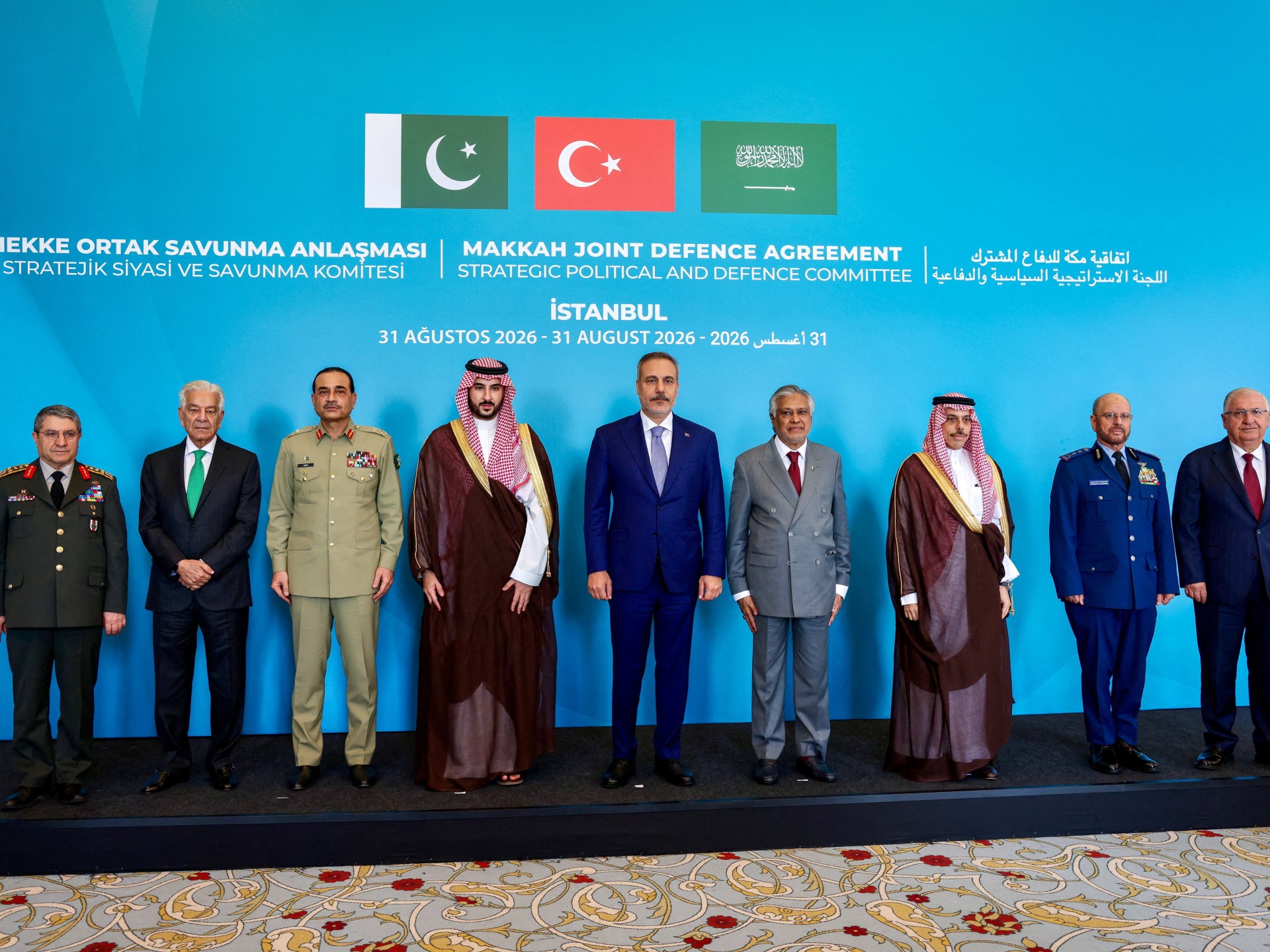
The three countries moved quickly to operationalise the pact. On August 31, their foreign ministers, defence ministers and military chiefs gathered in Istanbul for the inaugural session of the Strategic Political and Defence Committee, where they agreed to establish a permanent secretariat in Saudi Arabia and to deepen practical military cooperation. Thursday’s New York meeting represented the second high-level convening under this structure in less than a month, signalling that the signatories regard the pact not as a symbolic gesture but as a live instrument. The joint statement also invoked Article 51 of the UN Charter — the provision recognising the inherent right of states to individual or collective self-defence — affirming Saudi Arabia’s legal standing to respond to the missile attacks.
Where does France fit into this picture?
France’s intervention adds a further layer of complexity to an already crowded security landscape. President Emmanuel Macron announced on Thursday, in an interview with French broadcaster TF1, that Paris would deploy soldiers, radar systems and air defence assets to protect the Yanbu industrial complex. “We are going to send military assets, meaning soldiers, radars and defence systems to protect this site,” Macron said, framing the deployment in explicitly defensive terms. France’s decision to insert itself into the conflict’s protective architecture — outside the Mecca pact framework and without apparent coordination through any multilateral mechanism — reflects both its longstanding commercial and strategic interests in the Gulf and a broader pattern of European states calibrating their exposure to the conflict on a bilateral basis rather than through collective institutions.
What is the human cost of the renewed fighting inside Yemen?
While the diplomatic manoeuvring unfolded in New York and Paris, the fighting inside Yemen reached some of its most intense levels since hostilities re-escalated. In the single 24-hour period leading into Friday, at least 150 combatants were killed across multiple fronts, according to an AFP tally — 98 from forces aligned with Yemen’s internationally recognised government and 52 from Houthi ranks. Clashes were concentrated around the Kahboub Mountains and in areas between the governorates of Lahj and Taiz, a strategically critical zone overlooking the Bab al-Mandeb strait, one of the world’s most consequential maritime chokepoints through which approximately 12 percent of global trade ordinarily passes.
The Houthis have consolidated their territorial position along Yemen’s Red Sea coast in recent weeks, including by seizing the port city of Mocha and a series of strategic islands, moves that have materially strengthened their grip on the approaches to Bab al-Mandeb. Yemen’s Vice President Abdullah Abdulkader Al Alimi-Bawzer addressed the UN General Assembly with stark language, accusing the Houthis of “taking hostage the entire global economy” by weaponising freedom of navigation — a charge that frames the conflict not merely as a Yemeni civil war but as a threat to the international economic order.
How severe is the displacement crisis, and who is bearing its weight?
The renewed military offensives have set off a displacement emergency that the UN refugee agency UNHCR describes as rapidly compounding an already catastrophic baseline. Since the beginning of September alone, more than 230,000 people have been driven from their homes as clashes spread across multiple front lines simultaneously. That figure is layered onto a pre-existing crisis of approximately 5.2 million internally displaced Yemenis — a population whose scale alone represents one of the largest internal displacement situations anywhere in the world.
Families have been uprooted across governorates including Hodeidah, Taiz, Lahj, Aden, Abyan, Marib, al-Dhalea and Shabwah, with many departing on short notice and carrying little. UNHCR has identified shelter, food, clean water, healthcare and protection services as the most acute needs, while noting that host communities and existing displacement sites are being stretched well beyond their capacity to absorb new arrivals. The pattern of displacement — dispersed across eight governorates, driven by fighting on multiple simultaneous fronts — makes coordinated humanitarian response structurally difficult and logistically punishing. For the civilians caught between the military calculations of regional powers and the territorial ambitions of armed factions, the gap between the language of collective defence and the reality of collective suffering remains as wide as it has ever been.