
Damascus Airport Redevelopment Plan Draws Alarm Over Mass Graves and Expropriated Land
A Test of Accountability in Post-Assad Syria
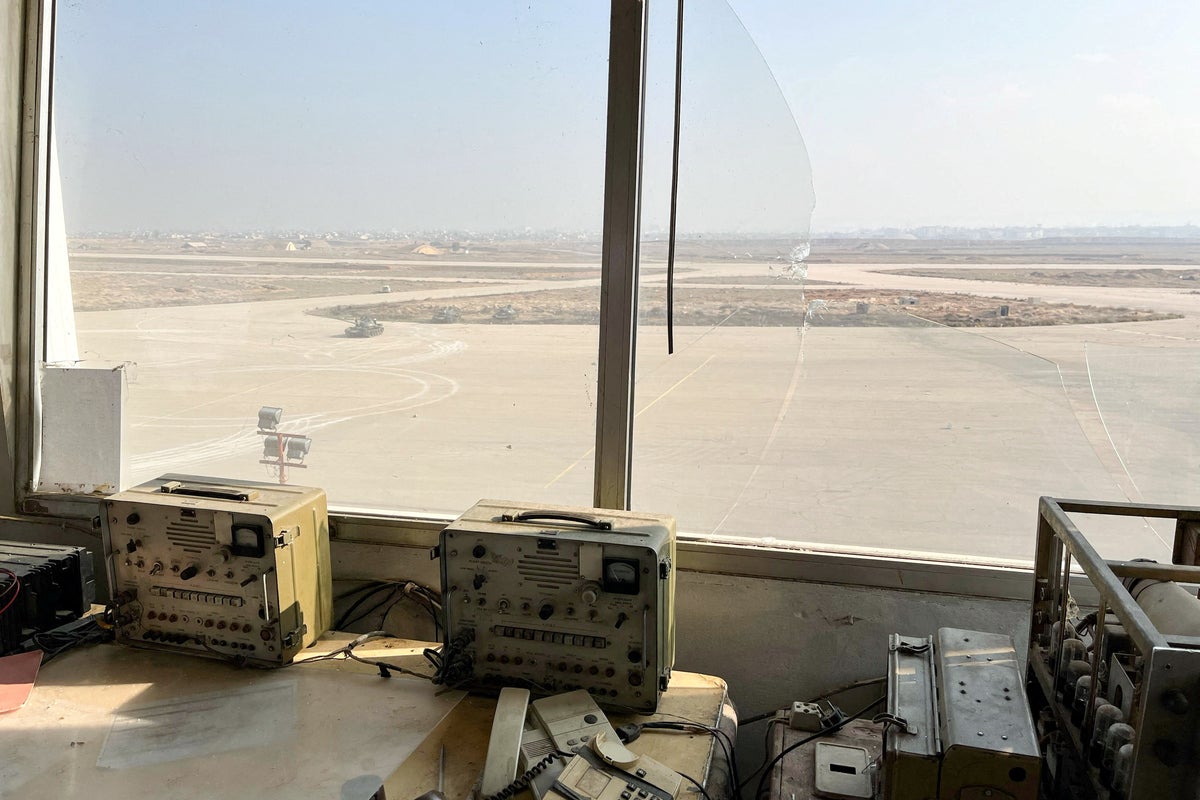
Syria’s new authorities face an early and consequential reckoning. Plans to convert Mezzeh military airport in Damascus into a hub for private and executive aviation have drawn sharp condemnation from human rights organisations and local residents, who warn that construction could destroy evidence of mass atrocities and override unresolved property claims stretching back decades. The project, still in its early stages, has already exposed a tension that will define the post-Assad transition: whether the drive to attract investment will take precedence over the demands of truth, justice, and legal restitution.
What Mezzeh Conceals
Mezzeh was never simply an airfield. Under Bashar al-Assad and his father Hafez, the compound housed key branches of the Air Force Intelligence Directorate (AFI) — one of the most feared instruments of state repression in the Arab world — along with detention facilities where suspected government opponents were tortured, executed, and subjected to enforced disappearance. The site’s function as a killing ground was not incidental; it was, according to newly obtained documents, deliberate and formally sanctioned at the highest levels of the military command.
AFI documents recently obtained by the Syria Justice and Accountability Centre (SJAC), a U.S.-based, Syrian-led human rights organisation, and shared exclusively with Reuters, show that senior Syrian military officials approved Mezzeh in 2012 as a designated site for executing detainees sentenced to death by military field courts. One document explicitly proposed relocating executions from Sednaya prison — Syria’s most notorious detention facility at the time — to Mezzeh on the grounds that it was a “closed security compound” in close proximity to Damascus. Subsequent correspondence identified a firing range and later a hangar beside the runway as execution sites. Officials ordered the construction of a platform at the hangar, requested nylon rope, and directed that all works be carried out under AFI supervision “in utmost secrecy.” The bureaucratic precision of these instructions is, in itself, a form of evidence.
Suspected Graves, Documented Coordinates
A 2025 SJAC investigation identified two suspected grave sites within the airport perimeter linked to individuals who died in detention at Mezzeh, where the organisation estimates more than 1,150 detainees perished — some by execution, others through torture or maltreatment. In July 2025, SJAC transmitted the precise coordinates of both suspected sites to Syria’s National Commission for Missing Persons, urging authorities to halt any construction or excavation pending forensic investigation. The commission reportedly told SJAC at that time that no construction or refurbishment plans existed for Mezzeh.
That assurance proved short-lived. Syria’s civil aviation authority announced the redevelopment scheme shortly thereafter, prompting SJAC to write again on September 8, warning that rubble removal, excavation, or infrastructure upgrades could irreversibly damage human remains and destroy forensic evidence essential to identifying victims. As of the time of reporting, SJAC had received no response to its second letter. The civil aviation authority, the National Commission for Missing Persons, and Syria’s defence ministry — which has been operating the airport — did not respond to questions from Reuters about the suspected graves or land rights.
Amer Matar, founder of the Syria Prisons Museum, a Germany-based NGO that has documented detention facilities including those at Mezzeh, was unsparing in his assessment. “To construct a business airport on a site that may contain mass graves, without a thorough prior investigation, without site protection, without searching for the missing and their remains, and without preserving evidence, is an act of extreme recklessness and disregard,” he told Reuters. His words carry weight. Under international humanitarian law and established forensic standards, suspected mass grave sites require protection and systematic investigation before any ground disturbance — a principle the Syrian authorities have not publicly acknowledged in the context of this project.
Land Seized, Never Returned
The accountability problem at Mezzeh is not confined to the dead. The airport sits on 2.76 square kilometres of land that belonged, according to municipal records from Moadamiya shared with Reuters, to hundreds of private citizens. Expropriation decrees issued under the Assad government retroactively justified the state’s seizure of those lands when the airport was constructed in 1956; a former municipal official, speaking on condition of anonymity, confirmed to Reuters that no compensation was ever paid. Decades of dispossession, formalised through legal instruments designed to insulate the state from accountability, left the original landowners and their descendants with documented claims and no recourse.
The announcement of the redevelopment triggered immediate protests in Moadamiya. One organiser, who identified himself as Abu Khaled, captured the community’s position with clarity: “We welcome investment, but we should be sitting at the table and discussing our share with investors, not the state. We have a documented right to this land.” The sentiment reflects a broader pattern across Syria, where property dispossession under the Assads operated as a systematic instrument of political control and economic extraction. On September 2, United Nations land rights experts formally appealed to Syria’s government to suspend and repeal laws that had enabled this dispossession, and to establish mechanisms for restitution or adequate compensation.
Key Findings
Syria’s new authorities have not yet demonstrated how — or whether — they intend to reconcile the imperatives of economic reconstruction with the unfinished obligations of transitional justice. Mezzeh is not merely a piece of real estate. It is a site where the machinery of state killing operated with bureaucratic deliberation, where the missing may still lie, and where families continue to wait for answers that construction machinery could permanently foreclose. The decisions made here will signal, with considerable precision, what kind of accountability the post-Assad order is actually prepared to deliver.