
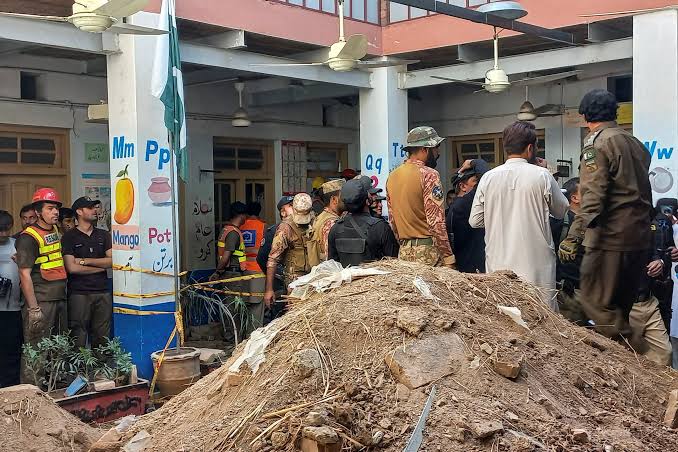
A Preventable Catastrophe in Peshawar
On a Thursday morning in Peshawar, the roof of a school collapsed onto its students. Thirty-four children — most of them under fourteen years old — and one woman teacher were crushed to death beneath the rubble. The families who gathered outside the site the following day came not only to mourn, but to demand answers from a state they hold responsible.
“The parents of all these children must receive justice,” said Muhammad Wahab, a tailor who lost his eleven-year-old nephew Hammad in the collapse. His appeal was directed explicitly at Pakistan’s political leadership. “I appeal to our rulers,” he told AFP, describing Hammad as a child who had been doing well in school before the building killed him.
The scene after the collapse was, by all accounts, chaotic and desperate. A man named Sohail described to AFP how his niece arrived home having escaped the building, triggering immediate panic. “Everyone began screaming,” he said. When he reached the school, he found ten to fifteen children buried to their necks in debris. Rescuers and ordinary residents pulled them out by hand.
The Evidence of Negligence
A senior Peshawar official, speaking to AFP on condition of anonymity because he lacked authorisation to address the media, attributed the collapse to “weak infrastructure”. That phrase carries specific weight in the Pakistani context. It is not an explanation so much as an admission: the building was known to be deteriorating, and children were sent into it regardless.
The school’s owner has been detained, according to the same official. That is a start. It is not, on its own, accountability.
Another bereaved parent, Asadullah, told AFP he lost a son, a nephew, and three other close relatives in a single morning. “They happily went to school every day,” he said of the children. The phrase lands with quiet devastation — ordinary trust, catastrophically betrayed.
A Systemic Pattern, Not an Isolated Incident
Pakistan’s political leadership issued condolences through official channels. Prime Minister Shehbaz Sharif expressed “deep sorrow and grief over the loss of precious lives” via a post on X. President Asif Ali Zardari called the collapse a “heartbreaking tragedy.” Neither statement addressed the structural conditions that made the disaster possible.
Those conditions are well documented. Building collapses are a recurring feature of life in Pakistan, a country of more than 240 million people where safety standards are routinely bypassed and substandard construction materials remain widespread. The regulatory frameworks exist; enforcement does not.
The Peshawar collapse does not stand alone. In June of the same year, more than a dozen children were killed when a roof fell in at a tutoring centre in Lahore. Earlier in 2025, twenty-seven people died and ten were injured when a five-storey building collapsed in the Lyari district of Karachi — one of the country’s most impoverished urban areas, where residents have the least capacity to demand or access safe housing.
Children as the Recurring Victims of Institutional Failure
What connects these incidents is not bad luck. It is the systematic failure of public authorities to enforce building codes, inspect educational facilities, and hold negligent owners criminally liable before lives are lost rather than after. Each collapse produces arrests, condolences, and commissions. Each is followed, in time, by another collapse.
The grief outside the Peshawar school on Friday was real and specific. One father showed AFP a photograph on his phone of his young daughter, dressed in red and gold. She is now dead because a roof was allowed to remain structurally unsound above a classroom full of children. That is not a tragedy in the sense of an unavoidable event. It is the predictable outcome of sustained institutional neglect.
The families demanding justice understand this. The question is whether Pakistan’s authorities — and the international community that funds development programmes in the region — will treat this as the accountability crisis it demonstrably is, rather than another occasion for mourning that changes nothing.