
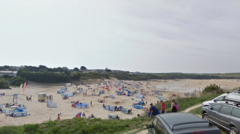
On a bank holiday weekend in Polperro, a harbour village on Cornwall’s southern coast, untreated sewage forced its way through the harbour wall and into the water below. Families were nearby. The sea was open. The company responsible had alarms that went unanswered.
That episode was one of hundreds. South West Water has now been fined £7,867,733 — the largest penalty ever imposed for environmental offences in the South West of England — after pleading guilty at Plymouth Magistrates’ Court to 18 charges arising from pollution incidents spanning six years, between 2015 and 2021. The Environment Agency’s investigation covered sites in Bodmin, Harlyn, Playing Place, and Polperro in Cornwall, as well as Plymouth in Devon. Seventeen of the charges related to illegal sewage discharges; one concerned the company’s failure to take reasonable remedial action following a breakdown at a sewage pumping station. The court also ordered South West Water to pay £329,993 in costs.
Sentencing Judge Jo Matson did not soften her language. She described the pollution as “horrendous” and “very significant,” and reminded the court that she had stated plainly in an earlier 2023 case involving the same company that “incidents of pollution by water companies will not be tolerated.” That 2023 fine — itself a record at the time — was set at just over £2.1 million. The latest penalty is more than three times higher, a trajectory that reflects both the scale of the offending and a judicial determination to signal that financial consequences must be felt.
The judge acknowledged that the incidents predated her 2023 sentencing remarks and noted changes the company had since undertaken. “Only time will tell if those changes are successful,” she said. “I certainly hope that will be the case.” She also observed, with a precision that carried its own weight, that South West Water had adopted the internal motto that “one pollution is too many” — before noting that the company had presided over hundreds of sewage spills onto beaches and into waterways, rivers, and the sea.
Clarissa Newell, environment manager for Devon and Cornwall at the Environment Agency, described a pattern of institutional failure that extended beyond individual incidents. Alarms had not been responded to. Data had been collected but not acted upon. “There’s been a clear message today to show that pollution will not be tolerated,” she said, while also noting that the investigation had been a protracted one — challenged at every stage by the company, requiring calibrated instruments and qualified personnel to withstand legal scrutiny. The length of time between the offences and the courtroom is itself a feature of the accountability gap that regulators face when pursuing well-resourced corporate defendants.
South West Water’s response followed a familiar template. The company issued an apology for “what happened in the past,” characterised the offences as relating to “historic matters” and attributed the majority of spills to storm overflow conditions. It pointed to a £760 million investment programme targeting storm overflows, cited a 17% reduction in spills over the past year and a 25% drop in spill duration, and stated that “significant improvements” had been made at the affected sites. The company also claimed it was working toward cleaner rivers and seas across the South West by 2040, a decade ahead of national targets.
This is not the first time South West Water has stood before a court on pollution charges. In July of this year, it was fined £1.8 million in connection with a parasite outbreak. The 2023 fine preceded that. The accumulation of penalties — now totalling well over £11 million across three proceedings — raises a question that fines alone cannot answer: at what point does financial punishment constitute a genuine deterrent for a regulated monopoly, rather than an operating cost absorbed and passed on?
The communities most directly affected — sea swimmers, kayakers, coastal residents, those who work on the water — have watched this litigation unfold over years while the discharges occurred around them. For many of them, the record fine will register not as vindication but as confirmation: that a system permitted this to continue for six years, that alarms sounded and were ignored, and that accountability arrived long after the sewage had cleared. The harbour at Polperro has since been cleaned. The question of whether the conditions that produced what happened there have been structurally addressed remains, for now, open.