
Washington’s Hand in Venezuela: Who Is Really Setting the Terms for Peace Talks?
A Crisis Reshaped by External Force
Seven months ago, the trajectory of Venezuela’s political crisis shifted in a manner that few analysts had anticipated. What had long been a domestic confrontation between the government of President Nicolás Maduro and a fractured opposition became, in rapid succession, a matter openly managed from Washington. The sequence of events since January has raised a question that neither Caracas nor its interlocutors have answered with clarity: who is actually setting the agenda for negotiations in Venezuela?
The turning point arrived in January, when U.S. forces detained Maduro and transferred him to New York to face federal drug-trafficking charges. The arrest was not merely a law enforcement action — it reconfigured the entire landscape of Venezuelan politics, removing the sitting head of government and placing Washington at the centre of whatever came next.
Control Over Oil, Control Over the State
In the months that followed, the United States consolidated a form of leverage that extends well beyond the judicial. Washington now effectively controls how Venezuela accesses revenues from its oil sector — the single most important source of income for the country’s economy. That control gives the U.S. government a structural role in Venezuela’s fiscal life, independent of any formal political arrangement.
The significance of that position cannot be overstated. Venezuela’s capacity to pay public sector salaries, import food and medicine, and service its debts runs through a mechanism that Washington can tighten or ease at will. This is not influence at the margins; it is leverage at the core.
Into this vacuum, interim leader Delcy Rodríguez has emerged as the figure backed by the United States while talks between the Venezuelan government and opposition factions are brokered. The arrangement is notable for what it excludes as much as for what it includes.
Machado Sidelined, Questions Multiply
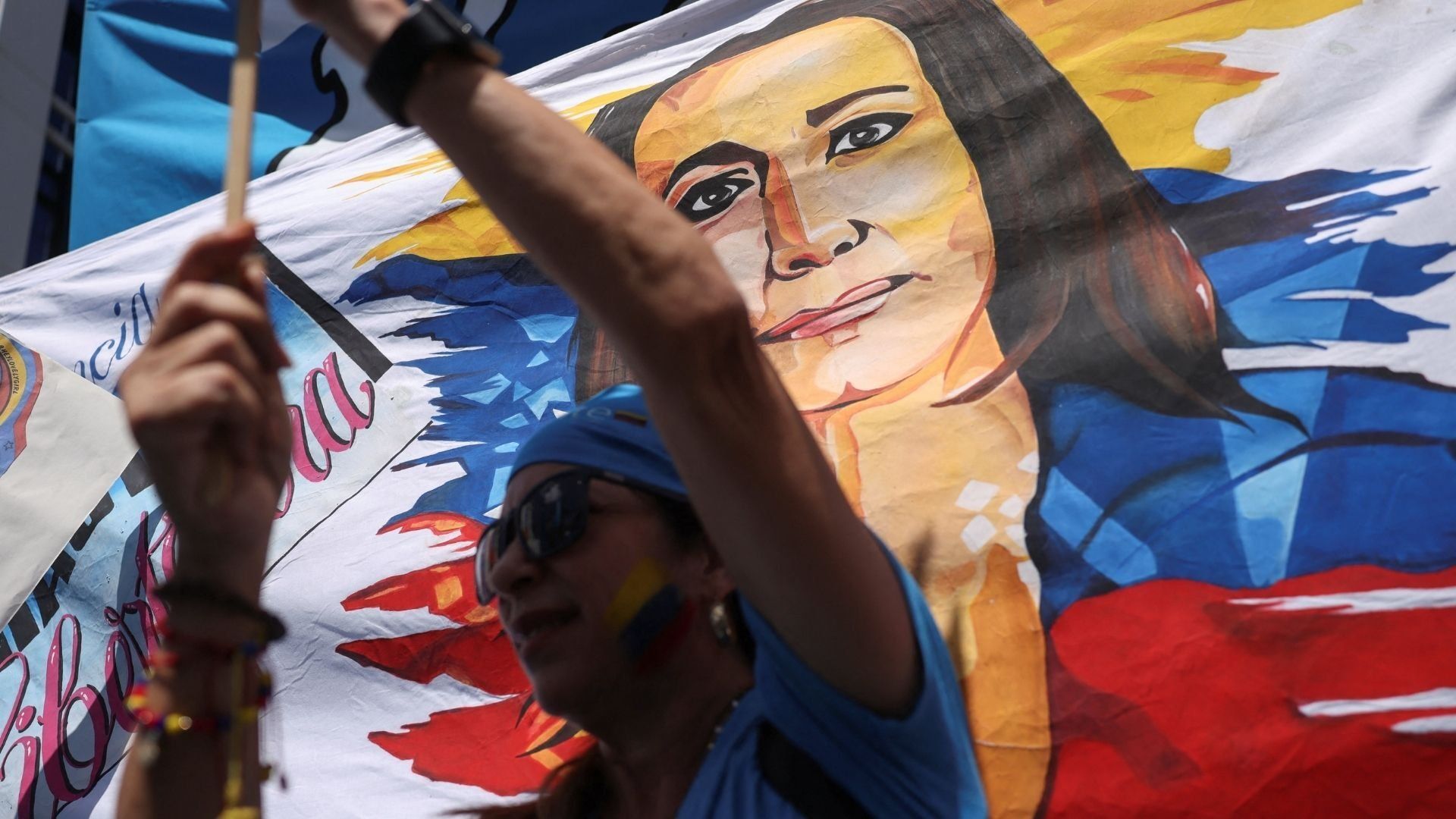
María Corina Machado — arguably the most prominent opposition figure inside Venezuela, and one who built her standing through years of domestic political mobilisation — has been conspicuously absent from the negotiating framework. Her exclusion raises pointed questions about whether the talks represent a genuine attempt at political resolution or a managed process designed to produce outcomes acceptable to Washington rather than to Venezuelans.
The distinction matters. A negotiation shaped by external actors with specific strategic and economic interests is not the same as a negotiation shaped by the political realities of the country in question. International law, including the foundational principles governing state sovereignty and the right of peoples to determine their own political futures, does not sit easily alongside the arrangement now taking shape.
Voices on the Ground and in Washington
To examine what the talks might realistically achieve — and what Washington is seeking to extract from them — TrueFrontPress considered analysis from three distinct vantage points. Elias Ferrer, an analyst specialising in political economy and founder of Orinoco Research, brings a perspective rooted in the structural dynamics of Venezuela’s economy. Vanessa Neumann, founder and CEO of Asymmetrica and a former official representative for opposition figure Juan Guaidó, offers insight into the opposition’s internal fractures and external alignments. Charles Shapiro, a former U.S. Ambassador to Venezuela, speaks from within the institutional framework that has, for decades, shaped Washington’s approach to Caracas.
Their accounts, taken together, illuminate a situation in which the formal architecture of diplomacy and the underlying exercise of power point in different directions. Talks are framed as a path toward political normalisation. Yet the conditions under which they proceed — who is included, who is excluded, and who controls the economic levers — suggest that normalisation, as currently conceived, may serve some interests far more than others.
What Venezuela’s population stands to gain from this process remains, at present, the least clearly answered question of all.