
Drone Strikes on Saudi Pipeline and Houthi Advances at Bab el-Mandeb Tighten the Grip on Global Oil Routes
A Convergence of Pressure Points
Saudi Arabia’s East-West pipeline, one of the most strategically significant oil conduits on the planet, was struck by drones on Thursday morning in an attack that Riyadh and Baghdad both confirmed had originated from Iraqi territory. The Saudi foreign ministry condemned what it described as “the targeting of the East–West pipeline in the Riyadh and Medina regions by several drones coming from Iraq, which caused human injuries and damage.” An energy ministry official confirmed the pipeline had been temporarily shut as a precautionary measure. The closure did not come in isolation: it arrived at the precise moment that Houthi forces were consolidating their most significant territorial gains along the Bab el-Mandeb Strait in years, compressing Saudi Arabia’s principal crude export options from two directions simultaneously.
The 745-mile pipeline traversing the Arabian Peninsula had served, in recent months, as the kingdom’s primary workaround to a severely disrupted Strait of Hormuz, where tanker traffic has slowed to a trickle following the escalation of the U.S.-Iran war. Saudi Aramco CEO Amin Nasser said last month that the pipeline had done more to offset the supply disruption caused by that conflict than the release of emergency crude reserves. Damaging it now, at this particular juncture, is not an act of random violence. It is a calculated intervention in a broader strategic architecture.
What the Evidence Shows
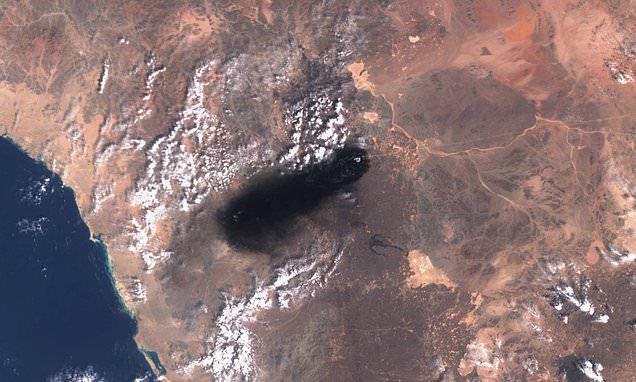
Satellite imagery provided the clearest independent corroboration of the attack’s scope. NASA FIRMS detected multiple large fires in the vicinity of the East-West pipeline, while Sentinel-3 imagery appeared to show a massive plume of black smoke stretching across western Saudi Arabia, visible south of Medina. An initial U.S. assessment concluded that pumping stations located alongside the pipeline had been struck by projectiles. Satellite imaging analysis identified clear and substantial impacts at two separate pumping stations, with particularly extensive fire damage recorded at one of the facilities.
This was not the first such strike. The pipeline was attacked in April, and Saudi Arabia subsequently restored it to its full stated pumping capacity of approximately 7 million barrels per day. The recurrence, however, signals both the persistence of the threat and the limits of protective measures put in place following the earlier incident.
Iranian-backed militia groups maintain a substantial operational presence in Iraq. In July, Riyadh reported that drones targeting petroleum facilities in eastern Saudi Arabia and in the capital had also originated from Iraqi territory. The pattern is consistent. The dismissed Iraqi military commander — who led operations in Maysan province, a border region long regarded as a stronghold of Iran-backed Shi’ite militias — was removed following an internal investigation that confirmed the attack’s point of origin. That a commander was dismissed rather than the militias themselves being neutralised reflects the structural limits of Baghdad’s authority over armed factions operating within its borders.
The Bab el-Mandeb Dimension
The Houthi movement in Yemen declared a maritime embargo against Saudi Arabia in July and has since sought to interdict the kingdom’s oil exports through the Bab el-Mandeb Strait, the narrow waterway connecting the southern Red Sea to global shipping lanes. The gains made this week along Yemen’s southern Red Sea coastline represent the Houthis’ most significant territorial advance in years, and their strategic purpose is not obscure. As the Institute for the Study of War assessed on Thursday, the Houthis are attempting to capture territory that would allow them to threaten commercial shipping through Bab el-Mandeb directly, in service of Tehran’s broader objective of driving up global energy prices to pressure the United States and its regional allies.
With the Strait of Hormuz severely disrupted and Houthi forces now threatening the Red Sea corridor, Saudi Arabia faces a situation in which both of its primary crude export routes are simultaneously under threat. The kingdom’s strategic depth, in energy terms, has narrowed considerably.
Iran-allied militants have intensified attacks on Saudi Arabia in recent days beyond the pipeline strike alone. Earlier this week, Houthi forces launched strikes on Saudi energy facilities and civilian infrastructure, injuring more than 70 people according to the Saudi government. The cumulative picture is one of a coordinated, multi-vector campaign rather than a series of opportunistic incidents.
Market Response and Its Contradictions
Oil prices broke above $100 per barrel this week for the first time in months as fighting escalated across the region. Prices closed the week more than 8% higher. Yet Brent crude fell on Friday, dropping approximately three percent to settle at around $104 per barrel, despite the pipeline attack and the Houthi territorial advances near Bab el-Mandeb. The divergence between the severity of the underlying events and the market’s day-to-day movements reflects the difficulty of pricing geopolitical risk in real time, particularly when the full extent of infrastructure damage remains uncertain and official communications are carefully managed.
Markets are, in effect, betting on partial disruption rather than catastrophic failure. Whether that assessment holds will depend on how quickly Saudi Arabia can restore full pipeline capacity, and on whether the Houthi advances along the Red Sea coastline translate into effective control over the strait itself.
Diplomatic Restraint and Its Limits
Riyadh announced that it would refrain from retaliating for now, offering the Iraqi government time to take measures to prevent further attacks from its territory. The Saudi foreign ministry simultaneously stressed that the kingdom “reserves the right to take all necessary measures to protect its sovereignty, its security, its facilities,” and its population — language that functions as a formal reservation of options rather than a genuine concession. Saudi Arabia has also approached Washington for military assistance in dealing with the Houthi threat, at a moment when elevated fuel prices have already imposed a political cost on President Donald Trump and the Republican Party ahead of November’s congressional elections.
The Iraqi government’s response — condemning the attack and dismissing a military commander — is the minimum credible action available to a government that lacks the capacity, or the political will, to dismantle the militia networks operating within its territory. It satisfies the diplomatic requirement of a response without addressing the structural problem. Maysan province, bordering Iran in southeastern Iraq, has functioned for years as a zone where Iranian influence operates with effective impunity.
The Broader Architecture of Coercion
What is unfolding across the Arabian Peninsula and the Red Sea is not simply a series of military incidents. It is a sustained effort, coordinated across multiple proxy actors, to compress the economic and strategic options available to Saudi Arabia and its partners, while simultaneously driving up the energy costs borne by the United States and Western-aligned economies. The instruments are drones launched from Iraqi territory, Houthi advances along Yemeni coastlines, and maritime embargoes declared against a major oil exporter — each individually deniable, collectively coherent.
Iran does not need to fire a single missile directly to achieve these effects. The architecture of pressure it has constructed — through the Houthis, through Iraqi militia groups, through the strategic geography of chokepoints — is already operating. The question now is whether the international response, diplomatic and military, will address that architecture or continue to treat each individual incident as a discrete event requiring a discrete response.
The pipeline will likely be repaired. The structural conditions that made it a target will not.